Free STD Testing Near Me: Where to Go and What to Expect
Cost should never be the reason someone skips an STD test, and in the United States, it genuinely does not have to be. A network of public health departments, community clinics, and nonprofit programs provides testing at no charge or on sliding scales that reach zero, in every state. The catch is that these services are scattered across different systems with different names, which is why the search for free std testing near me can feel harder than it should. This guide maps the whole landscape: where free testing actually lives, what happens at the visit, and the privacy facts that put most worries to rest.
Where Free Testing Actually Exists
Several categories of providers answer the free std testing near me question, and most towns have at least two of them:
Local and county health departments. The backbone of free STD testing in America. City and county health departments run sexual health clinics offering free or very low-cost testing for common infections, often on walk-in schedules. Search your county name plus “health department STD clinic” or call the department’s main line.
The CDC’s GetTested locator. The single best tool for this entire search: gettested.cdc.gov lets you enter a zip code and filters results for free testing, specific tests, and services. It covers health departments, community clinics, and nonprofit sites nationwide, and it turns free std testing near me from a search phrase into an address and hours.
Planned Parenthood health centers. Testing and treatment with fees on a sliding scale based on income, which reaches free or near-free for many patients, and they walk you through the cost question by phone without judgment.
Community health centers (FQHCs). Federally qualified health centers charge on income-based sliding scales and cannot turn patients away for inability to pay. Find them through the HRSA find-a-health-center tool.
Nonprofit and community organizations. HIV/AIDS service organizations and LGBTQ+ community centers frequently run free testing programs, mobile testing vans, and outreach events, often with rapid results.
College health centers. For students, the free std testing near me answer is usually already on campus, included in their fees.
Health observance events. National HIV Testing Day (June 27) and similar observances bring pop-up free testing to pharmacies, community centers, and events, often with no appointment.
One more route worth knowing: many health departments now mail free at-home test kits for HIV and other infections in participating states, ordered online with results handled through the program. For people far from clinics or wanting maximum privacy, mailed kits close the distance.
What the Visit Actually Involves
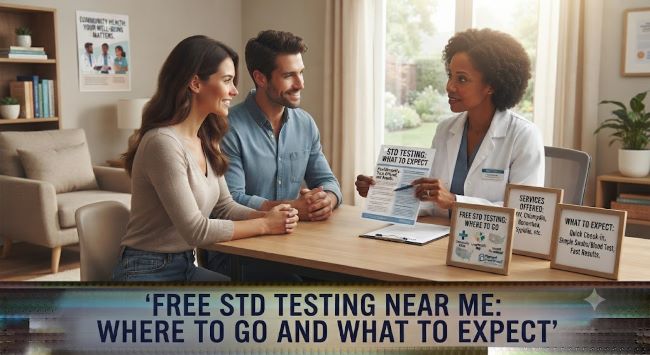
Fear of the unknown keeps more people from acting on a free std testing near me search than cost does, so here is the honest walkthrough. A typical visit runs 20 to 45 minutes. You fill out a short intake covering symptoms, if any, and general history; a staff member or counselor talks through which tests fit your situation; and the samples themselves are quick: urine samples and blood draws cover most common infections, with swabs where relevant. Rapid HIV tests return results in about 20 minutes at many sites; lab-based results typically arrive in a few days to a week by phone, portal, or a callback you choose.
Two practical notes improve the visit. First, ask what the panel includes, because “STD test” is not one test: standard panels commonly cover chlamydia, gonorrhea, syphilis, and HIV, while others are added based on your conversation. Asking “what am I being tested for today?” is normal and encouraged. Second, if a test comes back positive, the same free and low-cost systems handle it: health departments treat many infections on site at no or low cost, and staff connect you to treatment for the rest. A positive result inside these systems comes with a path, not just news.
Privacy, Answered Plainly
Privacy worries sit under most free std testing near me hesitation, so here are the facts, plainly:
- Confidential testing is the standard everywhere. Your results are protected health information, shared with you and handled under the same medical privacy laws as any clinic visit.
- Anonymous testing exists for HIV at some sites, where the sample carries a number rather than your name. The GetTested locator flags sites offering it.
- Free clinics do not bill insurance unless you ask them to, which means no explanation-of-benefits letter arrives anywhere. For young adults on family plans, this is often the deciding advantage of free clinics over insured testing.
- Minors can consent to STD testing in every US state, though the details of confidentiality vary; clinic staff will explain their state’s specifics before anything happens.
Making the Search Fast
The efficient version of the free std testing near me process takes one evening:
- Enter your zip code at gettested.cdc.gov and filter for free services.
- Cross-check your county health department’s sexual health clinic page for walk-in hours.
- Call the top option and ask three things: what tests are included free, whether walk-ins or appointments are faster this week, and what ID (if any) to bring. Many sites require nothing but showing up.
- If distance or privacy is the barrier, ask the health department about mailed at-home kits.
Bring the visit full circle by asking about retesting guidance, since some infections warrant a follow-up test after treatment, and about how often routine screening makes sense for your situation. The staff at these clinics answer those questions all day and want to be asked.
The larger point behind every free std testing near me search deserves saying directly: most STDs are common, most are curable, and all are manageable, but only the diagnosed ones get treated. The free testing infrastructure exists precisely so that a checkup costs nothing but half an hour. Routine screening is simply healthcare, the people providing it think so too, and this is a sensitive topic, so if any part of it is weighing on you personally beyond the logistics, consider also talking things through with a healthcare provider you trust.
Key Takeaways
- County health departments, the CDC’s GetTested locator (gettested.cdc.gov), Planned Parenthood sliding scales, community health centers, and nonprofit programs form the free testing network.
- The GetTested locator converts a zip code into filtered, free-testing locations and is the fastest starting point.
- Visits run 20-45 minutes with urine, blood, or swab samples; rapid HIV results take about 20 minutes and lab results a few days.
- Always ask what the panel covers, since standard panels test chlamydia, gonorrhea, syphilis, and HIV, with others added by conversation.
- Free clinics typically do not bill insurance, so no paperwork reaches a family plan, and anonymous HIV testing exists at flagged sites.
- Minors can consent to testing in all US states, with clinic staff explaining state-specific confidentiality.
- Positive results inside these systems come with free or low-cost treatment paths, not just a diagnosis.
- Mailed at-home test kits from health department programs cover people far from clinics or wanting maximum privacy.