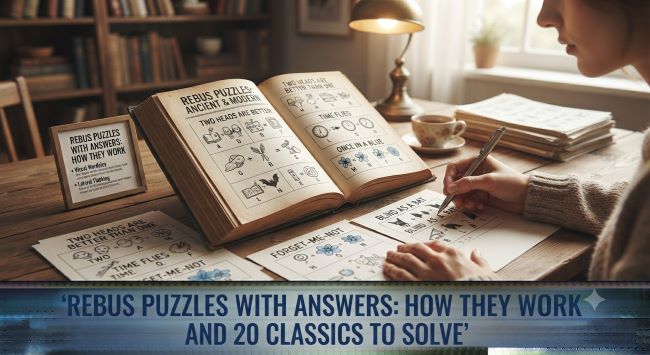
Rebus Puzzles With Answers: How They Work and 20 Classics to Solve
BAD Wolf. Wolf BAD. B A D written over the word wolf. Each arrangement means something completely different, and figuring out what is the entire game. Rebus puzzles turn phrases into visual riddles where the position, size, direction, and repetition of words carry the meaning, and once your brain clicks into the logic, you start seeing them everywhere. This guide explains the rules that unlock them, then serves 20 classic rebus puzzles with answers so you can train on the real thing.
What a Rebus Puzzle Is
A rebus represents a word or phrase through the arrangement of letters, words, numbers, and symbols rather than through their literal meaning. The word “stand” printed with the letter I inside it is not about standing at all: it reads “I understand,” because the I is under “stand.” That is the fundamental move, and every rebus builds on it.
The form is ancient. Rebus writing appears in Egyptian hieroglyphs and medieval heraldry, and the modern puzzle version became a staple of newspapers, game shows, and classrooms because it exercises lateral thinking: the answer is always hiding in how the clue looks, not what it says.
The Rules That Solve Almost Everything
Nearly all rebus puzzles with answers trace back to a small set of visual tricks. Learn these seven and most rebus puzzles with answers crack open:
- Position. Above, below, inside, beside. A word sitting under another means “under”; inside means “in.” (MAN over BOARD = man overboard.)
- Size. Big text means big; tiny text means little. A microscopic “TOWN” = small town.
- Repetition. Count the copies. The word “STORY” written twice is not “story story” but a two-story building. Four copies of a word often signal “four” + word or “for” + word.
- Direction. Backward, upside down, slanted upward or downward. “PIT” upside down and backward tricks read fast; a word climbing diagonally means “rising” or “up.”
- Color and style. A word printed in red, bold, or crossed out adds “red,” “bold,” or “no/cross” to the phrase.
- Missing or extra parts. A word with a letter absent means “missing” or “without”; an obviously incorrect letter signals “wrong.”
- Sound substitution. Numbers and letters stand for their sounds: 4 = for, 8 = ate, U = you, C = sea/see.
The solving method: describe the picture out loud, literally. Say what you see, including position words, and the phrase usually assembles itself in the description.
20 Classic Rebus Puzzles With Answers
Cover the right column of these rebus puzzles with answers and test yourself. They range from beginner to head-scratcher:
| # | Puzzle | Answer |
|---|---|---|
| 1 | STAND with I inside | I understand |
| 2 | MAN written over BOARD | Man overboard |
| 3 | HEAD written over HEELS | Head over heels |
| 4 | WEAR with LONG under it | Long underwear |
| 5 | READING between two LINES | Reading between the lines |
| 6 | The word CYCLE written 3 times | Tricycle |
| 7 | The letter T flying apart in pieces | Scattered tea |
| 8 | KNEE written above LIGHT | Neon light (knee-on light) |
| 9 | The word LAND sliding down a slope | Landslide |
| 10 | ONCE written above 4:56 PM | Once upon a time |
| 11 | The word MILLION with 1 in front | One in a million |
| 12 | NOON followed by GOOD | Good afternoon |
| 13 | ECNALG | Backward glance |
| 14 | HISTORY HISTORY HISTORY | History repeats itself |
| 15 | SYMPHON | Unfinished symphony |
| 16 | BAN ANA | Banana split |
| 17 | The word WORLD with a tiny YOU in it | You mean the world to me |
| 18 | GROUND with FEET FEET FEET FEET FEET FEET above it | Six feet underground |
| 19 | ARREST with YOU’RE under it | You’re under arrest |
| 20 | ii ii written over a large O | Circles under the eyes |
A note on numbers 7 and 9, the sound-and-motion entries: number 7 shows the letter T (which sounds like “tea”) broken into flying pieces, reading as scattered tea. Number 9 puts the whole word LAND on a downward slope, sliding, and the description “land slide” is the answer. Both prove the core method: say what you literally see, sounds included, and good rebus puzzles with answers always resolve cleanly once you do.
Making Your Own
Building rebuses is the fastest way to get better at solving them, and it takes one phrase and one trick from the rules list. Take any idiom: “once in a blue moon” becomes ONCE inside a blue-colored MOON. “Split second” becomes the word SECOND with a gap cut through it. Work backward from position words (over, under, in, between), quantity words (two, four, half), and direction words (up, down, backward), because those are the words that translate into visual arrangements. Teachers use exactly this exercise because writing rebus puzzles with answers forces students to hear the structure inside phrases they normally say on autopilot.
Why These Puzzles Are Worth Your Time
Beyond the fun, rebuses train a specific mental gear: the switch from reading words to observing them. Regular readers process text automatically, and a rebus only cracks when you interrupt that autopilot and treat text as a picture. Puzzle researchers file this under cognitive flexibility, the same lateral-thinking muscle crosswords and riddles work, with the bonus that rebus puzzles with answers scale from kindergarten (a picture of an eye + a heart + U) to genuinely difficult adult versions. They cost nothing, need no equipment, and turn a napkin into a game. Keep a few in your pocket for long dinners, and you will learn which of your friends can stop reading and start seeing.
Key Takeaways
- A rebus encodes a phrase in how words look and sit: position, size, repetition, direction, color, and missing pieces all carry meaning.
- The core solving trick is describing the image literally out loud, including position words, until the phrase assembles.
- Seven rules cover most puzzles: position, size, repetition, direction, style, missing/extra parts, and sound-alike substitutions.
- Classic examples include I-inside-STAND (I understand), CYCLE x3 (tricycle), and ECNALG (backward glance).
- Trick entries exist in most collections; a fair rebus always resolves cleanly once seen, and unfair ones are drawing problems, not solver failures.
- Build your own by working backward from idioms containing position, quantity, or direction words.
- Rebuses train cognitive flexibility by forcing the brain out of automatic reading and into visual observation.
- The format scales from picture-based kids’ versions to difficult adult puzzles, making it one of the most versatile free word games.