How to Get Rid of Fruit Flies: Every Method That Actually Works
Fruit flies are one of the most frustrating household pests precisely because they seem to appear out of nowhere and multiply faster than almost any other common pest. A single overripe banana left on the counter for a day or two can produce a small swarm within a week, since fruit flies reproduce on a remarkably fast cycle. Getting rid of them effectively requires understanding both how to kill the ones currently in your home and how to eliminate the breeding source that’s producing new ones continuously, since addressing only one of those two problems means you’ll be fighting the same infestation indefinitely.
Why Fruit Flies Show Up So Quickly
Fruit flies are drawn to the fermenting sugars in overripe or rotting fruit and vegetables, but they’re also attracted to a surprisingly wide range of other sources: drain residue, empty beverage containers with sugar residue, compost bins, recycling bins with unrinsed containers, and even damp mop heads or cleaning rags left sitting out. Female fruit flies can lay up to 500 eggs, and the entire life cycle from egg to adult takes as little as eight days in warm conditions, which is why a problem that seems minor on day one can feel like a genuine infestation by the end of the week.
This rapid reproduction cycle is the central reason source elimination matters as much as trapping the adult flies you can see — killing the visible flies without removing their breeding source simply means a fresh wave will emerge within days.
Step 1: Find and Eliminate the Breeding Source
Before setting any traps, do a thorough search for where fruit flies are actually breeding, since this is the step most people skip and the reason many trapping efforts fail to produce lasting results.
Check all fruit and vegetables. Inspect your fruit bowl, pantry, and refrigerator produce drawers for anything overripe, bruised, or starting to break down. Even a single forgotten potato or onion gone soft in the back of a cabinet can sustain a fruit fly population.
Check your drains. Fruit flies frequently breed in the organic buildup inside kitchen and bathroom drains, not just in visible food. Run your finger around the inside rim of your drain — if it comes away with a slimy residue, that’s a likely breeding ground.
Check the garbage disposal. Food particles trapped in and around the disposal blades and the underside of the splash guard are a common overlooked breeding source.
Check trash and recycling bins. Unrinsed containers, particularly anything that held juice, soda, beer, or wine, provide both food and a breeding environment. Check underneath bin liners and around the rim of the can itself, not just the visible trash.
Check houseplants. Overwatered houseplants with consistently damp soil can sometimes host fungus gnats, which are commonly confused with fruit flies but require a different elimination approach (allowing soil to dry out between waterings).
Check less obvious spots. Empty wine or liquor bottles in a recycling area, a forgotten reusable shopping bag with old produce residue, or a dish sponge that’s been sitting wet for too long can all sustain a small but persistent population.
Step 2: Deep Clean Identified Breeding Areas
Once you’ve identified the source, address it directly rather than just removing the visible trigger:
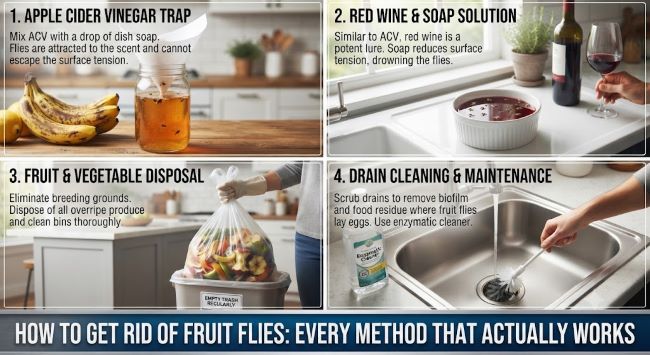
For drains: pour boiling water down the drain, followed by a mixture of baking soda and vinegar, let it sit for 10-15 minutes, then flush with more boiling water. For stubborn buildup, a drain brush specifically designed to reach the inner walls of the pipe can physically remove residue that liquid treatments alone might not fully clear.
For the garbage disposal: run ice cubes through the disposal to help dislodge buildup, followed by a citrus peel (lemon or orange) run through to help with both cleaning and odor. Clean the underside of the rubber splash guard by hand, since this is a commonly overlooked breeding spot.
For trash and recycling: rinse the bin itself with soap and hot water, not just the bag, and make sure all recyclables are rinsed before being placed in the bin going forward.
Step 3: Set Effective Traps for Existing Flies
With the breeding source addressed, trapping the adult flies that are already present clears out the remaining population.
Apple cider vinegar trap. Pour apple cider vinegar into a small bowl or jar, add a few drops of dish soap (which breaks the surface tension so flies sink rather than simply landing and flying away), and cover loosely with plastic wrap secured with a rubber band, poking several small holes in the top. The vinegar’s scent draws flies in through the holes, and the soap-treated liquid prevents escape. This remains one of the most consistently effective DIY methods.
Wine trap. A small amount of red wine (or wine mixed with a few drops of dish soap) in a jar works similarly to the vinegar method and is a good alternative if you happen to have leftover wine that’s gone slightly past drinking quality anyway.
Fruit trap. A piece of very ripe fruit in a jar, covered with plastic wrap with small holes poked in the top, works on the same principle — flies are drawn in by the scent and have difficulty finding their way back out through the small holes.
Commercial fruit fly traps. Store-bought options (often using a similar attractant-and-trap principle, sometimes with a sticky adhesive component) are convenient if you’d rather not assemble a DIY version, and tend to work reliably as long as you place several around the kitchen rather than relying on just one.
Place multiple traps. Rather than setting one trap and waiting, place 3-4 traps around your kitchen simultaneously, particularly near the areas you identified as the breeding source, the fruit bowl, and the sink. Multiple traps working at once will clear the existing population significantly faster than a single trap.
Step 4: Prevent Future Infestations
Once you’ve cleared the current population, a few ongoing habits prevent fruit flies from establishing themselves again:
Store ripening fruit in the refrigerator once it reaches peak ripeness rather than leaving it on the counter, since the cold temperature significantly slows the fermentation process that attracts flies.
Take out the trash and recycling regularly, particularly anything with food or beverage residue, rather than letting it accumulate over several days.
Clean your drains periodically as routine maintenance, not just when you notice a problem, since residue buildup happens gradually and is easier to prevent than to fully eliminate once established.
Wash dishes and wipe counters promptly after meals rather than leaving food residue sitting out, even overnight.
Keep a tight-fitting mesh cover over any fruit bowl if you prefer to display fruit on the counter rather than refrigerating it, since this physically prevents flies from reaching ripening fruit while still allowing air circulation.
For other practical household and budget-conscious tips that pair well with keeping your kitchen pest-free and efficient, how to reduce food spending covers smart grocery and food storage habits that, alongside reducing fruit fly risk, also help you waste less food and money overall.
Key Takeaways
- Fruit flies breed extremely quickly (egg to adult in as little as eight days), which is why addressing only the visible adult flies without finding the breeding source leads to a recurring problem
- Check overripe fruit and vegetables first, but also inspect drains, garbage disposals, recycling bins, and even houseplant soil, since these are commonly overlooked breeding sources
- Deep clean identified breeding areas with boiling water, baking soda and vinegar for drains, and thorough rinsing for trash and recycling containers
- Apple cider vinegar traps with a few drops of dish soap are one of the most consistently effective DIY trapping methods, and placing several traps at once clears an existing population faster than relying on just one
- Refrigerating ripening fruit, taking out trash regularly, cleaning drains as routine maintenance, and using a mesh cover over any counter fruit bowl all prevent future infestations
- If flies persist despite trapping and cleaning efforts, recheck for a missed breeding source rather than assuming more traps alone will solve the problem