How Far Back Should a Resume Go? The Real Answer
This is one of the most commonly asked resume formatting questions, and for good reason: too little work history can make you look inexperienced or raise questions about gaps, while too much can bury your most relevant recent experience under outdated roles that no longer reflect your actual current skill set or career direction. Understanding the general guideline, along with the genuine exceptions where deviating from it makes sense, helps you build a resume that presents your strongest possible professional story.
The General Rule of Thumb
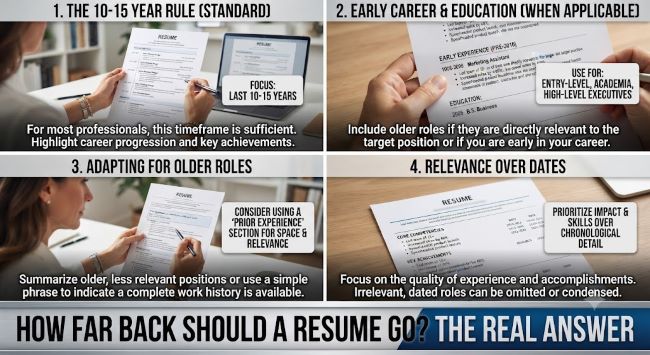
Most career experts and resume writing professionals generally recommend including 10 to 15 years of work history on your resume, focusing on your most recent and most relevant positions rather than attempting to document your entire career chronologically back to your very first job. This timeframe generally captures enough experience to demonstrate genuine career progression and relevant skill development, without diluting your resume’s impact with increasingly outdated roles that may no longer reflect technologies, methodologies, or industry standards relevant to the position you’re currently pursuing.
Why This Timeframe Generally Makes Sense
Hiring managers and recruiters spend very limited time on initial resume review, often just seconds during an initial scan, making it genuinely important that your most relevant, most impressive, and most recent accomplishments are immediately visible rather than buried beneath older positions that take up valuable resume real estate without adding proportional value to your candidacy for the specific role you’re applying to.
Older experience often reflects outdated skills or contexts. A role from 20 years ago likely involved technologies, tools, or industry practices that have since evolved considerably, meaning the specific skills demonstrated in that older role may not accurately represent your current, up-to-date professional capabilities in the same way your more recent experience does.
It helps mitigate, rather than highlight, potential age-related bias. While age discrimination in hiring is illegal, it remains an unfortunate practical reality in some hiring contexts, and a resume that extends back 25-30+ years can inadvertently signal your approximate age in ways that, fairly or not, sometimes work against candidates, making a more focused recent-experience approach a practical consideration alongside the more straightforward relevance argument.
Important Exceptions Where Going Further Back Makes Sense
When older experience is directly and specifically relevant to the role you’re applying for. If a position from 18 or 20 years ago involved exactly the kind of specialized work directly applicable to your current target role, particularly in fields where this specific expertise is relatively rare, including it (even briefly) can genuinely strengthen your candidacy more than strictly following the 10-15 year guideline would suggest.
When you’re applying within a field where extensive tenure itself is a meaningful credential. Certain fields, particularly in academia, certain technical specialties, or roles where deep institutional or industry knowledge is specifically valued, sometimes benefit from a more complete career history that demonstrates the full scope of your accumulated expertise.
When omitting older roles would create confusing or suspicious-looking gaps. If your career path included a notable older achievement, credential, or position that provides important context for understanding your overall career trajectory, strategically including a brief mention, even outside the standard 10-15 year window, can provide useful clarity that a strictly truncated resume might otherwise obscure.
How to Handle Older, Less Relevant Experience
Consider a brief “Additional Experience” section. Rather than fully detailing older roles with the same level of bullet-point detail as your recent positions, a condensed section simply listing job titles, companies, and years (without extensive bullet-point elaboration) allows you to acknowledge your complete career history without disproportionately emphasizing outdated experience.
Omit graduation dates from older degrees if age-related bias is a genuine concern. While your education section should generally still include relevant degrees, omitting the specific graduation year, particularly for degrees completed more than 15-20 years ago, is a commonly used and reasonable approach for managing the same potential bias concerns discussed above.
Focus older role descriptions, if included at all, on transferable skills and major achievements rather than the kind of detailed day-to-day responsibility descriptions more appropriate for your recent, more relevant positions.
What About Your Resume’s Overall Length?
The “how far back” question connects directly to overall resume length, since attempting to document an entire multi-decade career in full detail almost inevitably produces a resume that’s too long for what most hiring managers and applicant tracking systems are realistically able to process effectively. For practical strategies specifically focused on trimming an overly long resume down to a more effective length, 5 quick fixes to shorten your long resume covers concrete editing techniques worth applying alongside the timeframe guidance covered here.
Using Modern Tools to Help With This Decision
Determining exactly which experience to include, condense, or omit entirely can be genuinely challenging to assess objectively about your own career, which is part of why many job seekers have found value in AI-assisted resume tools that can help analyze and suggest the most relevant content to highlight based on a specific target role or job posting. Best AI resume builders covers current tools worth considering if you want assistance specifically with this kind of content prioritization decision, beyond just the formatting and design side of resume creation.
The Visual and Structural Side of This Decision
How you structure and visually present your experience timeline also affects how this “how far back” question plays out in practice, since a well-designed resume layout can sometimes accommodate slightly more historical context without feeling cluttered, while a poorly organized one makes even a focused 10-15 year history feel overwhelming. Designing a resume covers layout and formatting principles worth considering alongside your content decisions about exactly how far back to go.
Key Takeaways
- The general guideline is to include 10-15 years of work history on your resume, focusing on your most recent and most relevant positions rather than your complete career chronology
- This timeframe helps ensure your most relevant, current accomplishments remain prominently visible during the brief initial review most hiring managers and recruiters conduct, while also helping mitigate potential age-related bias
- Exceptions exist when older experience is directly relevant to your target role, when extensive tenure itself is a valued credential in your specific field, or when omitting older context would create confusing gaps in your career story
- Consider a condensed “Additional Experience” section for older roles you want to acknowledge without the same level of detail as your recent positions
- Omitting graduation years from older degrees is a commonly used approach for managing age-related bias concerns, separate from the work experience timeframe question itself
- The “how far back” decision connects directly to overall resume length and effective formatting, both worth addressing together rather than treating as entirely separate resume considerations
- AI-assisted resume tools can help with the genuinely challenging task of objectively assessing which of your own experiences are most relevant and worth including for a specific target role