How Far Does Your Full Target Range Extend? Understanding Effective Range Across Contexts
The question “how far does your full target range extend” comes up across several genuinely different contexts, and understanding which specific application you’re asking about matters significantly for getting a useful, relevant answer. This guide covers the main contexts where this question commonly applies and what determines the answer in each one.
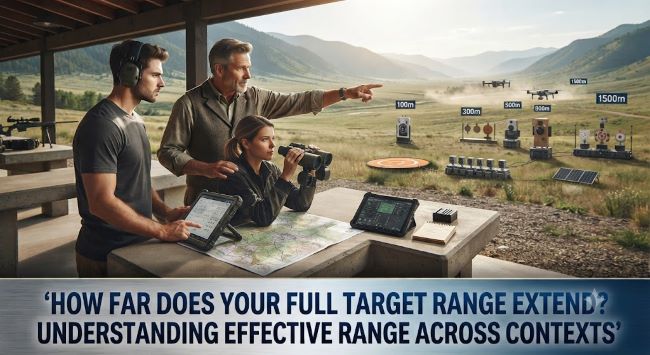
In Archery Context
For archery specifically, effective target range depends heavily on bow type and draw weight: recurve bows used in Olympic-style target archery typically compete at standardized distances of 70 meters (for outdoor competition) or 18 meters (for indoor competition), while compound bows, which generally offer flatter trajectories and greater accuracy at distance due to their mechanical advantage, are often used effectively at similar or somewhat greater distances depending on the specific competitive format.
Traditional and recreational archery effective range varies considerably based on individual skill, bow draw weight, and arrow selection, with many recreational archers comfortably shooting accurately at 20-40 yards, though this range can extend considerably for more experienced archers with appropriate equipment.
In Networking and Wireless Technology Context
If your question relates to wireless networking, “target range” often refers to the effective broadcast or reception distance of a specific wireless device or network:
Standard home WiFi routers typically have an effective indoor range of roughly 100-150 feet, though this varies considerably based on building construction materials, the number of walls or obstacles signals must pass through, and the specific router’s transmission power and antenna configuration.
Bluetooth devices generally have a much shorter effective range, typically 30-100 feet depending on the specific Bluetooth version and device class, with newer Bluetooth standards generally offering improved range compared to older implementations.
Cellular network range depends on cell tower density and signal strength, varying enormously by location and specific carrier infrastructure, making this a context where “full range” is determined more by external infrastructure than by any single device’s inherent capability.
In Sales, Marketing, and Audience Targeting Context
In a business or marketing context, “target range” sometimes refers to the geographic or demographic scope a specific marketing campaign, sales territory, or service area is designed to reach, a meaningfully different concept from the physical distance measurements discussed in the contexts above. This usage generally requires understanding the specific business strategy or campaign parameters in question rather than any standardized physical measurement, since this kind of “range” is defined by business decisions and market analysis rather than physical or technical limitations.
In Vision, Hearing, and Sensory Range Context
Human sensory range also gets discussed in target-range terms occasionally: typical human visual acuity allows recognition of large, high-contrast objects at considerable distance (sometimes cited in the range of a mile or more under ideal conditions for very large objects), while recognizing finer details or smaller targets requires considerably closer distance, generally measured in tens to low hundreds of feet depending on the specific visual task and individual eyesight quality.
Determining Your Specific Effective Range
Across all of these contexts, a few common principles apply to understanding your actual effective range in any specific situation:
Manufacturer or governing body specifications provide a starting baseline, but real-world effective range often differs from theoretical maximum specifications due to environmental conditions, individual skill or equipment variation, and practical accuracy requirements that differ from simply reaching maximum theoretical distance.
Testing under your specific actual conditions provides the most reliable answer for your particular situation, since published general specifications, while useful as a starting reference point, don’t account for your specific equipment combination, environment, skill level, or other situational factors that meaningfully affect actual achieved range in practice.
Safety and practical accuracy requirements often matter more than theoretical maximum range, particularly in shooting sports and archery contexts specifically, where the more relevant practical question is usually not “how far can this theoretically travel” but rather “how far can I reliably and accurately hit my intended target,” a meaningfully different and generally more useful framing for most practical purposes.
Why Context Matters So Much for This Question
The genuinely wide range of contexts where this question applies is worth emphasizing, since searching for an answer without specifying your particular context can lead to confusing or irrelevant results. Someone asking about wireless router range and someone asking about rifle effective range are looking for completely different information despite using structurally similar phrasing in their question, and search engines and AI assistants alike benefit from additional context (the specific equipment, activity, or technology involved) to provide a genuinely useful, relevant answer rather than a generic response that might not address your actual situation.
If you’re researching this question for a specific practical purpose, providing that context upfront, whether you’re setting up a home network, evaluating firearm or archery equipment, or researching something else entirely, will generally get you to a useful answer more efficiently than a broad, unqualified search on the general phrase alone.
Key Takeaways
- “How far does your full target range extend” applies to several distinct contexts including firearms and shooting sports, archery, wireless networking, business marketing scope, and human sensory range, each with entirely different relevant measurements and determining factors
- In firearms contexts, effective range varies dramatically by weapon type: handguns typically 25-50 yards, hunting rifles 200-400+ yards, and specialized long-range rifles 1,000+ yards under appropriate conditions
- In archery, competitive recurve bow distances are standardized (70 meters outdoor, 18 meters indoor for Olympic-style competition), while recreational archery range varies considerably based on individual skill and equipment
- In wireless networking, home WiFi typically reaches 100-150 feet indoors while Bluetooth generally covers a shorter 30-100 foot range, both varying based on obstacles and specific device capabilities
- Across all contexts, practical achieved range under real conditions often differs meaningfully from theoretical maximum specifications, making actual testing under your specific situation more reliable than relying purely on published general specifications
- The more practically useful question in skill-based contexts like shooting and archery is usually about reliable accuracy at distance rather than theoretical maximum range alone