Best Ukulele for Beginners: How to Choose and Which Models to Consider
The ukulele is one of the most beginner-accessible instruments available: four strings, manageable size, relatively forgiving on fingertips compared to guitar, and capable of producing a satisfying sound quickly. But the range of ukuleles available — from $20 toy-grade instruments to $500 professional models — is wide enough that buying the wrong one is easy. This guide covers what beginners actually need, which features to prioritize, and which specific models have earned consistent recommendations from players and teachers.
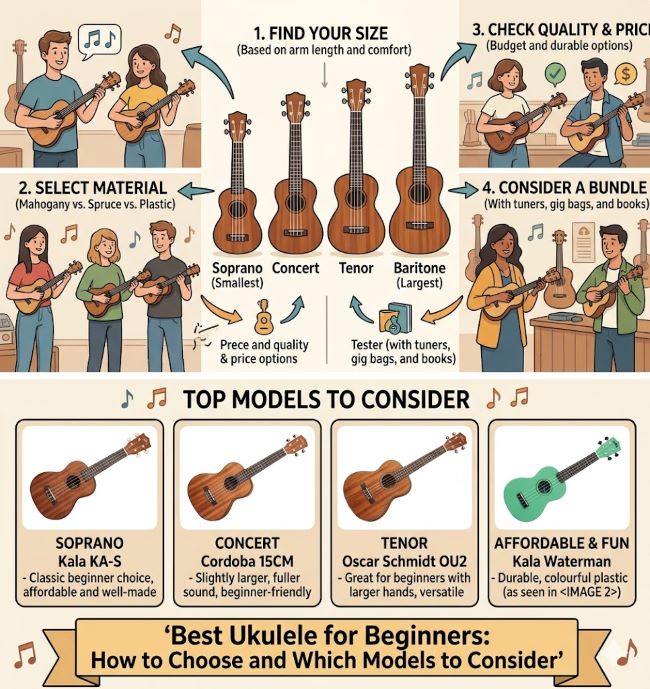
What Size Ukulele Should a Beginner Get?
There are four main sizes: soprano, concert, tenor, and baritone. Each has a different scale length, body size, and sound character.
Soprano is the smallest and most iconic: the sound most people associate with ukulele, light and bright with a compact body. Scale length is around 13 inches. Great for children or adults who want the classic ukulele sound. The smaller fret spacing can make it harder to navigate for people with larger hands.
Concert is slightly larger than soprano with a 15-inch scale length. More fret space, slightly fuller sound, and more comfortable for adult players with average-to-large hands. Still clearly “ukulele” in character. This is the size most commonly recommended for adult beginners.
Tenor is larger again at around 17 inches scale length, with a fuller, warmer sound and even more fret spacing. Popular among players who want a richer tone. Higher price point on average than soprano or concert.
Baritone is the largest and tuned differently (DGBE, like the bottom four strings of a guitar) rather than the standard GCEA tuning of the other sizes. Not recommended for beginners who want the classic ukulele experience.
The recommendation for most adult beginners: concert size. It’s comfortable to play, sounds good, and the GCEA tuning applies to virtually all beginner lessons and chord charts. Children under 10 may be better served by a soprano.
What Features Matter for a Beginner Ukulele
Solid top versus laminate. A solid wood top resonates more freely than laminate (thin layers of wood pressed together). Solid tops sound noticeably better but cost more and are more sensitive to humidity changes. For beginners, a high-quality laminate top is completely acceptable and more durable for the learning environment where the instrument may get bumped or experience varying conditions. Solid top becomes worth prioritizing as your playing develops.
Tuning stability. This is the most underrated beginner concern. Cheap ukuleles have cheap tuning pegs that don’t hold tuning reliably. If you have to retune every five minutes, practicing becomes exhausting. Geared tuners (resembling guitar tuners) are more stable than friction tuners. Some budget ukuleles can be upgraded with aftermarket geared tuners.
Nut and saddle material. The plastic nut and saddle on very cheap ukuleles affect intonation and tone. Bone or synthetic bone upgrades are inexpensive and make a meaningful improvement.
Intonation. This is whether the instrument plays in tune up the neck. A ukulele that sounds fine open but goes out of tune as you move up the fretboard has poor intonation, usually from fretwork issues that can’t be fixed at home. Testing intonation before buying (or checking reviews from buyers who tested it) matters.
Setup. Most ukuleles at every price point arrive with action (string height) higher than optimal, which makes pressing strings harder than necessary and can cause intonation issues. A basic setup from a local music store ($20-$40) is worth it on any beginner instrument.
Best Ukulele for Beginners: Specific Model Recommendations
Kala KA-C Concert Ukulele ($60-$80) Kala is the most widely recommended beginner ukulele brand among teachers, and the KA-C is their entry-level concert model. Mahogany body, geared tuners, decent factory setup, and consistent quality control across units. It sounds like a real ukulele rather than a toy and holds tune reasonably well. The best starting point for most adult beginners who want a reliable instrument without spending significantly more.
Donner DUC-1 Concert Ukulele ($50-$70) A strong budget alternative to Kala. The Donner DUC-1 comes with a gig bag and clip-on tuner, making it good value at its price point. Tone and build quality are comparable to Kala’s entry level. Factory setup is acceptable though a professional setup is still beneficial.
Kala KA-C Mahogany Concert with Case ($90-$110) Slightly up from the base KA-C, this bundle includes a padded case which is worth having to protect the instrument. The tone is the same as the standard KA-C.
Luna Tattoo Concert Ukulele ($80-$110) Luna’s instruments have distinctive visual designs (laser-etched tribal patterns) that many beginners find appealing. Build quality is solid for the price and the sound is comparable to Kala at the same tier. Good option if aesthetics matter alongside playability.
Cordoba 15CM Concert Mahogany ($100-$130) Cordoba comes from classical guitar manufacturing, and that heritage shows in their ukuleles’ attention to setup and playability out of the box. The 15CM consistently receives praise for being close to ready to play when it arrives without a professional setup. A step up in quality from the Kala entry level.
Kala KA-SMHCE Solid Mahogany Concert with Pickup ($150-$200) For beginners who know they want to perform or connect to an amplifier at some point, this model has a built-in pickup and solid mahogany top. The solid top produces noticeably better tone than laminate models. Worth the extra cost if performance is in your plans.
What to avoid: Any ukulele under $40 from an unknown brand. These instruments, commonly sold on Amazon without brand recognition, are factory rejects or intentionally low-quality builds. They can’t be set up properly, don’t hold tuning, and make the learning experience significantly harder. Paying $60 minimum ensures you’re getting an instrument that can actually support learning.
Accessories Worth Getting
Clip-on tuner. Tuning by ear as a beginner is frustrating. A clip-on chromatic tuner (Snark, D’Addario NS, Korg AW) costs $10-$15 and makes tuning instant. Some ukulele bundles include one.
Padded gig bag. Protects the ukulele during transport. Basic bags are $15-$20 and many beginner bundles include one.
Extra strings. Strings break (usually at the worst time). Having a spare set of Aquila Nylgut or Worth strings costs $5-$10 and saves a ruined practice session.
Strap: optional but useful if you want to play standing up. Ukulele straps typically hook into the soundhole.
Key Takeaways
- Concert size is the best ukulele for beginners who are adults: comfortable fret spacing, classic GCEA tuning, and full enough sound without being as large as a tenor
- Kala KA-C is the most consistently recommended entry-level model: reliable quality control, geared tuners, mahogany body, and genuine playability in the $60-$80 range
- Avoid ukuleles under $40 from unknown brands: they can’t hold tuning, have poor intonation, and make learning harder than it needs to be
- Geared tuners are significantly more stable than friction tuners: if your chosen ukulele has friction tuners, consider an aftermarket upgrade
- A $20-$40 professional setup from a local music store is worth doing on any beginner ukulele: it lowers string action, improves playability, and makes learning significantly easier
- Essential accessories: clip-on chromatic tuner ($10-$15), padded gig bag ($15-$20), and spare strings ($5-$10)
- Solid top becomes worth the extra cost as your playing develops: for the first year of learning, a high-quality laminate top is completely adequate