Is Honey Good for Dogs? What You Need to Know Before Sharing
Honey shows up in a lot of conversations about natural health remedies, and dog owners are increasingly curious about whether the same properties that make it appealing for humans translate to their pets. The answer is nuanced: honey is not toxic to dogs, and in small amounts it can be a reasonable occasional treat. But it’s also not without risks, and those risks depend heavily on the individual dog. This guide covers the full picture so you can make an informed decision for your specific pet.
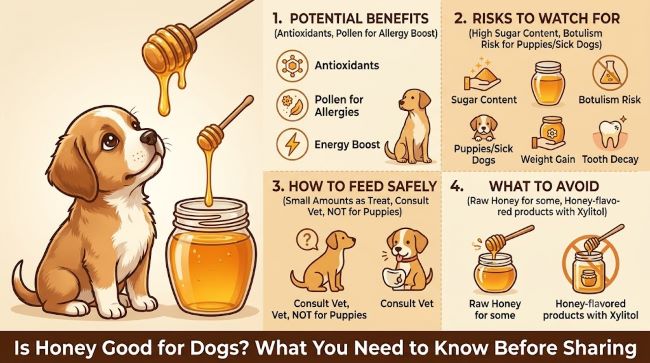
Is Honey Safe for Dogs?
For healthy adult dogs, honey is safe in small quantities. It is not on the list of foods that are toxic to dogs the way grapes, xylitol, macadamia nuts, and onions are. A lick of honey or a small amount mixed into food will not harm a healthy dog.
That said, safe and beneficial are not the same thing. Honey is high in natural sugar: roughly 17 grams of sugar per tablespoon. For dogs, whose digestive systems are not designed to handle large amounts of sugar, regular or excessive consumption of honey creates real problems over time regardless of how natural the source is.
So the complete answer to is honey good for dogs is: yes in very small amounts for healthy adult dogs, with important caveats for puppies, diabetic dogs, overweight dogs, and dogs with compromised immune systems.
Potential Benefits of Honey for Dogs
The case for giving dogs small amounts of honey rests on several properties that have documented support in human health and some animal research:
Antimicrobial properties. Honey, particularly raw honey, contains hydrogen peroxide, low pH, and osmotic properties that inhibit bacterial growth. This is well-established in wound care and has some application in veterinary contexts, though internal consumption is different from topical use.
Antioxidants. Raw honey contains flavonoids and polyphenols that function as antioxidants. These compounds help reduce oxidative stress, which is linked to aging and inflammation. Darker honeys (buckwheat, manuka) tend to have higher antioxidant concentrations than light honeys.
Soothing properties for irritated throats. Some dog owners and holistic veterinarians suggest small amounts of honey for dogs with kennel cough or seasonal irritation. The thick consistency coats the throat similarly to how it works in humans. There isn’t strong clinical evidence specific to dogs but the mechanism is plausible and the risk of a small amount is low in a healthy dog.
Local pollen for seasonal allergies. The theory is that locally sourced raw honey contains trace amounts of regional pollen that may help dogs build tolerance to local allergens over time. This is a popular concept among owners of dogs with environmental allergies, though the scientific evidence is limited and inconsistent. It’s not a substitute for veterinary allergy treatment but is considered low-risk in appropriate amounts.
Wound care and hot spots. Topically, medical-grade Manuka honey is used in some veterinary settings for wound care and skin conditions. This is distinct from feeding honey internally but worth knowing as a separate application.
How Much Honey Can a Dog Have
If you decide that honey is something you want to occasionally give your dog, portion control is the critical factor. The high sugar content means small amounts are the only appropriate approach.
General guidelines by size:
- Small dogs (under 20 lbs): no more than a quarter teaspoon per day
- Medium dogs (20-50 lbs): up to half a teaspoon per day
- Large dogs (50+ lbs): up to one teaspoon per day
These are daily maximums, not recommended daily doses. Honey is better thought of as an occasional treat or specific-purpose addition (mixed into food when a dog is reluctant to eat, or used for throat soothing during illness) rather than a daily supplement. Regular daily honey adds up to a meaningful sugar load over time.
Raw honey is generally preferred over processed commercial honey because the pasteurization process used in commercial honey destroys some of the beneficial compounds. However, raw honey carries a small risk for immunocompromised dogs (discussed below) due to potential bacterial spores.
Dogs That Should Not Have Honey
Puppies under one year. This is the most important restriction. Raw honey can contain Clostridium botulinum spores. In healthy adult dogs, the gut bacteria keep these spores from becoming a problem. In puppies whose gut flora is still developing, these spores can germinate and produce botulism toxin. This is the same reason raw honey is not given to human infants under one year. Do not give puppies honey of any kind.
Diabetic dogs. Is honey good for dogs with diabetes? No. The rapid glycemic impact of honey is incompatible with blood sugar management in diabetic dogs. Even small amounts can cause significant blood glucose spikes. Any dog with a diabetes diagnosis should not receive honey without explicit veterinary approval.
Overweight or obese dogs. Dogs on caloric restriction or weight management plans don’t have room in their daily intake for the sugar load that honey adds. A small dog at a quarter teaspoon of honey per day is adding roughly 20 calories from sugar alone, which is meaningful for a dog on a controlled diet.
Immunocompromised dogs. Dogs on chemotherapy, dogs with immune-mediated diseases, or dogs recovering from serious illness should not have raw honey due to the risk of bacterial spores. Pasteurized honey is safer for these dogs if honey is given at all, but veterinary guidance should come first.
Dogs with bee allergies. Rare, but documented. Dogs can be allergic to bee products including honey. Signs include facial swelling, hives, or digestive upset after first exposure. If you’re giving honey for the first time, start with a tiny amount and monitor for thirty minutes.
For dogs with underlying health conditions or dietary sensitivities, overall diet quality is the foundation that determines how well they handle any additions like honey. Dogs on a well-formulated food designed for their specific needs tend to tolerate occasional extras more predictably. Purina Pro Plan Sensitive Skin and Stomach is a commonly recommended option for dogs who need a controlled nutritional base before any supplemental foods are introduced.
How to Give Honey to Your Dog
The simplest method is off a spoon: most dogs will lick it directly without hesitation. You can also mix a small amount into their regular food, stir it into plain yogurt (if your dog tolerates dairy), or use it to make the dog take medication that they’d otherwise refuse.
For topical use on minor skin irritation or hot spots, apply a thin layer of Manuka honey to the affected area and cover with a light bandage if the dog can’t reach it. Manuka honey is the most researched variety for topical wound care and has a higher concentration of methylglyoxal (MGO), the compound primarily responsible for its antimicrobial properties.
What to avoid: honey-flavored products made for humans (candy, snacks, sauces) that contain xylitol. Xylitol is a sweetener found in many human foods that is acutely toxic to dogs even in very small amounts. Always check the ingredient label on anything honey-flavored before giving it to a dog.
Key Takeaways
- Is honey good for dogs? In small amounts, for healthy adult dogs, yes: it is non-toxic and offers some antimicrobial and antioxidant properties
- Do not give honey to puppies under one year due to the risk of botulism spores in raw honey
- Dogs with diabetes, obesity, or compromised immune systems should not have honey without veterinary guidance
- Portion limits matter: quarter teaspoon for small dogs, half teaspoon for medium, one teaspoon for large dogs, as an occasional treat not a daily supplement
- Raw honey retains more beneficial compounds than processed honey but carries a slightly higher risk for vulnerable dogs
- Topical Manuka honey has veterinary applications for wound care and skin conditions, distinct from internal consumption
- Never give dogs any honey-flavored human product without checking for xylitol, which is toxic to dogs even in tiny amounts