Leasing a Car vs Buying
Getting a new car brings a big question: should you lease or buy? Leasing often means lower monthly payments and a new car every few years. Buying means higher payments at first, but you own the car and can keep it as long as you want.
This guide compares leasing a car vs buying in simple terms, with current numbers, real tradeoffs, and tips to help you choose.
This guide is educational and not financial advice. Check exact terms with your dealer or lender.
What Is Leasing a Car?
What is leasing a car? Leasing is like a long term rental. You pay to use a car for a set time, usually 24 to 36 months, and drive up to a set number of miles. At the end, you return the car, buy it, or lease a new one.
Your payment covers the car’s expected loss in value during the lease, plus interest (called the money factor), taxes, and fees.
What Does Buying Mean?
When you buy, you pay the full price of the car, either with cash or a loan. Once the loan is paid off, the car is yours. You can keep it, sell it, or trade it in whenever you like.
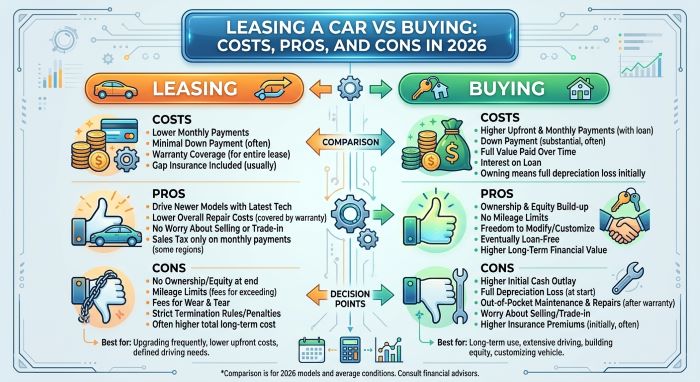
Leasing a Car vs Buying at a Glance
| Feature | Leasing | Buying (with a loan) |
|---|---|---|
| Ownership | No | Yes, once paid off |
| Monthly payment | Usually lower | Usually higher |
| Upfront cost | First payment, fees, possible down payment | Down payment, taxes, fees |
| Mileage limits | Yes, often 10,000 to 15,000 miles per year | No |
| Wear and tear | Charged for excess damage | Your choice |
| Customizing | Not allowed | Allowed |
| Repairs | Usually under warranty | You pay after warranty ends |
| Long term cost | Higher if you lease forever | Lower if you keep the car |
| End of term | Return, buy, or lease again | You own an asset |
The Numbers: 2026 Averages
According to Experian data for the second quarter of 2026:
| Payment Type | Average Monthly Payment |
|---|---|
| New car loan | $765 |
| Lease | $617 |
| Used car loan | $542 |
Average loan interest rates were about 6.35% for new cars and 11.19% for used cars. These averages vary widely based on your credit score and the vehicle.
On average, leasing saves about $150 a month compared with financing a new car. But that’s only part of the story.
Long Term Cost Example
Let’s compare a $40,000 car over six years. These numbers are simplified for illustration.
| Plan | Payments Over 6 Years | What You Have at the End |
|---|---|---|
| Two 3 year leases at $550/month | About $39,600 plus fees | No car |
| 5 year loan at $750/month, then keep 1 year | About $45,000 | A car worth roughly $15,000 to $20,000 |
The buyer pays more in total payments but ends up with a valuable asset and no payments after year five. The leaser never owns anything and starts over each time.
Pros of Leasing
- Lower monthly payments for the same car
- New car every few years with the latest tech and safety features
- Warranty coverage for most of the lease
- No resale hassle at the end
- Possible business tax benefits for some self employed drivers
Cons of Leasing
- Mileage limits. Extra miles often cost $0.15 to $0.30 each.
- Wear and tear fees for dents, stains, or worn tires.
- No equity. You never own the car.
- Early termination fees can be very high.
- Always having a payment if you keep leasing.
Pros of Buying
- You own it. Once paid off, no more monthly payments.
- No mileage limits. Drive as much as you want.
- Freedom to customize with wheels, tint, or upgrades.
- Lower long term cost if you keep the car many years.
- Trade in or resale value you can use toward your next car.
Cons of Buying
- Higher monthly payments during the loan.
- Depreciation. New cars lose value fast in the first few years.
- Repair costs after the warranty ends.
- Selling or trading in takes time and effort.
Is It Better to Lease or Buy a Car?
Is it better to lease or buy a car? It depends on how you drive and what you value.
| You… | Better Choice |
|---|---|
| Drive more than 15,000 miles a year | Buy |
| Want the lowest monthly payment | Lease |
| Like a new car every 2 to 3 years | Lease |
| Keep cars for 6+ years | Buy |
| Want to customize your car | Buy |
| Use your car for business | Lease may offer tax benefits |
| Want no car payment someday | Buy |
| Want predictable repair costs | Lease |
In general, buying is cheaper long term, while leasing offers flexibility and lower payments. So is it better to lease or buy a car for most people? If you plan to keep a car for more than five years, buying usually wins. That’s the simplest rule in the leasing a car vs buying debate.
Consider a Used Car
There’s a third path many people overlook: buying used. A two to three year old car has already taken its biggest depreciation hit, so you pay less for a car that still has years of life. Many come off leases with low miles and service records. Browse options in our guide to Used Cars for Sale.
Tips for Leasing
- Negotiate the price. The car’s price (capitalized cost) is negotiable, just like when buying.
- Ask for the money factor. Multiply it by 2,400 to estimate the interest rate.
- Pick realistic mileage. Paying for more miles upfront is cheaper than overage fees.
- Avoid large down payments. If the car is totaled early, you may lose that money.
- Consider gap insurance. Many leases include it, but check.
Tips for Buying
- Get preapproved for a loan from a bank or credit union before visiting the dealer.
- Keep loans short. Aim for 60 months or less to avoid owing more than the car is worth.
- Put down at least 10% to 20% to lower your payment and interest.
- Shop total price, not just monthly payment.
- Maintain the car well to protect its resale value.
Leasing vs Buying a Car: Hidden Costs to Watch
When comparing leasing vs buying a car, look beyond the monthly payment:
| Cost | Leasing | Buying |
|---|---|---|
| Acquisition fee | Often $500 to $1,000 | None |
| Disposition fee at end | Often a few hundred dollars | None |
| Excess mileage | Per mile charge | None |
| Excess wear | Charged at return | Lowers resale value |
| Sales tax | Usually on monthly payments | Usually on full price upfront |
| Insurance | Lender may require higher coverage | Your choice once paid off |
These extra fees can add up, so ask for a full breakdown before you sign.
Leasing a Car vs Buying for Electric Vehicles
Electric vehicles are a special case. Battery and charging technology improves quickly, and EV resale values can drop fast. Leasing lets you avoid that risk and upgrade to newer technology in a few years. Lease deals on EVs are sometimes especially attractive when automakers offer incentives. If you plan to keep an EV for 8 to 10 years, buying can still make sense, especially with a strong battery warranty.
Lease or Buy a Car? Ask Yourself These Questions
Before you decide whether to lease or buy a car, answer these questions honestly:
- How many miles do I drive each year?
- How long do I usually keep a car?
- Do I want a car payment forever, or for a few years?
- Is a lower monthly payment more important than long term savings?
- Do I need the car for work or business?
If you drive a lot and keep cars for years, buying is usually smarter. If you want a new car often and drive less, leasing can be a good fit.
Leasing vs Buying a Car: Real World Scenarios
Scenario 1: A commuter drives 20,000 miles a year. Buying avoids mileage fees and makes more sense.
Scenario 2: A young professional wants a reliable new car with low payments and drives 10,000 miles a year. Leasing fits well.
Scenario 3: A family plans to keep a minivan for 10 years. Buying is the clear winner, and the leasing a car vs buying math isn’t close.
These examples show that the leasing a car vs buying decision depends on your lifestyle as much as the math. Whether you lease or buy a car, shop around and compare at least three offers.
Frequently Asked Questions
Can you buy a car at the end of a lease? Yes. Most leases include a buyout price, called the residual value.
Does leasing affect your credit? Yes. A lease is reported like a loan, and on time payments can help your credit.
Can you end a lease early? Usually, but fees can be steep. Lease transfer services are another option.
Is leasing a waste of money? Not always. It’s a cost for convenience, similar to renting a home instead of buying.
Final Thoughts
The leasing a car vs buying decision comes down to your driving habits, budget, and how long you keep cars. Leasing offers lower payments and a fresh car every few years. Buying costs more upfront but saves money over time and gives you full ownership. Run the numbers for your situation before you sign.
Key Takeaways
- Leasing a car vs buying: leasing means lower payments but no ownership; buying builds equity.
- What is leasing a car? A long term rental, usually 24 to 36 months, with mileage limits.
- In Q2 2026, average payments were $617 for leases and $765 for new car loans (Experian).
- Buying is usually cheaper long term if you keep the car for many years.
- Leasing suits drivers who want a new car often and drive under 15,000 miles a year.
- A used car can offer the best value for budget minded buyers.