Used Cars for Sale: The Complete 2026 Guide to Finding, Inspecting, and Buying
Buying a used car has become one of the smartest money moves you can make, and in 2026 more people are making it than ever. With new vehicles averaging around $50,000 and monthly payments creeping past $700 for many buyers, the used market has surged. Shopping used cars for sale lets you skip the steep depreciation that hits a new car the moment it leaves the lot, while still getting a reliable, modern vehicle. The challenge is no longer whether to buy used. It is how to find the right car at the right price without getting burned.
This guide covers the whole process, from understanding today’s market to knowing where to search, how to compare sellers, what to inspect, and how to finance and negotiate. Whether this is your first car or your fifth, the goal is the same: drive away in a solid vehicle you did not overpay for.
The Used Car Market in 2026
Before you shop, it helps to understand the landscape. Right now, demand for used cars is high and supply is tighter than usual, which has pushed prices up. The average used car sells for around $29,000, though prices vary enormously by make, model, age, and mileage.
A few forces are driving this. Tariffs raised the price of many new 2026 models, sending more buyers toward used vehicles. At the same time, fewer lease returns from a few years ago mean fewer high-quality, low-mileage certified pre-owned cars are available, which limits supply. The result is strong demand meeting limited inventory, so prices have climbed. The good news is that analysts expect supply to improve over the next year or two, which should ease pricing.
The used market is now at least twice the size of the new-car market, and vehicles priced under $30,000 are selling the fastest. That tells you where the competition is. If you want an affordable, in-demand model, you will need to move quickly and know your numbers. A useful tip from the data: the slow winter months of January and February often bring the best deals, since demand cools when the weather turns cold.
Where to Search Online
The internet is where almost every used car search now begins, and a handful of major platforms dominate. Each aggregates thousands of listings so you can compare prices, mileage, and features from your couch before ever visiting a lot.
Auto Trader
Auto Trader is one of the longest-running and largest online marketplaces for vehicles. It lists a huge inventory from both dealers and private sellers, with filters for make, model, price, mileage, location, and more. The depth of listings makes it a strong starting point when you want to see what is available across a wide area. Many shoppers use it to get a sense of fair pricing for a specific model before narrowing their search, since seeing dozens of comparable listings reveals the going rate fast.
Car Gurus
Car Gurus stands out for its deal ratings and pricing tools. The platform tracks millions of listings and labels each one as a great deal, good deal, fair price, or overpriced based on its market value analysis, which takes a lot of guesswork out of shopping. It also offers an Instant Market Value tool and pre-qualification for financing with no credit impact, so you can see realistic rates before committing. For buyers who want data on whether a price is actually fair, it is one of the most useful tools available.
Carfax Used Cars
Carfax is best known for vehicle history reports, but it also runs a full listings marketplace. The advantage of browsing Carfax used cars is that every listing connects directly to the vehicle’s history, so you can spot accidents, title issues, and service records right alongside the price. For buyers who prioritize a clean history above all, starting there means you are screening for reliability from the very first click. The platform also highlights listings with a single owner or no reported accidents, which narrows your search to lower-risk vehicles.
These platforms overlap, so it pays to check more than one. A car listed on one site may appear on another at a different price, and comparing across them helps you spot the best offer.
Searching for Cars Near You
Once you know what you want, the search usually turns local, since you will need to see and test the car in person. Typing used cars for sale near me into a search engine or app pulls up nearby listings from dealers and private sellers, sorted by distance. This is the most practical way to build a shortlist you can actually go visit.
A broader search for cars for sale near me casts a wider net, surfacing both new and used inventory in your area, which helps when you are still deciding between options. If you specifically want a pickup, searching trucks for sale near me filters the results to the body style you want, and trucks remain in strong demand, so acting quickly matters there. Pickup trucks have held their value well, which means a search for trucks for sale near me will often turn up higher prices than the equivalent sedan.
A few tips make local searching more effective. Widen your radius if your area has thin inventory, since driving an hour for the right car at the right price is often worth it. Set up alerts on the major platforms so you get notified when a matching used cars for sale near me listing appears, because good deals move fast in this market. And always cross-check a local listing’s price against the national averages you saw on the big platforms, so you know whether a nearby deal is genuinely competitive.
Dealerships Versus Private Sellers
Where you buy matters as much as what you buy. The two main paths are dealerships and private sellers, and each has clear trade-offs.
Dealerships
Searching car dealerships near me brings up both franchise dealers and independent used-car lots. Dealerships offer convenience, financing on site, warranties on some vehicles, and the reassurance of a business you can return to. Certified pre-owned programs at franchise dealers add manufacturer-backed inspections and warranties, which lower your risk. The trade-off is price, since dealerships build in overhead and profit, so you typically pay more than you would buying privately.
When you visit car dealerships near me, the certified pre-owned vehicles cost more but come with peace of mind, while a dealership’s non-certified used cars sit somewhere between private-party pricing and CPO pricing. Independent used car dealerships near me often price more aggressively than franchise stores, though their inventory and warranty options vary. It is worth visiting a few of them to compare both pricing and how they treat you, since reputation matters when you may need service or to resolve an issue later. Reading recent reviews before choosing among used car dealerships near me saves you from the lots with a history of problems.
Buy Here Pay Here
A specific type of dealership worth understanding is the buy here pay here lot. At such a dealer, the dealership finances the car directly rather than going through a bank or credit union, and you make payments to the dealer itself. These lots cater to buyers with poor or no credit who struggle to get traditional financing.
The honest truth is that the convenience comes at a high cost. Interest rates are usually much higher, the cars are often older with more miles, and some lots install payment-tracking or shut-off devices. If your credit makes one of these lots your only option, treat it as a short-term bridge, read every term carefully, and refinance into a normal loan as soon as your credit improves. For buyers with any other option, traditional financing almost always costs far less.
Private Sellers
Buying used cars for sale by owner means dealing directly with the person who owns the car, usually through a marketplace listing. The big advantage is price, since there is no dealer markup, so they are often the cheapest way to buy. You also get to talk directly to the person who drove the car and learn its real history.
The trade-off is risk and effort. There is no warranty, no financing help, and no business to return to if something goes wrong. When buying used cars for sale by owner, a pre-purchase inspection by an independent mechanic is essential, not optional, since you are taking on all the risk yourself. Handle the paperwork carefully, verify the title is clean and in the seller’s name, and never hand over money before the transfer is properly documented.
Shopping on a Tight Budget
Plenty of buyers come into the market looking for the cheapest reliable option. Searches for used cars for sale under $5,000 with low mileage are common, but it helps to set realistic expectations in today’s market.
The honest reality is that used cars for sale under $5,000 with low mileage are rare right now. With the average used car near $29,000 and prices elevated, a vehicle in the under-$5,000 range will usually have high mileage, significant age, or some wear, rather than being a low-mileage gem. That does not mean you cannot find a solid, reliable car at that price, but you should expect an older vehicle with more miles and budget for some maintenance.
If you are set on the bottom of the market, a few strategies help. Focus on models known for long-term reliability, since a high-mileage example of a dependable model often outlasts a lower-mileage example of a problem-prone one. Prioritize a clean history and good maintenance records over low mileage alone. And always get a pre-purchase inspection, because at this price point a single major repair can exceed what you paid. Hunting at the bottom of the market rewards patience, a flexible model choice, and a willingness to act fast when a genuinely good one appears.
Considering a Used Electric Car
Electric vehicles have become one of the better values in the used market. Used electric cars for sale have grown sharply in availability, with used EV sales climbing significantly year over year, and prices have come down as more of them reach the second-hand market.
The appeal of used electric cars for sale is strong. EVs depreciate faster than gas cars in their early years, which means you can often buy a lightly used one for far less than its original price. Lower fuel and maintenance costs add to the savings over time. When shopping for one, the most important factor is battery health, since the battery is the most expensive component and degrades with age and use. Ask for a battery health report, check the remaining warranty on the battery, and factor in your access to charging at home or work. With those checks done, they can be one of the smartest buys in the entire market for the right driver.
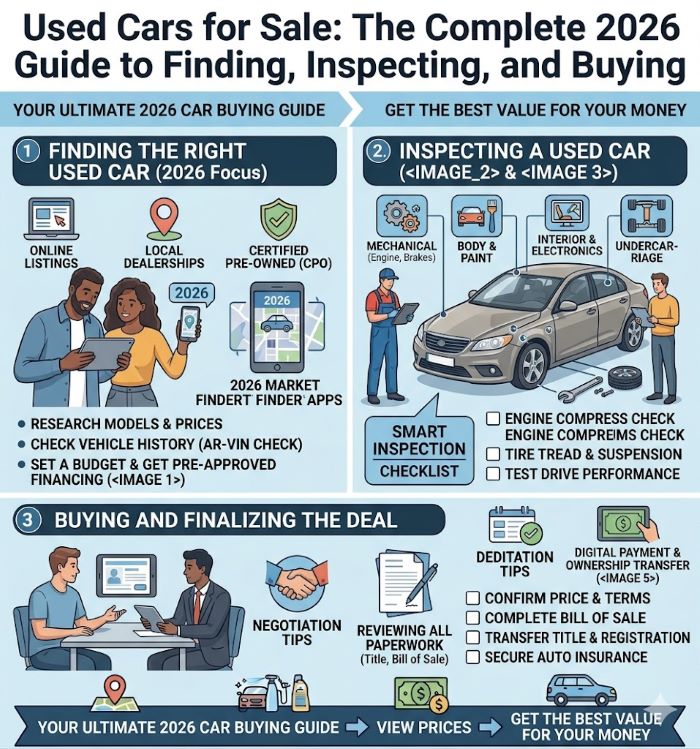
Inspecting and Verifying Any Car
No matter where you buy, a thorough check protects you from an expensive mistake. The steps are the same whether you buy from a dealer or a private seller.
Start with the vehicle history report, which reveals accidents, title problems, odometer issues, and service records. This is where a platform tied to history data is so useful, since it flags red flags before you waste time. Next, inspect the car in daylight, checking for mismatched paint, rust, uneven tire wear, fluid leaks, and signs of past repairs. Look underneath and in the trunk for evidence of flood or collision damage.
The test drive matters enormously. Drive on different road types, listen for unusual noises, test the brakes, watch for warning lights, and pay attention to how the transmission shifts. Finally, and this is the step buyers skip most often, pay an independent mechanic for a pre-purchase inspection. For around a hundred dollars, a mechanic can catch problems that cost thousands later. Any seller who refuses an independent inspection is a seller to walk away from.
Financing Your Purchase
Unless you are paying cash, financing shapes the true cost of your car. The interest rate and loan length matter as much as the sticker price, since a low monthly payment stretched over seven years can cost far more in total interest.
Get pre-approved before you shop. A pre-approval from your bank, credit union, or an online lender gives you a real rate to compare against whatever a dealer offers, and it strengthens your negotiating position. Credit unions often have the most competitive used-car rates, so they are worth checking first. The platforms mentioned earlier also offer pre-qualification that shows estimated rates without affecting your credit.
Watch the loan term. Shorter loans cost more per month but far less overall, while long loans lower the payment but risk leaving you owing more than the car is worth. Aim for the shortest term you can comfortably afford. And keep the total cost in view, including taxes, registration, insurance, and maintenance, not just the monthly payment, since the payment is only part of what the car really costs.
Negotiating and Closing the Deal
Negotiation is expected in the used market, so do not skip it. Knowledge is your leverage, and you built that knowledge by comparing prices across the major platforms.
Come in knowing the fair market value for the exact car you want, including its mileage and condition. Deal ratings and market value tools give you a number to anchor to. Point to comparable listings if a price is high, and be willing to walk away, since walking away is the strongest negotiating tool there is. With private sellers, a respectful but firm offer based on real comparable prices usually works. With dealerships, negotiate the total price rather than the monthly payment, since focusing only on the payment lets a dealer hide cost in a longer loan.
Before you sign anything, read the paperwork carefully. Confirm the price matches what you agreed, check for add-on fees you did not approve, and verify the title and registration details. Never feel rushed, since pressure to sign quickly is a warning sign. A good deal is still there tomorrow, and a deal that disappears the moment you ask questions was probably not a good one.
Common Mistakes to Avoid
A few mistakes trip up used-car buyers again and again, and avoiding them saves real money and stress.
The biggest is skipping the pre-purchase inspection, which is the single most reliable way to avoid buying a money pit. Another is focusing on the monthly payment instead of the total price, which lets sellers bury cost in a long loan. Buyers also overlook the full cost of ownership, forgetting that insurance, registration, fuel, and maintenance add up beyond the purchase price.
Rushing is a frequent error too. The pressure to act fast in a tight market is real, but rushing into the wrong car costs far more than waiting for the right one. Failing to check the vehicle history, not comparing prices across multiple platforms, and neglecting to get pre-approved for financing all lead to overpaying. Slow down, do the checks, and let your research rather than your emotions drive the decision.
Certified Pre-Owned: A Middle Ground
Between bargain private-party cars and expensive new vehicles sits the certified pre-owned option, which is worth understanding before you decide. Certified pre-owned, or CPO, vehicles are used cars for sale that a manufacturer or dealer has inspected, reconditioned, and backed with an extended warranty. They cost more than ordinary used cars, but the added protection makes them a popular middle ground.
The appeal of CPO is risk reduction. A manufacturer-backed program means the car passed a detailed inspection and comes with warranty coverage that an ordinary used car lacks. Demand for certified pre-owned vehicles has surged as buyers look for affordable options they can trust, which is part of why so many people now scroll through used cars for sale with the CPO filter turned on. The trade-off is price, since you pay a premium for the inspection and warranty.
CPO makes the most sense for buyers who want newer used cars for sale with peace of mind and plan to keep the car for several years. If you are shopping at the budget end, CPO is usually out of reach, since the programs focus on relatively recent, low-mileage vehicles. But for anyone buying a car a few years old who wants to minimize surprises, comparing the CPO version against a non-certified equivalent is a smart step. Weigh the warranty value against the price difference, and decide whether the protection is worth it for your situation.
Timing Your Purchase
When you buy can affect what you pay almost as much as where you buy. The market for used cars for sale follows seasonal and monthly patterns that a patient shopper can use to their advantage.
The slow winter months of January and February often bring the best deals, since cold weather cools demand and sellers grow more willing to negotiate. End of month, end of quarter, and end of year are also strong times at dealerships, when sales staff chase targets and may offer better prices to close a deal. Shopping used cars for sale during these windows can save you real money on the same vehicle.
Beyond timing, patience itself is a tool. Inventory refreshes constantly, so if the right car at the right price is not available today, it often appears within days or weeks. Setting alerts and checking listings regularly means you catch good deals as they post rather than settling for whatever is on the lot the day you happen to shop. The buyers who get the best prices on used cars for sale are usually the ones who waited for the right moment rather than rushing the first acceptable option.
Frequently Asked Questions
Is now a good time to buy a used car? Prices are elevated due to high demand and tight supply, but used still beats new on value. Winter months tend to offer better deals, and supply is expected to improve over the next year or two.
Should I buy from a dealer or a private seller? Dealers offer convenience, financing, and sometimes warranties at a higher price, while private sellers are usually cheaper but riskier. A pre-purchase inspection is essential either way.
What is a buy here pay here lot? It is a dealership that finances the car itself rather than through a bank. It serves buyers with poor credit but charges much higher rates, so it is best used only as a short-term option.
Are used electric cars worth it? Often yes, since they depreciate fast early on and cost less to fuel and maintain. Battery health is the key thing to check before buying.
How do I know if a price is fair? Compare the same model across multiple listing platforms, and use market value and deal-rating tools to anchor your expectations.
Can I really find a reliable car under $5,000? It is possible but harder in today’s market. Expect higher mileage and older age, prioritize reliable models and clean history, and always get an inspection.
Do I need a vehicle history report? Yes. It reveals accidents, title issues, and odometer problems that are otherwise hard to detect, and it is one of the cheapest forms of protection available.
Key Takeaways
- The market for used cars for sale is strong in 2026, with the average used car near $29,000, driven by tariffs on new cars, tight supply, and high demand, though supply should ease over the next year or two.
- Start your search online, comparing listings across multiple platforms like Auto Trader, since each offers different strengths in inventory, deal ratings, and history data.
- Use Car Gurus deal ratings and market value tools to judge whether a price is fair, and browse Carfax used cars to screen for clean vehicle history from the start.
- Search used cars for sale near me and cars for sale near me to build a local shortlist, and use trucks for sale near me when you want a pickup, which holds value well.
- Dealerships found through searches for car dealerships near me offer convenience and warranties at higher prices, while used car dealerships near me vary, so compare a few and read recent reviews.
- These lots finance the car directly for buyers with poor credit but charge high rates, so treat one as a short-term bridge and refinance when you can.
- Buying used cars for sale by owner is usually the cheapest route but carries more risk, so a pre-purchase inspection and careful title verification are essential.
- Truly low-mileage used cars for sale under $5,000 with low mileage are rare now, so expect older, higher-mileage vehicles and prioritize reliable models with clean history at that price.
- Used electric cars for sale are a strong value thanks to fast early depreciation and low running costs, but always check battery health and your charging access first.
- Protect yourself with a vehicle history report, an independent pre-purchase inspection, a thorough test drive, pre-approved financing, and firm negotiation on the total price rather than the monthly payment.