How to Make a Charcuterie Board
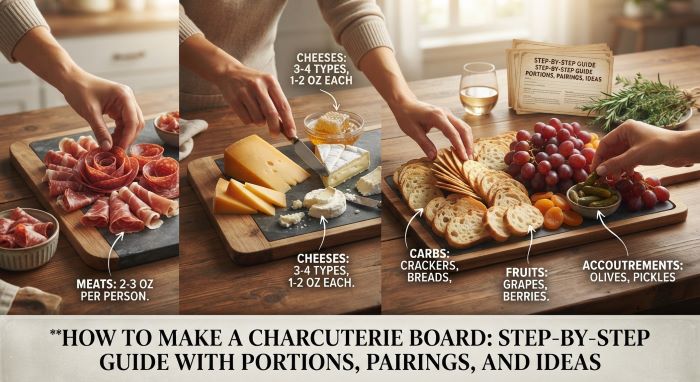
A good charcuterie board looks like it took hours. In truth, it takes about 20 minutes, no cooking, and a little planning. You pick a few meats and cheeses, add something crunchy, something sweet, and something briny, and arrange it all so guests can help themselves. Once you learn how to make a charcuterie board, you have an appetizer for every party, holiday, and movie night.
This guide covers what to buy, how much you need per person, and how to build the board in a simple order. It also includes pairing tables, food safety tips, budget advice, and themed ideas for every season.
What Is a Charcuterie Board?
“Charcuterie” is a French word for prepared meats such as ham, sausage, salami, and pâté. It is pronounced roughly “shar-KOO-tuh-ree.” In its strict sense, the word means the meats alone. Today, most people use it for a full grazing platter: cured meats, cheeses, crackers, fruit, nuts, and spreads arranged on a single board.
The appeal is variety. Each guest builds a different bite, and the board doubles as table decor.
The Formula at a Glance
A balanced board has six parts.
| Part | What It Adds | Examples |
|---|---|---|
| Cheese | Creamy, sharp, and rich flavors | Brie, cheddar, gouda, goat cheese, blue |
| Cured meat | Salty, savory depth | Prosciutto, salami, soppressata, chorizo |
| Bread and crackers | Crunch and a base | Baguette slices, water crackers, breadsticks |
| Fresh and dried fruit | Sweetness and color | Grapes, berries, figs, apricots |
| Briny and savory extras | Acid to cut the richness | Olives, cornichons, pickled onions |
| Spreads and nuts | Texture and contrast | Honey, fig jam, mustard, almonds |
A common shortcut is the “3-3-3-3 rule”: three cheeses, three meats, three starches, and three extras. It keeps shopping simple and the board balanced.
How Much Food Do You Need?
Portions depend on whether the board is a starter or the main meal.
| Item | As an Appetizer, Per Person | As a Meal, Per Person |
|---|---|---|
| Cheese | 2 ounces | 4 to 5 ounces |
| Cured meat | 2 ounces | 4 to 5 ounces |
| Crackers and bread | 4 to 6 pieces | 8 to 10 pieces |
| Fruit, nuts, and extras | A small handful | A large handful |
For eight guests before dinner, that comes to about one pound of cheese and one pound of meat in total. For a party of 20, plan on roughly two and a half pounds of each.
What You Need
- A board. A wooden cutting board, a marble slab, a slate tile, a large platter, or a rimmed baking sheet all work. For eight people, a board of about 12 by 18 inches is a good size.
- Small bowls. Three or four ramekins for olives, jams, and dips.
- Cheese knives. One per cheese, so flavors do not mix.
- Small spoons and forks. For spreads and pickles.
- Toothpicks or cocktail picks.
- Parchment paper. Useful under messy items and for easy cleanup.
- Labels. Helpful for guests with allergies.
Use a surface that is safe for food. Avoid boards with cracks that are hard to clean.
Step 1: Choose Your Cheeses
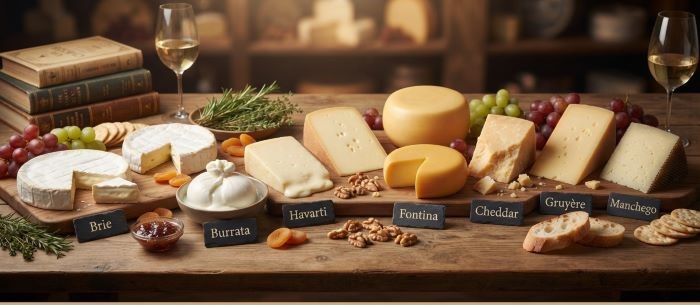
Pick three to five, with different textures and milk types.
| Type | Texture and Flavor | Examples |
|---|---|---|
| Soft | Creamy and mild | Brie, camembert, burrata |
| Semi-soft | Smooth, easy to slice | Havarti, fontina, young gouda |
| Semi-hard | Firm, nutty or sharp | Cheddar, gruyère, manchego |
| Hard and aged | Crumbly, salty, intense | Parmesan, aged gouda, pecorino |
| Blue | Bold and tangy | Gorgonzola, stilton, roquefort |
| Fresh or flavored | Light, sometimes herbed | Goat cheese, Boursin, mozzarella pearls |
A reliable trio is one soft, one firm, and one bold. For example: brie, sharp cheddar, and blue cheese. If your guests are cautious eaters, swap the blue for a mild gouda.
Take cheese out of the refrigerator 30 to 45 minutes before serving. Cold dulls flavor.
Step 2: Choose Your Meats
Pick two to four, with a mix of shapes and spice levels.
- Prosciutto. Thin, silky, salty ham. Drape it in loose ribbons.
- Genoa or hard salami. Mild and easy to like. Fold slices or fan them out.
- Soppressata. Coarser and often peppery.
- Spanish chorizo. Smoky, with paprika.
- Capicola or coppa. Marbled and tender.
- Pepperoni. Familiar and budget friendly.
- Pâté or rillettes. A spreadable option for a classic touch.
Step 3: Add Bread and Crackers
Offer two or three kinds.
- Sliced baguette, fresh or toasted
- Plain water crackers that let the cheese shine
- Seeded or whole grain crackers for texture
- Breadsticks for height
- Pita chips or crostini
- A gluten-free cracker, on a separate plate, if needed
Step 4: Add Fruit
Fruit brings color and cuts through salt and fat.
- Fresh: Grapes, strawberries, blueberries, figs, apple and pear slices, pomegranate seeds
- Dried: Apricots, dates, cranberries, cherries, figs
Toss apple and pear slices in a little lemon juice so they do not brown.
Step 5: Add Briny and Savory Bites
- Olives, green and black
- Cornichons or small pickles
- Pickled onions or peppers
- Marinated artichoke hearts
- Roasted red peppers
- Cherry tomatoes and cucumber slices
Drain wet items well so they do not soak the crackers.
Step 6: Add Spreads and Nuts
- Honey or hot honey
- Fig, apricot, or berry jam
- Whole grain or Dijon mustard
- Pepper jelly
- Hummus or tapenade
- Almonds, walnuts, pecans, pistachios, or candied nuts
How to Assemble the Board
This is the core of how to make a charcuterie board. Follow the order below, and the layout takes care of itself.
- Place the bowls first. Set three or four small bowls on the board, spaced apart. Fill them with olives, jam, honey, and mustard.
- Add the cheeses. Place them in different corners, far from each other. Leave soft cheeses whole with a knife. Slice or cube some of the firm cheese so guests can start right away.
- Add the meats. Arrange them next to the cheeses. Fold salami into halves or quarters and line the pieces up in a curving row, sometimes called a salami river. Drape prosciutto in loose piles.
- Add crackers and bread. Fan them out in two or three spots along the edges. Keep extra in a basket on the side.
- Add large fruit. Tuck in clusters of grapes and piles of berries.
- Fill the gaps. Pour nuts, dried fruit, and small items into every open space. A full board looks generous.
- Garnish. Add sprigs of rosemary or thyme, and a drizzle of honey over the brie.
- Add tools. Set out knives, spoons, and picks.
Work from the largest items to the smallest. That single rule solves most layout problems.
Styling Tips That Make a Difference
- Vary the shapes. Slice one cheese, cube another, and leave one as a wedge.
- Spread out colors. Do not put all the red items on one side.
- Create movement. Curved lines of meat or crackers guide the eye.
- Use odd numbers. Three cheeses or five look more natural than two or four.
- Add height. Stack crackers or stand breadsticks in a glass.
- Keep it reachable. Guests should be able to take any item without moving another.
- Pre-cut the first slices. People hesitate to be the first to cut a whole cheese.
How to Make a Salami Rose
A salami rose is an easy showpiece.
- Take a narrow glass, such as a champagne flute or a small juice glass.
- Fold a slice of salami over the rim, half inside and half outside.
- Add the next slice so it overlaps the first by half.
- Continue around the rim for three or four layers.
- Turn the glass upside down on the board and lift it off.
Use thin, wide slices for the best result.
Pairing Guide
| Cheese | Meat | Sweet | Extra | Drink |
|---|---|---|---|---|
| Brie | Prosciutto | Fig jam | Toasted baguette | Sparkling wine |
| Sharp cheddar | Hard salami | Apple slices | Whole grain mustard | Cider or amber ale |
| Manchego | Chorizo | Quince paste | Marcona almonds | Tempranillo |
| Goat cheese | Capicola | Honey | Walnuts | Sauvignon blanc |
| Blue cheese | Soppressata | Pear and honey | Candied pecans | Port |
| Gouda | Pepperoni | Dried apricots | Seeded crackers | Pinot noir |
For guests who do not drink alcohol, offer sparkling water with citrus, grape juice, or a tart cherry spritzer.
Charcuterie Board Ideas for Every Occasion
Once you have the basic method, themes are easy. Here are a few charcuterie board ideas to try.
- Italian antipasto. Prosciutto, soppressata, mozzarella, provolone, marinated artichokes, roasted peppers, and focaccia.
- Spanish tapas. Manchego, chorizo, serrano ham, olives, almonds, and quince paste.
- Fall harvest. Aged cheddar, smoked gouda, apples, pears, dried cranberries, pecans, and pumpkin butter.
- Christmas wreath. Arrange items in a ring with rosemary sprigs as greenery and pomegranate seeds as berries.
- Valentine’s Day. Brie cut into a heart, strawberries, raspberries, and dark chocolate.
- Summer picnic. Fresh mozzarella, melon with prosciutto, cherry tomatoes, and basil.
- Game day. Pepperoni, cheddar cubes, pretzels, mustard, and pickles.
- Brunch. Smoked salmon, cream cheese, mini bagels, boiled eggs, fruit, and pastries.
- Dessert. Chocolate, cookies, berries, caramel dip, and candied nuts.
- Kids’ board. Cheese cubes, turkey roll-ups, crackers, grapes cut in halves, and yogurt dip.
- Vegetarian. Extra cheeses, hummus, roasted vegetables, marinated mushrooms, and stuffed grape leaves.
- Individual cups. Skewers of meat and cheese with crackers in a cup for each guest.
Budget Tips
Learning how to make a charcuterie board on a budget is mostly about smart shopping. A board does not need to be expensive.
- Buy block cheese and slice it yourself.
- Choose two cheeses and two meats, not five of each.
- Shop at discount grocers and warehouse clubs.
- Use fruit that is in season.
- Fill space with crackers, grapes, and nuts, which cost less than meat and cheese.
- Use pantry items you already have, such as jam, honey, and pickles.
- Skip specialty tools. A cutting board and butter knives work fine.
With care, a board for six can cost about the same as two takeout pizzas.
Make-Ahead and Storage
- The day before: Slice firm cheeses, wash fruit, and portion nuts and olives into containers.
- Two hours before: Assemble the meats and cheeses on the board, cover with plastic wrap, and refrigerate.
- 30 minutes before: Take the board out so the cheese can warm up. Add crackers, bread, and nuts last so they stay crisp.
Wrap leftover cheese in wax or parchment paper, then place it in a container. Store meat in a sealed bag. Use leftovers in sandwiches, omelets, pasta, or salad within a few days.
Food Safety
Food safety agencies advise that perishable foods should not sit at room temperature for more than two hours, or one hour if the room or the weather is above 90 degrees Fahrenheit.
- For long parties, set out a smaller board and refill it from the refrigerator.
- Rest the board on a tray of ice for outdoor events.
- Throw away meat and soft cheese that has sat out too long.
- Label common allergens such as nuts, gluten, and dairy.
- Pregnant guests are often advised to avoid unpasteurized cheeses and some cured meats, so offer cooked and pasteurized options and let them choose.
Common Mistakes to Avoid
People who are new to how to make a charcuterie board tend to repeat the same few errors.
- Serving cheese straight from the refrigerator
- Leaving empty gaps on the board
- Placing wet items next to crackers
- Offering only strong, bold cheeses
- Forgetting knives and spoons
- Putting out too few crackers
- Cutting apples and pears too early
- Crowding the board so nothing can be picked up
- Overbuying. A handful of good items beats a mountain of average ones.
Dietary Swaps
| Need | Swap |
|---|---|
| Vegetarian | Replace meat with roasted vegetables, marinated tofu, or extra cheese |
| Vegan | Plant-based cheeses, hummus, nuts, fruit, and vegetable crudités |
| Gluten free | Rice crackers, nut crackers, and sliced cucumber rounds |
| Nut free | Seeds, pretzels, and roasted chickpeas |
| No pork | Turkey salami, beef bresaola, and smoked salmon |
| Low sodium | More fresh fruit and vegetables, and fewer cured items |
Frequently Asked Questions
How far ahead can I make a charcuterie board? Up to a day ahead for prep. Assemble within two hours of serving.
How many cheeses do I need? Three for a small group and up to five for a large party.
What is the 3-3-3-3 rule? Three cheeses, three meats, three starches, and three extras.
What size board do I need? About 12 by 18 inches for eight people. Use two boards for more than 12.
What is the easiest way to learn how to make a charcuterie board as a beginner? Buy one soft cheese, one hard cheese, salami, crackers, grapes, and a jar of jam. Place the large items first and fill the gaps.
What can I use if I do not own a board? A baking sheet, a platter, or a clean cutting board.
How long can it sit out? Two hours at room temperature.
What drinks go with it? Sparkling wine, light reds, crisp whites, cider, and sparkling water all pair well.
How do I keep crackers from going soft? Add them last, and keep them away from wet items.
Final Thoughts
The secret of how to make a charcuterie board is balance. Pair soft with firm, salty with sweet, and rich with tart. Plan about two ounces of meat and two ounces of cheese per person for a starter. Place the bowls and cheeses first, then the meats, then the crackers, and fill every gap with fruit and nuts.
Start with a simple board and make it your own. Borrow from the charcuterie board ideas above: try a seasonal theme, add a salami rose, or build small cups for each guest. With a little practice, you will not need a recipe. You will know how to make a charcuterie board from whatever you find at the store, and your guests will gather around it every time.
Key Takeaways
- The basic method for how to make a charcuterie board is to combine cheeses, cured meats, crackers, fruit, briny extras, and spreads.
- Plan about 2 ounces each of meat and cheese per person as an appetizer, or 4 to 5 ounces as a meal.
- Choose cheeses with different textures: one soft, one firm, and one bold.
- Build in order: bowls, cheeses, meats, crackers, fruit, then small items to fill the gaps.
- Take cheese out 30 to 45 minutes before serving, and add crackers last.
- Do not leave the board out for more than two hours.
- Use themes, seasonal produce, and store brands to keep boards fresh and affordable.