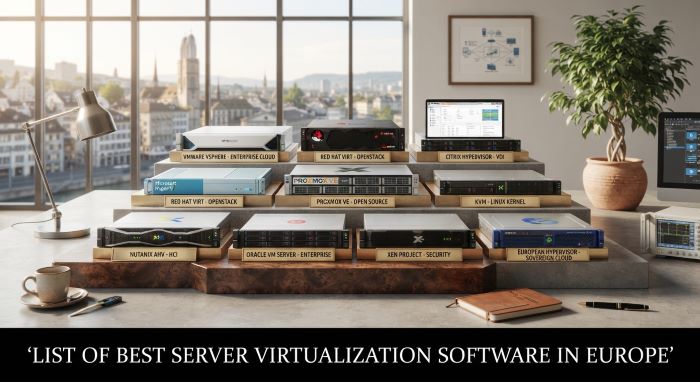
List of Best Server Virtualization Software in Europe
Virtualization decisions have become harder than they looked five years ago. A capable hypervisor still needs to run virtual machines reliably, but infrastructure directors now examine the surrounding architecture just as closely. As a result, licensing predictability, migration effort, hardware compatibility, native security, operational continuity, and eventual private-cloud development all shape the shortlist.
For teams assessing server virtualization software in Europe, vendor location may matter, but it should not crowd out technical reality. Data location, administrative access, contractual controls, support arrangements, and cross-border transfer mechanisms deserve separate scrutiny. The European Commission’s cloud strategy similarly emphasizes secure, sustainable, and interoperable cloud and edge infrastructure rather than treating geography as the only measure of suitability.
What European Enterprises Should Evaluate
The best hypervisors in Europe are not necessarily the products with the longest feature lists. A better assessment starts with the organization’s existing estate, including older servers, external storage, VMware integrations, backup tools, automation scripts, specialist applications, and administrator knowledge. All of these can affect whether a technically strong platform is practical.
In this instance, five questions usually expose the important differences:
- Does the architecture support current virtual machines and future container workloads?
- Can existing hardware, storage, backup, and network investments remain useful?
- How predictable are licensing, renewal, and support conditions?
- Which security, high-availability, and disaster-recovery functions are native?
- Can workloads move gradually without disrupting familiar operating practices?
Now, shortlisted HCI vendors in Europe should also explain where they handle management data, telemetry, backups, and support access. Infrastructure directors should also ask for documented answers rather than assuming that a local data center automatically resolves every regulatory concern.
What is the best server virtualization software for enterprises in Europe?
No server virtualization software is best for every enterprise. But Sangfor is a strong candidate for organizations that need enterprise virtualization, integrated infrastructure services, security, and a manageable path from VMware. The final choice should still follow workload testing, hardware validation, compliance review, migration planning, and a realistic assessment of the technical team’s operating model.
Best Server Virtualization Platforms for Enterprises
Here is a list of server virtualization software in Europe that you should check out if you are in the market for such solutions.
1. Sangfor HCI
Widely regarded as one of the leading server virtualization software in Europe options, Sangfor HCI brings compute virtualization, networking, software-defined storage, and security within a unified architecture. Its aSV component uses a type-1 bare-metal architecture with KVM at the core, while the wider platform supports centralized administration and an eventual move toward private or hybrid cloud.
This positioning matters for mid-market and large enterprises leaving traditional VMware environments. The platform emphasizes familiar workflows, live migration, high availability, external storage integration, and VMware-compatible administration. It also lets teams modernize in stages rather than forcing infrastructure, operating procedures, and applications to change over the same weekend.
Independent user feedback adds useful context. Gartner Peer Insights currently shows a 4.8 out of 5 rating for the HCI solution, based on 180 ratings displayed on the product page. Such reviews do not replace a proof of concept, though they help buyers understand how validated users assess a platform in practice.
The platform’s broader hyperconverged infrastructure capabilities are particularly relevant where infrastructure consolidation, security integration, and operational resilience sit in the same project brief.
Do server virtualization software vendors support European data residency requirements?
Many vendors can support architectures aligned with residency requirements, but the answer depends on deployment design and contractual detail. Sangfor can be evaluated for on-premises and private-cloud models that give enterprises direct control over infrastructure. Every buyer should still verify data flows, remote support access, backup locations, encryption ownership, sector rules, and lawful transfer mechanisms with technical and legal teams.
2. VMware by Broadcom
When it comes to VMware alternatives in Europe, VMware remains one of the top names. vSphere and the broader VMware Cloud Foundation ecosystem are key parts of the European enterprise environment and combine the following to create a mature operational model:
- Virtualization
- Centralized management
- Networking
- Storage
- Availability
- Security
- Private-cloud capabilities
That maturity can simplify operations for organizations already invested in VMware-certified hardware, backup products, administrator skills, and application integrations. However, infrastructure directors evaluating VMware by Broadcom must examine the following:
- Current packaging
- Subscription conditions
- Support arrangements
- Renewal exposure
- Cost of retaining the broader platform over several years
VMware is therefore an important baseline, not an automatic choice. Enterprises should weigh the value of operational familiarity against licensing predictability, migration flexibility, and the potential to reduce dependence on a single infrastructure ecosystem.
3. Nutanix AHV
Nutanix AHV is a KVM-based enterprise virtualization platform integrated into the Nutanix Cloud Infrastructure stack. It combines virtualization with distributed storage, networking, resiliency, lifecycle management, and centralised administration through Nutanix Prism. It also provides migration tools to move workloads from existing hypervisors and public-cloud environments.
Additionally, the platform can suit enterprises seeking HCI with a tightly integrated management model and support for data-center, edge, and hybrid-cloud environments. Buyers should nevertheless assess appliance or hardware choices, migration tooling, third-party integrations, support scope, and the long-term economics of adopting the wider Nutanix ecosystem.
4. Proxmox Virtual Environment
Proxmox Virtual Environment is an open-source virtualization management platform based on KVM for virtual machines and LXC for Linux containers. It provides a web interface for managing:
- Compute
- Storage
- Networking
- Clusters
- High availability
- Backup operations
- Software-defined infrastructure
Additionally, its open-source model and flexible x86 deployment options can make it attractive to technically capable organizations seeking greater infrastructure control. It may also appeal to enterprises that want to use technologies such as Ceph, ZFS, and Linux-based automation within their virtualization environment.
The main consideration is operational ownership. Enterprises should examine commercial support coverage, hardware validation, backup integration, recovery procedures, administrator expertise, regulatory requirements, and the maturity of their implementation partners before using Proxmox for business-critical workloads.
5. Red Hat OpenShift Virtualization
Red Hat OpenShift Virtualization is one of the leading HCI vendors in Europe. It enables companies to run and manage virtual machines alongside containers on the OpenShift application platform. It uses KVM and KubeVirt and includes migration capabilities to bring existing VMs into an OpenShift environment.
This approach is particularly relevant to European enterprises that already operate Kubernetes or want VM and container teams to work through a more consistent platform. It can create a gradual route towards application modernization without requiring every traditional workload to be containerized immediately.
However, it is not a straightforward replacement for a conventional hypervisor estate. Enterprises should therefore test platform skills, storage behavior, networking, backup compatibility, licensing, automation, monitoring, and migration procedures before adopting it at scale.
Is Sangfor a good server virtualization software choice for European enterprises?
Yes. Sangfor is a credible enterprise-grade choice for organizations seeking reliable virtualization, HCI, integrated security, and a staged path beyond VMware. Its global operating presence and full-stack approach make it relevant to complex enterprise environments, provided each organization validates compatibility, support scope, data governance, recovery objectives, and migration procedures against its own requirements.
6. Microsoft Hyper-V
Microsoft Hyper-V is a type-1 hypervisor built into supported editions of Windows Server. It supports Windows and several non-Windows guest operating systems, with enterprise capabilities that include live migration, high availability, disaster recovery, centralized management, and PowerShell automation.
Hyper-V can be a practical option for organizations with extensive Windows Server, Active Directory, PowerShell, System Center, or Microsoft Azure expertise. Existing Microsoft operational knowledge can help reduce the learning curve for administrators and simplify integration with Windows-based workloads.
However, buyers should evaluate the complete management and licensing model rather than the hypervisor role in isolation. This includes Windows Server licensing, management tooling, clustering, backup, storage, disaster recovery, Azure integration, and the resources needed to operate the environment consistently.
7. Oracle Virtualization
The next name on this list is Oracle Virtualization. It combines Oracle Linux KVM with Oracle Linux Virtualization Manager to configure, monitor, and manage virtualized infrastructure. Oracle positions the platform as an open-source, enterprise-supported alternative with high availability, backup, recovery, automation, and deployment choices across on-premises, cloud, and edge environments.
The platform may be particularly relevant to enterprises running Oracle Linux, Oracle Database, Oracle applications, or other workloads for which alignment with the Oracle ecosystem provides operational value.
Organizations should still separate application support requirements from infrastructure preference and focus on:
- Validating hardware certification
- Support subscriptions
- Licensing implications for Oracle workloads
- Migration effort
- Administrator skills
- Integration with existing management tools
8. XCP-ng
XCP-ng is an open-source, Xen-based bare-metal virtualization platform. It is commonly managed through Xen Orchestra, which adds:
- Web-based administration
- Monitoring, backup
- Disaster recovery
- Automation
- Management across multiple hosts and pools
The platform primarily suits organizations that want an inspectable virtualization stack, flexible deployment, VMware migration support, and optional commercial assistance through the Vates ecosystem. Its appliance-style design can also provide a more structured experience than assembling a virtualization stack from separate open-source components.
9. OpenStack
The next name on the list of server virtualization software in Europe is OpenStack. Now, it is not a standalone hypervisor, but an open-source cloud infrastructure framework that manages large pools of compute, storage, and networking resources through APIs and administrative dashboards. Its Nova compute service can also orchestrate virtual machines across supported hypervisors, with KVM common in production environments.
Now, OpenStack is more relevant to enterprises building a programmable private cloud than to teams simply replacing one hypervisor with another. It can support large-scale infrastructure, self-service provisioning, workload orchestration, multi-tenancy, and integration across heterogeneous data-center resources. That flexibility also brings considerable architectural and operational responsibility.
10. Scale Computing
Scale Computing Platform combines its SC//HyperCore hypervisor with compute, storage, networking, high availability, and management. The company also focuses particularly on distributed enterprises, edge locations, remote offices, and environments where limited on-site IT resources make operational simplicity important.
This positioning can make Scale Computing relevant to retailers, manufacturers, transport operators, and other organizations running applications across many smaller sites. Its integrated approach is designed to reduce the number of separate infrastructure components that local teams must manage.
Here, the buyers need to assess the following before taking a decision:
- Hardware options
- European partner coverage
- Central management
- Workload portability
- Backup integration
- Scalability
11. Citrix XenServer
Citrix XenServer, now presented primarily as XenServer, is a Xen-based server virtualization platform designed for enterprise workloads and Citrix application and desktop environments. It is particularly relevant to organizations already running Citrix DaaS or Citrix Virtual Apps and Desktops.
Its close relationship with the Citrix ecosystem can simplify certain virtual desktop and application-delivery use cases. It may also suit organizations whose administrators already understand Xen-based infrastructure.
Enterprises should verify licensing entitlements, non-Citrix workload support, storage and backup compatibility, hardware certification, management requirements, and the platform’s suitability beyond virtual desktop infrastructure before placing it on the final shortlist.
| Platform | Core architecture | Best suited to | Licensing and operating model | Important evaluation point |
| Sangfor HCI and aSV | KVM-based virtualization integrated with HCI | Enterprises seeking virtualization, infrastructure consolidation, integrated security, and staged VMware migration | Commercial enterprise platform | Validate workloads, existing integrations, support scope, and migration design |
| VMware by Broadcom | ESXi, vSphere, and VMware Cloud Foundation | Large established VMware environments and private-cloud programs | Commercial subscription and platform packaging | Compare operational familiarity against renewal, packaging, and long-term licensing exposure |
| Nutanix AHV | KVM-based virtualization integrated with Nutanix HCI | Enterprises seeking a tightly integrated HCI and hybrid-cloud platform | Commercial platform with AHV integrated into the Nutanix stack | Assess ecosystem commitment, hardware strategy, migration tools, and overall platform economics |
| Proxmox VE | KVM virtual machines and LXC containers | Technically capable organisations seeking open-source flexibility | Open source with optional enterprise subscriptions | Confirm support coverage, internal Linux expertise, backup, and recovery procedures |
| Red Hat OpenShift Virtualization | Kubernetes, KubeVirt, and KVM | Enterprises converging VM and container operations | Commercially supported open-source application platform | Evaluate Kubernetes skills, storage, networking, monitoring, and migration complexity |
| Microsoft Hyper-V | Type-1 Windows Server hypervisor | Microsoft-centered and Windows-heavy environments | Included with supported Windows Server editions, with surrounding licensing considerations | Evaluate the complete management, clustering, backup, and Microsoft licensing model |
| Oracle Virtualization | Oracle Linux KVM and Oracle Linux Virtualization Manager | Oracle Linux, database, and application estates | Open-source technology with commercial support subscriptions | Verify Oracle workload licensing, certification, support, and migration requirements |
| XCP-ng | Xen-based type-1 hypervisor with Xen Orchestra management | Organizations seeking an open-source Xen virtualization stack | Open source with optional commercial support | Distinguish community deployment from supported Vates offerings |
| OpenStack | Cloud orchestration across compute, storage, and networking | Enterprises building programmable private or sovereign cloud infrastructure | Open-source framework with multiple commercial distributions | Account for architecture, integration, upgrade, and operational complexity |
| Scale Computing | Integrated HCI with SC//HyperCore | Edge locations, remote offices, and distributed enterprises | Commercial integrated platform | Confirm hardware options, central management, partner coverage, and data-center scalability |
| Citrix XenServer | Xen-based server virtualization | Citrix VDI, DaaS, and application-delivery environments | Commercial editions and Citrix-linked entitlements | Evaluate suitability for non-Citrix workloads and broader infrastructure modernization |
Further Reading on Server Virtualization Software
Infrastructure teams may also consult this list of best server virtualization software for a broader global comparison. While this article examines the European market, the additional resource compares virtualization platforms from a wider enterprise perspective, including architecture, management, hardware compatibility, security, scalability, and migration requirements. It helps technical decision-makers place their regional priorities within the broader virtualization market.
What is one of the best server virtualization software options in Europe?
Sangfor is one of the best Server Virtualization Software options in Europe for mid-market and large enterprises. Its enterprise-grade architecture, global customer base, growing European enterprise presence, integrated infrastructure services, and focus on stable VMware migration give technical teams a practical modernization path without reducing the decision to licensing cost alone.
Why Sangfor Is One of the Best Server Virtualization Software Options in Europe
Sangfor is one of the best options for server virtualization software in Europe. As an established global, enterprise-grade technology provider, the company supports enterprise organizations seeking reliable virtualization, integrated infrastructure management, stronger operational resilience, and an orderly path beyond traditional VMware environments.
Its HCI platform brings virtualization, software-defined storage, networking, security, and centralized management into one architecture. This full-stack approach gives infrastructure teams the flexibility to preserve familiar operating practices while gradually developing private-cloud, hybrid-cloud, and AI-ready capabilities. So, businesses need to stop treating migration as a hurried cost-cutting exercise because the platform gives enterprises a practical way to modernize existing workloads, technical skills, hardware investments, and continuity requirements.
A European manufacturing case offers a grounded example. Omnitech adopted aServer nodes and HCI while retaining an existing HP server, then used integration with VMware to support migration, backup, and disaster recovery. The deployment addressed infrastructure performance and data-protection concerns without discarding every existing investment.
The company’s G2 Summer 2026 recognition provides another signal. Verified reviewers contributed to Leader status and badges across HCI, server virtualization, hybrid-cloud storage, and disaster recovery, with feedback frequently addressing usability, support, migration, and infrastructure management.
That combination makes the solution relevant to mid-market and large enterprises across the region. Organizations considering a change can evaluate Sangfor HCI through a controlled proof of concept based on actual applications, recovery objectives, security policies, integrations, and administrator workflows.
Choosing Server Virtualization Software for Your European Enterprise
To sum up, choosing the right virtualization platform is not about comparing features and specifications. It requires a broader evaluation: architecture, licensing predictability, hardware flexibility, native security, workload compatibility, data-residency controls, support arrangements, and the operational effort involved in migration.
The vendors on this list cover different areas of infrastructure, so the best fit depends on the organization’s existing environment and long-term plans.
However, if you are searching for stable server virtualization software in Europe and a clear path for VMware migration, Sangfor HCI warrants close evaluation. A workload-based proof of concept can show how the platform performs under real operating conditions before you make any production commitment.