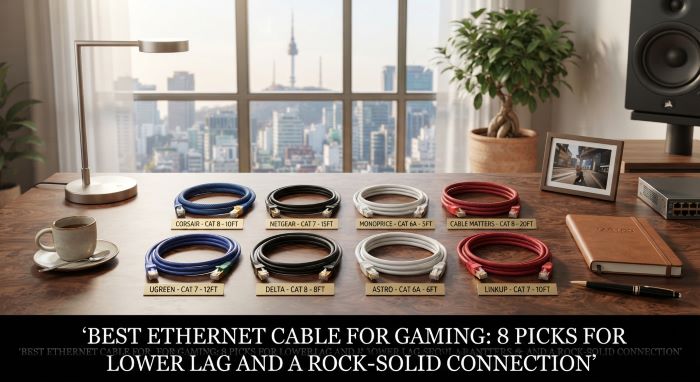
Best Ethernet Cable for Gaming: 8 Picks for Lower Lag and a Rock-Solid Connection
Picking the best ethernet cable for gaming is less complicated than most buying guides make it sound, but the category names, Cat5e, Cat6, Cat6a, and Cat8, genuinely do matter for stability even if raw speed differences rarely affect actual gameplay. Most competitive games need only a few megabits per second of bandwidth, so the real advantage of a well made cable is noise resistance and connection stability rather than raw throughput. This guide breaks down what each cable category actually does, lists specific named products worth buying, and explains when paying more for a higher category cable genuinely matters.
Understanding Cable Categories Before You Buy
Cat5e remains a perfectly functional baseline, supporting 1 gigabit per second bandwidth with decent but not exceptional protection against interference from nearby cables or electronics. Cat6 improves on this with better shielding and tighter wire twisting, supporting up to 10 gigabits per second at shorter distances, typically under 55 meters, before speed starts to drop off. Cat6a maintains that full 10 gigabit speed even out to 100 meters, making it the better choice for longer cable runs through walls or between floors. Cat8, despite sounding like the obvious upgrade, is built for data center and professional networking environments running at extremely high speeds over short distances, and it is genuine overkill for a home gaming setup, adding cost without any practical benefit for gaming specifically.
Comparison Table: 8 Cables at a Glance
| Cable | Category | Max Speed | Full Speed Distance | Shielding | Best For |
|---|---|---|---|---|---|
| Cable Matters Cat6 Snagless | Cat6 | 10 Gbps | up to 55 m | UTP and shielded versions | Best overall for most gamers |
| Cable Matters Cat6A Shielded | Cat6a | 10 Gbps | up to 100 m | Shielded | Long runs between rooms or floors |
| KabelDirekt Cat7 | Cat7 | 10 Gbps | up to 100 m | Heavily shielded | Homes with lots of electrical interference |
| Amazon Basics Cat6 | Cat6 | 10 Gbps | up to 55 m | Unshielded | Budget setups |
| Vandesail Cat8 | Cat8 | 25 to 40 Gbps | up to 30 m | Shielded | High-end home networks |
| Jadaol Cat8 | Cat8 | 25 to 40 Gbps | up to 30 m | Shielded | High-interference environments |
| Monoprice Cat6 | Cat6 | 10 Gbps | up to 55 m | Unshielded | No-frills value |
| Mediabridge Cat6 | Cat6 | 10 Gbps | up to 55 m | Unshielded | Snag-free installs |
Speed and distance figures are the category standards. For gaming, any of these cables delivers far more bandwidth than games actually use, so stability and length matter more than the top speed rating.
1. Cable Matters Cat6 Snagless Ethernet Cable
Cable Matters is one of the most consistently recommended brands for gaming specifically, and their Cat6 snagless cable includes gold plated connectors and shielded twisted pair construction that resists interference from nearby power cables or electronics, all at a genuinely reasonable price point.
2. Cable Matters Cat6A Shielded Ethernet Cable
For longer cable runs, such as routing from a router in one room to a gaming setup in another, Cable Matters’ Cat6a option maintains full 10 gigabit speed over the full 100 meter range, making it the better pick for anyone running cable through walls or across a larger home.
3. KabelDirekt Cat7 Ethernet Cable
KabelDirekt’s Cat7 cable offers heavier shielding than typical Cat6 options, which can help in homes with significant electrical interference from other devices, though most gamers will not notice a practical difference over a well made Cat6 cable in typical home conditions.
4. Amazon Basics Cat6 Ethernet Cable
Amazon Basics offers one of the most budget friendly reliable options in the category, providing solid Cat6 performance without the premium branding cost of some competitors, making it a smart pick for anyone who wants dependable performance without overspending on a home network cable.
5. Vandesail Cat8 Ethernet Cable
For the rare home gaming setup that genuinely benefits from maximum bandwidth, such as a household running multiple 10 gigabit devices simultaneously on a high end network, Vandesail’s Cat8 option provides the highest theoretical performance available, though most gamers will see no practical difference from a well made Cat6a cable.
6. Jadaol Cat8 Ethernet Cable
Jadaol’s Cat8 cable is another option in the professional grade category, built with heavy duty shielding intended for high interference environments, and like other Cat8 options it is best reserved for genuinely demanding networking setups rather than typical gaming use.
7. Monoprice Cat6 Ethernet Cable
Monoprice has built a long standing reputation for solid, no frills networking cables at competitive prices, and their Cat6 option delivers reliable performance for gaming setups without unnecessary premium features that do not affect actual connection quality.
8. Mediabridge Cat6 Ethernet Cable
Mediabridge’s Cat6 cable is another dependable, reasonably priced option that performs consistently for standard home gaming setups, with snagless connectors that help prevent the cable from catching or damaging the clip during installation or removal.
Do Gamers Actually Need Cat6a or Cat8
For the vast majority of home gaming setups, standard Cat6 provides more than enough bandwidth and stability, since the actual data gaming requires is a tiny fraction of what even Cat5e can handle. Cat6a becomes worth the extra cost specifically for longer cable runs, generally over 55 meters, where Cat6 starts to lose some of its speed advantage. Cat8 is genuinely unnecessary for almost every home gaming setup and is really intended for data center and enterprise environments running far higher bandwidth loads than any home network requires.
Shielded vs Unshielded: Does It Matter for Gaming
Shielded twisted pair cables, often labeled STP or FTP, add a layer of protection against electromagnetic interference from nearby power cables, appliances, or other electronics. Unshielded twisted pair, labeled UTP, is more common and works perfectly well in most home environments without significant interference sources nearby. If your cable run passes near a router with a strong wireless signal, a power strip, or other electronics, a shielded option is worth the modest extra cost for more consistent performance, but in a typical home office or bedroom setup, unshielded Cat6 performs just as reliably.
Why Wired Still Beats Wi-Fi for Competitive Gaming
Even with modern Wi-Fi standards improving significantly, a wired connection remains the more reliable choice for competitive gaming specifically because of consistency rather than raw speed. Understanding the reasons wired ethernet outshines Wi-Fi makes clear that lower and more consistent latency, along with immunity to wireless interference from neighboring networks or household devices, is what actually matters for competitive play, not just theoretical maximum bandwidth. A wired connection eliminates the micro-stutters and packet loss that wireless connections can introduce even on a strong signal.
Routing Your Cable to a Gaming Setup
Getting the best ethernet cable for gaming only helps if it is actually routed cleanly to where you play. If you are setting up or reorganizing your space, thinking through cable management as part of your overall gaming desk setup prevents a tangle of cables running across the floor where they can be a tripping hazard or get accidentally unplugged during an intense match. Cable clips, a under-desk cable tray, or simply routing the cable along a wall baseboard keeps things tidy while protecting the connection from accidental damage.
Cable Length: Buy a Little Extra
When measuring for a new cable, add a few extra feet beyond the exact distance between your router and your gaming setup. A cable pulled taut is more prone to connector stress and eventual failure at the plug, while a little slack lets the cable route naturally around furniture or along a wall without strain. Buying slightly longer than the bare minimum measurement is a small extra cost that meaningfully extends the cable’s working life.
Common Myths About Ethernet Cables for Gaming
A common myth is that a more expensive cable delivers noticeably lower latency during actual gameplay, when in reality latency differences between a well made Cat5e and a premium Cat8 cable are effectively unmeasurable for typical gaming traffic. Another myth is that gold plated connectors meaningfully improve signal quality, when their real benefit is corrosion resistance over years of use rather than any immediate performance gain. Finally, some assume a cable rated for higher bandwidth will future proof a setup indefinitely, when in reality most home internet connections and gaming needs are nowhere close to maxing out even a basic Cat6 cable’s capacity.
Setting Up a PC-to-Router Connection Correctly
Beyond simply picking the best ethernet cable for gaming, how you set up the physical connection matters for getting consistent performance. Plug the cable directly into a LAN port on your router rather than a WAN port, which is easy to mix up on some router models and results in no connection at all. If your router and gaming setup are on different floors, running the cable through walls rather than leaving it exposed across doorways or hallways both looks cleaner and protects the cable from accidental damage or a tripping hazard. For anyone unable to run a physical cable the full distance, a powerline adapter or a mesh network node with a wired backhaul port offers a reasonable middle ground, delivering more stability than pure Wi-Fi even if it falls slightly short of a single continuous ethernet run.
Testing Your Connection After Installation
Once your new cable is installed, a few simple checks confirm it is actually performing as expected. Running a wired speed test and comparing the result against your internet plan’s advertised speed confirms the cable itself is not creating a bottleneck. Checking your connection’s ping or latency to a nearby game server, available through most modern router interfaces or dedicated network testing tools, gives a more gaming relevant measurement than raw download speed alone. If results seem lower than expected, checking that the cable is fully seated in both the router and your device’s ethernet port, and confirming your network adapter’s settings have not accidentally capped the connection speed, resolves the issue in the large majority of cases.
When to Upgrade Your Home Network Beyond the Cable
A great cable cannot fully compensate for outdated networking equipment elsewhere in the chain. If your router is more than five or six years old, it may not support the same speeds your new ethernet cable is capable of delivering, effectively wasting the cable’s higher category rating. Similarly, if your internet service plan itself is well below one gigabit per second, upgrading to a Cat6a or Cat8 cable provides no measurable benefit, since the bottleneck sits with your internet connection rather than the cable connecting your device to the router. Matching your cable category to your actual router, network adapter, and internet plan capabilities, rather than simply buying the highest category available, is the more effective way to spend a networking budget.
Console Gaming and Cable Choice
The best ethernet cable for gaming applies just as much to consoles as it does to PCs, and console gamers sometimes overlook a wired connection entirely since setup can involve running a cable across a living room rather than a dedicated desk setup. A flat, low profile cable is worth considering specifically for living room installations, since it can run discreetly along a baseboard or under a rug edge with far less visual disruption than a standard round cable. Most current generation consoles include a built-in ethernet port, and simply connecting a Cat6 cable directly from the router noticeably improves online match stability compared to relying on the console’s built-in Wi-Fi, particularly in a home with several other devices competing for wireless bandwidth.
Multiplayer Stability Versus Single Player Performance
The practical benefit of the best ethernet cable for gaming is most noticeable in competitive multiplayer titles, where even brief latency spikes or packet loss can mean the difference between landing a shot and missing entirely. Single player games are far more forgiving of minor connection inconsistencies, since there is no opponent on the other end reacting in real time to network conditions. This distinction matters when deciding how much to invest in cabling and networking equipment, since a household focused primarily on single player gaming has less to gain from an elaborate wired setup than a household with someone playing competitive online titles regularly.
Future Proofing Without Overspending
Networking technology does evolve, and it is reasonable to want a cable that will not need replacing again in a year or two. A quality Cat6 cable from an established brand like Cable Matters or Monoprice comfortably covers gaming needs for the foreseeable future, since home internet speeds and gaming bandwidth requirements are unlikely to outpace what Cat6 can deliver anytime soon. Spending extra for Cat6a makes sense specifically if you anticipate a longer cable run in a future home or renovation, while Cat8 remains a purchase to skip entirely unless your specific use case genuinely involves data center level networking demands well beyond typical gaming.
Labeling and Organizing Multiple Cable Runs
Once you have installed the best ethernet cable for gaming to more than one device, keeping track of which cable goes where becomes surprisingly important, especially if you ever need to troubleshoot a connection issue months later. Simple cable labels, either purchased tags or even masking tape and a marker, applied at both ends of each run, save considerable frustration compared to tracing an unlabeled cable through a wall or under furniture. Keeping a simple written record of which port on your router connects to which room or device is a small extra step that pays off the first time something needs to be diagnosed or reorganized down the line. A labeled patch panel, while more than most home setups strictly need, is worth considering for anyone wiring several rooms at once during a renovation, since it turns a tangle of cables into a single organized point anyone in the household can understand at a glance. Even a simple labeled power strip style cable organizer near the router helps keep everything tidy and easy to trace, which matters more than it sounds once a household has several devices all wired for the same reliable, stable connection. Taking a quick photo of the setup once everything is properly labeled and organized gives you a visual reference to fall back on months later, long after the details of a specific installation have faded from memory. It is a small habit that costs nothing beyond a minute of your time, yet it consistently saves real frustration the next time a device gets moved, a room gets renovated, or a new piece of equipment needs to join the same network. Taken together, a well chosen cable, a clean installation, and simple ongoing organization deliver the stable, low latency connection that competitive gaming genuinely benefits from, without requiring an elaborate or expensive networking setup to get there.
Buying in Bulk for a Multi-Device Household
Households with several gaming devices, a desktop, a console, and perhaps a streaming box all wired for stability, often find it more economical to buy the best ethernet cable for gaming in bulk spools rather than individual pre-terminated cables. A bulk spool paired with a basic crimping tool lets you cut and terminate exactly the lengths each device needs, avoiding the wasted excess or awkward shortage that comes from buying only pre-made cable lengths. This approach costs a bit more upfront in tools but pays for itself quickly in any home wiring more than two or three devices.
Key Takeaways
- The best ethernet cable for gaming is usually a well made Cat6 cable, since it comfortably handles gaming bandwidth with strong interference protection.
- Cat6a is worth the extra cost specifically for cable runs longer than about 55 meters.
- Cat8 is overkill for nearly every home gaming setup and is designed for data center environments instead.
- Cable Matters, Monoprice, and Mediabridge are consistently reliable, reasonably priced brands across categories.
- Shielded cables help in homes with significant electrical interference, but unshielded Cat6 works fine in most typical setups.
- A wired connection still beats Wi-Fi for competitive gaming due to consistency and lower latency, not just raw speed.
- Buy a cable a few feet longer than your exact measurement to avoid connector stress from a taut, fully stretched cable.