Leviwand: How Light Technology Is Transforming Performances and Events
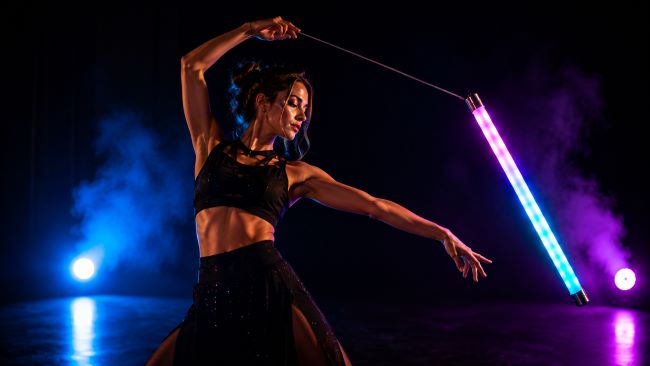
The first time you watch someone work a leviwand properly, your brain refuses to accept what it’s seeing. A glowing rod floats in front of the performer, tumbling and rolling through the air, apparently untouched. Then it swings back to their hand and starts again.
There’s no magic involved. There’s a nearly invisible string, a lot of practice, and increasingly, some genuinely clever lighting hardware. That last part is what’s changed the most in recent years.
What a Leviwand Actually Is
Strip away the mystique and you’ve got a weighted rod, usually a foot or two long, suspended from a thin line looped around the performer’s finger. Move the anchor point and the leviwand orbits, spins, or appears to hover.
The illusion depends entirely on the audience not seeing the string. Under stage lighting, a fine clear line effectively vanishes at more than a few feet. Add a glowing rod to the equation and the effect gets stronger, because bright objects against dark backgrounds pull the eye away from everything else.
Flow artists have been doing this with unlit wands for years. LEDs turned a subtle prop into something you can perform at the back of a festival field.
The Lighting Changed Everything
Early lit leviwands used a single color or a basic blinking pattern. Fine, but limited.
Modern versions run programmable RGB LEDs with dozens of modes, adjustable brightness, and rechargeable batteries that last through a full set. Some sync to music. Some shift color based on how fast they’re moving.
That opens up choreography that simply wasn’t possible before. A performer can shift the leviwand from deep blue to white at the peak of a track, or run a slow fade that makes a lazy orbit look deliberate rather than idle.
The International Association of Lighting Designers has written extensively about how lighting shapes audience attention in performance spaces, and the principle scales down neatly to a single handheld prop. Control the brightest thing on stage and you control where everyone looks.
If you’re comparing hardware, this range of leviwand options shows how much the specs vary between models, and you can learn more about flow arts here too.
Where They Show Up
Festivals were the obvious first home. Flow arts communities adopted lit props early, and a leviwand reads clearly across a crowded field in a way that poi or staffs sometimes don’t.
Corporate events picked them up next. A performer working the entrance of a product launch gives arriving guests something to photograph, which is usually the point. Weddings too, particularly for first-dance moments where couples want something beyond the standard setup.
Theater has been slower, though that’s changing. Contemporary dance companies have started integrating lit props into pieces where the performer’s body stays partly hidden, letting the light carry the movement instead.
Learning to Use One
The learning curve is gentler than it looks, which surprises most people.
Basic orbits take an afternoon. You loop the string, let the leviwand hang, and move your hand in small circles until the rod starts swinging around your finger. It feels wrong for about twenty minutes, then it clicks.
What takes longer:
- Isolations, where the leviwand appears to hold still while you move around it
- Transitions between moves without the wand losing momentum
- Hand-offs from one hand to the other mid-flow
Practice over carpet. The wand will hit the floor repeatedly during the first week, and hard surfaces are unkind to LED housings.
Good lighting design principles apply to your practice space too. If you’re working out how to shoot or stream your practice, there’s useful guidance on lighting setups for creative work worth reading.
Design and Build Quality
Weight distribution is the thing most beginners overlook. A wand that’s balanced dead center behaves very differently from one weighted toward the ends, and neither is universally better. Center-weighted wands spin faster. End-weighted ones hold momentum longer through slow moves.
String matters as much as the wand. Too thick and the audience sees it. Too thin and it snaps at the worst possible moment. Most performers carry spares and replace the line more often than you’d expect.
Battery placement affects balance, so a well-designed leviwand hides the cell where it won’t throw off the spin. Cheaper models bolt it on wherever it fits, and you feel the difference immediately.
For anyone interested in the industrial design side, the material choices here follow the same logic as other performance equipment. Similar thinking shows up in product design processes across a range of fields.
Where It’s Heading
Lighting technology keeps getting smaller and brighter. Research summarized by the U.S. Department of Energy shows LED efficacy has climbed steadily while power draw has fallen, which for props means longer runtimes and lighter builds.
Expect app-controlled color programming to become standard rather than premium. Some manufacturers are already shipping it.
Worth a Look
A leviwand sits in an odd spot: simple enough to learn in a weekend, deep enough that people spend years refining their flow. The lighting is what turned it from a busker’s trick into something that holds a festival crowd.
Start with a mid-range leviwand and carpet under your feet. The rest follows.