For Prior Restraint to Apply, What Must the Government Prove About the Speech in Question?
Prior restraint is the government stopping speech before it happens rather than punishing it afterward, and American constitutional law treats it as the most serious form of First Amendment intrusion there is. The Supreme Court has not banned it outright, but it has set a standard so demanding that the government almost always loses. Understanding what that standard actually requires is the substance of the question. Here is the answer and the case law behind it.
The Direct Answer
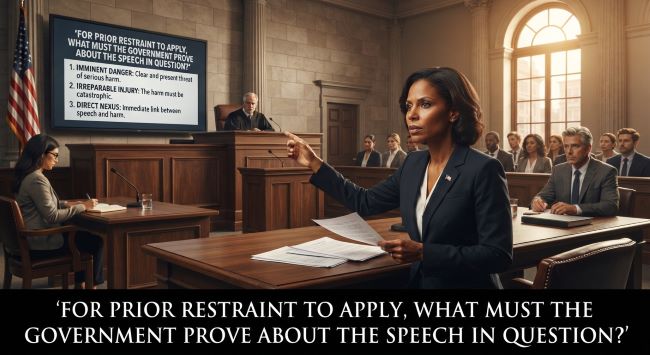
For prior restraint to apply, what must the government prove about the speech in question? The core requirement is that the government must overcome a heavy presumption against the constitutional validity of the restraint.
In practice, courts have required the government to demonstrate that the speech would cause a direct, immediate, and irreparable harm of the most serious kind, that the restraint is necessary to prevent that harm, and that no less restrictive alternative would suffice.
The burden sits entirely with the government, and it is described in the case law as a heavy one. Prior restraints are not categorically forbidden, but they are presumptively unconstitutional, and the government rarely meets the standard.
What Prior Restraint Means
Definition first, since the term is frequently misused.
Prior restraint is government action that prohibits speech or expression before it occurs. Examples include injunctions barring publication, licensing schemes requiring permission to speak or publish, and administrative prohibitions on distributing material.
This is distinct from subsequent punishment, where speech is permitted to occur and consequences follow afterward through defamation liability, criminal prosecution, or other sanctions.
American First Amendment doctrine treats the distinction as fundamental. Subsequent punishment is subject to constitutional limits but is analyzed under ordinary standards. Prior restraint receives the most exacting scrutiny in the field.
The reasoning is that prior restraint prevents ideas from entering public discourse at all, whereas subsequent punishment at least allows the speech to occur and be evaluated.
Near v. Minnesota
The foundational case, decided in 1931.
Minnesota law permitted authorities to enjoin publication of newspapers found to be malicious, scandalous, or defamatory. A publication was shut down under it.
The Supreme Court struck the law down, establishing that prior restraints on publication are presumptively unconstitutional under the First Amendment as applied to the states.
The Court did acknowledge that prior restraint might be permissible in exceptional circumstances, citing examples including obstruction of military recruiting, publication of troop movements and sailing dates in wartime, obscenity, and incitements to violence or forcible overthrow of government.
Those exceptions matter for anyone asking for prior restraint to apply, what must the government prove about the speech in question, because they define the narrow territory where the argument can even be made.
New York Times Co. v. United States
The 1971 Pentagon Papers case is the decision most directly answering the question.
The government sought to enjoin the New York Times and Washington Post from publishing a classified study of United States decision-making in Vietnam, arguing that publication would damage national security.
The Court ruled against the government in a brief per curiam opinion, stating that any system of prior restraints bears a heavy presumption against its constitutional validity, and that the government carries a heavy burden of showing justification for such a restraint.
The government had not met that burden, and publication proceeded.
The case produced multiple separate opinions with justices articulating somewhat different standards, which is why the precise formulation is sometimes debated. What is settled is the presumption against validity and the heavy burden on the government.
Nebraska Press Association v. Stuart
A 1976 decision applying the doctrine in a different context.
A trial judge issued an order restricting press reporting on a criminal case, aiming to protect the defendant’s right to a fair trial. This pitted First Amendment rights against Sixth Amendment fair trial rights.
The Supreme Court struck down the order, holding that the prior restraint had not been justified. The Court considered factors including the nature and extent of pretrial publicity, whether other measures would mitigate the effects, and how effectively the restraining order would actually prevent the harm.
That last point is significant. Courts examine whether the restraint would even work, since a restraint that fails to prevent the harm cannot be justified by it.
The decision also established that alternatives should be considered first, including change of venue, trial postponement, careful jury selection, jury instructions, and sequestration.
The Elements in Practice
Drawing the case law together on for prior restraint to apply, what must the government prove about the speech in question? the elements are these:
| Element | Requirement |
|---|---|
| Nature of harm | Direct, immediate, and irreparable |
| Severity | Grave, of the most serious kind |
| Causation | The speech itself would cause the harm |
| Necessity | The restraint is necessary to prevent it |
| Efficacy | The restraint would actually prevent the harm |
| Alternatives | No less restrictive means would suffice |
| Burden | Rests entirely on the government, and is heavy |
Speculative, indirect, or generalized harm does not suffice. Assertions of national security interest, without more, have been held inadequate.
Recognized Narrow Exceptions
Certain categories have been treated as potentially supporting prior restraint, and they narrow where the question of for prior restraint to apply, what must the government prove about the speech in question? can even be raised. Even these are contested.
Wartime national security of the most immediate kind, with the classic example being publication of troop movements or sailing dates during active conflict.
Obscenity, though this operates through specific procedural requirements and the definition of obscenity is itself narrow.
Incitement to imminent lawless action, subject to the standards developed in incitement doctrine.
Certain commercial contexts, including some regulation of commercial speech, which receives lesser protection.
Court orders protecting specific interests, such as protective orders in litigation over discovery material, which operate somewhat differently from restraints on public reporting.
Even where a category applies, procedural safeguards are generally required, including prompt judicial determination rather than unreviewable administrative discretion.
Licensing and Permitting
An area worth understanding, since it is where prior restraint doctrine most commonly affects ordinary people.
Requirements to obtain permission before speaking, publishing, or assembling constitute prior restraint. Courts have permitted such schemes in limited circumstances, but subject to requirements including:
Narrow, objective, definite standards rather than unbridled official discretion. A scheme allowing an official to grant or deny permission based on unguided judgment is generally unconstitutional.
Content neutrality, meaning the scheme cannot turn on the message being expressed.
Prompt decisions within a specified period.
Judicial review available.
This is why permit requirements for parades and demonstrations can be valid when they regulate time, place, and manner on neutral terms, but not when they let officials refuse permits based on disapproval of the message.
Why the Standard Is So Demanding
The rationale is worth understanding rather than merely noting.
Prior restraint prevents speech from reaching the public at all. Once suppressed, the idea does not enter the marketplace, cannot be evaluated, and cannot be answered. Subsequent punishment at least permits the speech to occur.
Historical experience also shapes the doctrine. English licensing of the press was a specific grievance in the period informing the First Amendment, and the framers were understood to be reacting against that system.
There is also a practical concern about chilling effects. A licensing regime suppresses far more speech than any individual prosecution, because speakers self-censor rather than seek permission.
Common Misunderstandings
Several errors recur when people discuss for prior restraint to apply, what must the government prove about the speech in question?
That prior restraint is absolutely prohibited. It is not. It is presumptively unconstitutional and subject to an extremely demanding standard, which is different.
That it applies to private actors. The First Amendment constrains government. A private publisher declining to publish, or a platform removing content, is not prior restraint in the constitutional sense.
That classification alone justifies restraint. The Pentagon Papers case established that asserting national security is not sufficient without demonstrating the required harm.
That it covers all pre-publication review. Contractual review obligations, such as those some government employees accept, operate differently from generalized restraints.
That the doctrine is identical elsewhere. This is United States constitutional law. Other countries balance these interests differently, and some permit injunctions that would fail in American courts.
A Necessary Caveat
This is a general explanation of a constitutional doctrine, not legal advice.
First Amendment analysis is fact-specific and genuinely complex, the case law contains competing formulations, and application depends on context including the forum, the speaker, the type of speech, and the government interest asserted.
Anyone facing an actual legal question involving publication, injunctions, or restrictions on expression should consult a qualified attorney rather than relying on any general summary.
The bottom line is that for prior restraint to apply, what must the government prove about the speech in question is that it overcomes a heavy presumption against constitutional validity, established in Near v. Minnesota and articulated most directly in New York Times Co. v. United States. The government carries a heavy burden of showing that the speech would cause direct, immediate, and irreparable harm of the gravest kind, that the restraint is necessary and would actually prevent that harm, and that no less restrictive alternative exists. Speculative or generalized harm, including bare assertions of national security interest, does not suffice, and Nebraska Press Association v. Stuart confirmed that courts must consider whether alternatives would address the concern first.
Key Takeaways
- Prior restraint is government action preventing speech before it occurs, rather than punishing it afterward.
- Any system of prior restraint bears a heavy presumption against its constitutional validity.
- The government carries a heavy burden of showing justification, and that burden rests entirely on it.
- The harm must be direct, immediate, and irreparable, not speculative or generalized.
- Near v. Minnesota (1931) established that prior restraints are presumptively unconstitutional.
- New York Times Co. v. United States (1971), the Pentagon Papers case, articulated the heavy presumption directly.
- Bare assertions of national security interest were held insufficient in the Pentagon Papers case.
- Nebraska Press Association v. Stuart (1976) required courts to consider less restrictive alternatives first.
- Courts also examine whether the restraint would actually prevent the harm claimed.
- Narrow exceptions include immediate wartime security, obscenity, and incitement to imminent lawless action.
- Licensing schemes must use narrow objective standards, be content neutral, and allow prompt judicial review.
- The First Amendment constrains government, so private publishers declining content are not imposing prior restraint.