What Is a Double Boiler? Uses, Setup, and Why It Works
Certain ingredients punish direct heat. Chocolate seizes into a grainy mess, egg yolks scramble instead of thickening, and delicate sauces split in seconds. The traditional solution is over a century old and beautifully simple: put a barrier of water between the flame and the food, capping the temperature at a point where nothing can burn. Understanding this piece of equipment, and knowing you can improvise one in about thirty seconds, solves a whole category of kitchen frustrations. Here is a complete guide.
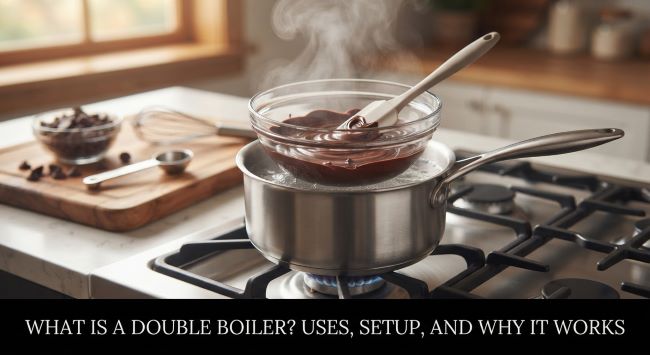
What Is a Double Boiler?
So, what is a double boiler? It is a two-part cooking setup with a lower pot holding simmering water and an upper vessel above it holding the food, which is heated by steam and gentle indirect heat rather than direct burner contact.
The key principle is temperature control. Water boils at 212°F (100°C) at sea level and cannot get hotter while liquid, so the upper vessel never exceeds roughly that. Direct stovetop heat reaches several hundred degrees and scorches delicate ingredients almost instantly. Understanding what is a double boiler comes down to that idea: a device guaranteeing gentle, controlled, indirect heat.
How It Works
The mechanics of what is a double boiler are straightforward:
- The bottom pot holds a shallow amount of water, brought to a simmer.
- The top vessel nests into or over the bottom pot, holding the ingredients.
- Steam and gentle heat warm the upper vessel indirectly.
- The water should not touch the upper bowl in most applications, since steam heat is gentler than direct water contact.
- The seal should not be airtight, allowing steam to escape rather than building pressure.
That fourth point is worth emphasizing, since it is where most people go wrong. If the bottom of the upper bowl sits in the water, you lose much of the gentleness the setup is designed to provide.
What It Is Used For
Knowing the applications answers much of what is a double boiler in practical terms. It is the standard tool for:
Melting chocolate. The most common use by far. Chocolate scorches easily and seizes when overheated, and gentle indirect heat prevents both.
Making custards and curds. Lemon curd and crème anglaise rely on egg yolks thickening without scrambling.
Emulsified sauces. Hollandaise and béarnaise split if too hot, and controlled temperature keeps the emulsion stable.
Melting butter, caramel, and delicate mixtures without separating or burning, and holding sauces at serving temperature.
Tempering chocolate, where precise control determines whether it sets with a proper snap and shine.
Melting wax or making cosmetics, a common non-culinary use.
The common thread is that every one of these involves an ingredient that fails badly when overheated.
How to Improvise One
A useful part of understanding what is a double boiler is knowing you almost certainly need not buy one:
- Choose a saucepan and a heatproof bowl that sits on top of it without falling in, ideally glass or metal.
- Add an inch or two of water to the saucepan, no more.
- Bring the water to a gentle simmer, not a rolling boil.
- Set the bowl on top, checking that its base sits above the water rather than in it.
- Add your ingredients and stir as needed.
- Watch the water level, topping up if it simmers away during longer preparations.
The bowl should rest securely on the pan rim. This improvised version is what most home cooks use, and dedicated equipment is largely unnecessary unless you do this constantly.
Common Mistakes
Several errors undermine the purpose of what is a double boiler:
| Mistake | Why It Matters |
|---|---|
| Water touching the bowl | Heat becomes too direct |
| Boiling rather than simmering | Excess heat defeats the purpose |
| Water splashing into food | Ruins chocolate instantly |
| Sealing the setup airtight | Traps steam and pressure |
| Too much water in the pan | Risks boiling into the bowl |
| Walking away | Delicate mixtures need attention |
The water-in-chocolate problem deserves special mention. Even a tiny amount of water or steam condensation in melting chocolate causes it to seize into a stiff, grainy mass, which is why keeping the setup dry and using a well-fitting bowl matters so much.
When You Do Not Need One
Being honest includes acknowledging alternatives. A microwave melts chocolate well in short bursts at reduced power with stirring between. A heavy-bottomed pan over genuinely low heat with constant stirring handles some tasks. And residual heat, like pouring hot cream over chopped chocolate for ganache, sidesteps the issue entirely. The double boiler earns its place where control matters most: large quantities, egg-based preparations, and tempering.
Choosing a Dedicated Double Boiler
If you use one often enough to justify buying dedicated equipment, look for a snug fit so steam does not escape excessively, and consider capacity, since an oversized upper vessel spreads small quantities too thin. Stainless steel is durable, while glass lets you monitor progress. For most home cooks, though, the improvised saucepan-and-bowl approach covers everything.
The bottom line on what is a double boiler is that it is a simple two-part setup, a pot of simmering water beneath a bowl holding your ingredients, that uses indirect steam heat to keep temperatures gentle and controlled. It exists because chocolate, custards, curds, and emulsified sauces all fail when exposed to direct high heat. You can improvise one in seconds with a saucepan and a heatproof bowl, keeping the water at a simmer, the bowl above the waterline, and everything scrupulously dry, and it will perform exactly as well as dedicated equipment for nearly every home application.
Key Takeaways
- A double boiler is a two-part setup with simmering water below and a bowl holding ingredients above.
- It works because water cannot exceed roughly 212°F while liquid, capping the temperature and preventing scorching.
- The upper vessel should sit above the water, not in it, since steam heat is gentler than direct water contact.
- Common uses include melting chocolate, making custards and curds, and preparing hollandaise and other emulsified sauces.
- It is also used for tempering chocolate, holding sauces at temperature, and non-culinary tasks like melting wax.
- You can improvise one with any saucepan and a heatproof bowl that rests securely on the rim.
- Use only an inch or two of water, keep it at a gentle simmer, and top it up during longer preparations.
- Never let water or steam condensation reach melting chocolate, since even a little causes it to seize.
- Do not seal the setup airtight, since steam needs somewhere to escape.
- Alternatives include microwaving chocolate in short bursts or using residual heat, as when making ganache.