What Is a Telephoto Lens? A Complete Beginner’s Guide
If you have ever wondered how photographers capture close-up shots of distant wildlife, tight action from the sidelines of a game, or beautifully compressed portraits with dreamy blurred backgrounds, the answer often comes down to one piece of gear: the telephoto lens. It is one of the most useful and popular lens types, letting you reach subjects far away and create distinctive looks impossible with standard lenses. But for anyone new to photography, the terminology can be confusing. This guide answers the question clearly and covers everything a beginner needs to know.
What Is a Telephoto Lens?
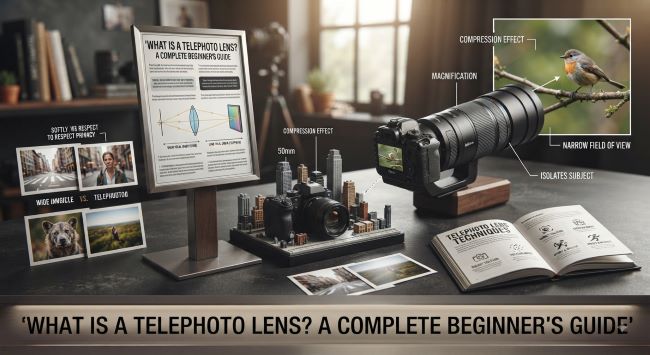
So, what is a telephoto lens? A telephoto lens is a lens with a long focal length that magnifies distant subjects, making them appear closer and larger in your frame. In simple terms, it lets you photograph things that are far away as if you were much closer to them, similar to how a telescope brings distant objects nearer.
Focal length, measured in millimeters, is the key. Lenses with longer focal lengths (generally around 70mm and up, with true telephoto often considered 100mm, 200mm, 300mm, and beyond) are telephoto lenses. The longer the focal length, the more magnification and the narrower the field of view. Understanding what is a telephoto lens really comes down to understanding that it magnifies distant subjects through its long focal length.
How Telephoto Lenses Work
To fully grasp how it works, it helps to understand the basics. A telephoto lens has a long focal length, which produces two main effects:
- Magnification, making distant subjects appear larger and closer.
- A narrow field of view, showing a smaller, more zoomed-in slice of the scene.
This is the opposite of a wide-angle lens, which has a short focal length and captures a broad view. A telephoto lens narrows in on a small part of the scene and enlarges it, which is why it excels at reaching distant subjects.
What Telephoto Lenses Are Used For
Knowing the uses answers much of the practical picture. These lenses excel at several types of photography:
- Wildlife photography, getting close-up shots of animals from a safe distance without disturbing them.
- Sports and action, capturing athletes from the sidelines or stands.
- Portraits, since telephoto focal lengths produce flattering perspective and beautiful background blur.
- Nature and birds, reaching distant subjects.
- Events, photographing from a distance without intruding.
- Detail and compression shots, isolating subjects and compressing backgrounds for creative effect.
This versatility for reaching distant subjects and creating distinctive looks is why understanding what is a telephoto lens matters for so many photographers.
The Unique Look of Telephoto Lenses
Beyond reach, these lenses create distinctive visual characteristics:
Background blur (bokeh). Telephoto lenses can produce beautifully blurred backgrounds that make subjects stand out, prized for portraits.
Compression. Telephoto lenses compress the perceived distance between near and far elements, making backgrounds appear closer and larger relative to the subject. This creates a distinctive, often flattering look.
Subject isolation. The narrow field of view and blur help isolate a subject from a busy background, drawing the eye to it.
These qualities give telephoto images a distinctive character that is part of the appeal, separate from the pure reach.
The Pros and Cons
A balanced view of what is a telephoto lens includes both strengths and limitations:
| Pros | Cons |
|---|---|
| Reaches distant subjects | Often larger and heavier |
| Beautiful background blur | More prone to camera shake |
| Flattering for portraits | Can be more expensive |
| Great subject isolation | Narrower field of view limits use |
| Compression effect | May need more light or higher ISO |
The main tradeoffs of a telephoto lens are size, weight, and susceptibility to camera shake, since the magnification also magnifies any movement. This makes stability important, a point worth remembering when shooting with these lenses.
Types of Telephoto Lenses
Understanding what is a telephoto lens includes knowing the main types. There are prime telephoto lenses (a single fixed focal length, often sharper and with wider apertures) and zoom telephoto lenses (a range of focal lengths, offering flexibility). There are also short telephoto lenses (around 70-100mm, great for portraits), medium telephoto, and super-telephoto lenses (300mm and beyond, for distant wildlife and sports). Choosing among them depends on your subjects and budget.
Dealing With Camera Shake
One important practical aspect of what is a telephoto lens is that the magnification makes camera shake much more noticeable, since any small movement is amplified along with the image. This is why sharp telephoto shots often require good stability, whether from a fast shutter speed, image stabilization, a tripod, or steady technique. For anyone struggling with blur from shaky hands, especially at telephoto focal lengths, the guidance in How to Fix Shaky Hands Photography offers a complete guide to getting sharp, blur-free photos, which is especially relevant with telephoto lenses since their magnification makes camera shake more of a challenge, so mastering stability techniques directly improves your telephoto photography results.
The bottom line on what is a telephoto lens is that it is a long-focal-length lens that magnifies distant subjects, letting you photograph faraway things as if you were closer while also creating beautiful background blur, subject isolation, and a distinctive compression effect. It excels at wildlife, sports, portraits, and any situation where reach or that distinctive look matters. Just remember that its magnification also amplifies camera shake, so stability is key. Understanding these fundamentals helps you decide whether a telephoto lens is right for your photography and how to get the most from one.
Key Takeaways
- A telephoto lens has a long focal length that magnifies distant subjects, making them appear closer and larger.
- Longer focal lengths (roughly 70mm and up, with true telephoto often 100mm to 300mm and beyond) mean more magnification and a narrower field of view.
- It works oppositely to a wide-angle lens, narrowing in on a small part of the scene and enlarging it.
- Telephoto lenses excel at wildlife, sports, portraits, nature, events, and distant or detail-focused shots.
- They create beautiful background blur, a flattering compression effect, and strong subject isolation.
- Tradeoffs include larger size and weight, higher cost, a narrow field of view, and susceptibility to camera shake.
- Types include prime and zoom telephotos, plus short, medium, and super-telephoto ranges for different subjects.
- Because magnification amplifies shake, stability through fast shutter speeds, stabilization, or a tripod is important.