How to Cut Your Own Hair: A Realistic Step-by-Step Guide
Cutting your own hair at home is a genuinely useful skill for basic maintenance between salon visits, though it’s worth setting realistic expectations from the start: this guide focuses on achievable, lower-risk techniques like trims and basic shaping rather than promising salon-quality dramatic transformations, since the latter genuinely requires professional training and experience that’s difficult to replicate safely at home regardless of how carefully you follow instructions.
Tools You’ll Need
Sharp hair-cutting shears, specifically designed for cutting hair rather than regular household scissors, since proper hair shears are sharper and produce cleaner cuts that don’t fray or split hair ends the way dull or improperly designed scissors tend to.
A wide-tooth comb and a fine-tooth comb, used for different stages of sectioning and detail work throughout the cutting process.
Hair clips or sectioning clips, for separating and securing portions of hair you’re not actively working on, helping you maintain organized, controlled sections rather than working with your entire head of hair loose and unmanaged simultaneously.
A handheld mirror, used in combination with a larger wall mirror to check the back and sides of your cut from angles you can’t directly see, an essential tool specifically for solo home haircutting.
A spray bottle with water, since cutting hair while damp (though not soaking wet) generally produces more controlled, predictable results than cutting completely dry hair.
Basic Trim Technique (Maintaining Length, Removing Split Ends)
This is the safest, most forgiving home haircutting technique, well suited to maintaining your current style and length while simply removing split ends and refreshing your overall shape.
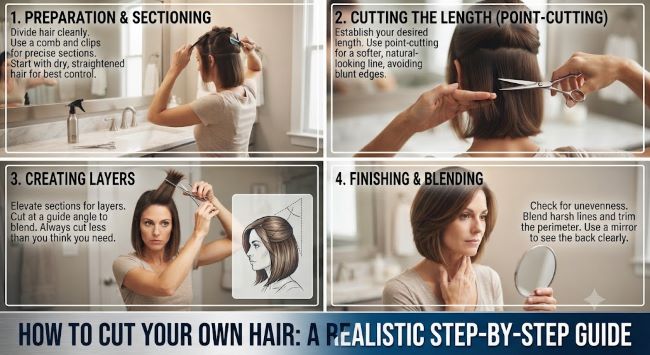
Step 1: Section your hair into manageable portions using clips, generally separating into top, sides, and back sections.
Step 2: Working with damp hair, take a small section and comb it straight down or to its natural fall direction.
Step 3: Determine how much length you genuinely want to remove, generally starting conservative with a smaller amount than you think you need, since you can always trim more but can’t undo cutting too much.
Step 4: Hold the section between two fingers at your desired length point, then cut straight across just below your fingers, maintaining a consistent angle across the section.
Step 5: Move to the next section, using your already-cut section as a length reference to maintain overall consistency across your full head.
Step 6: Continue methodically through all sections, regularly stepping back to check overall balance and symmetry, particularly comparing left and right sides for even length.
Cutting Bangs (Higher Risk, More Caution Needed)
Bangs are genuinely one of the more commonly attempted but higher-risk home cuts, since mistakes here are highly visible and can’t easily be hidden or grown out quickly if something goes wrong.
Step 1: Section off only the hair you actually want as bangs, using the front hairline and the natural part as guides, keeping the section relatively narrow rather than including more hair than you actually intend for the bang area.
Step 2: Comb the sectioned hair down flat, ensuring it’s properly damp but not dripping wet.
Step 3: Start significantly longer than you think you want your final bangs to be, since hair shrinks somewhat as it dries (particularly for curly or wavy hair types, where this shrinkage effect is meaningfully more pronounced) and you can always trim shorter but genuinely cannot undo cutting too short.
Step 4: Cut in small, incremental sections rather than one single decisive cut across the full bang width, checking the result after each small cut before continuing further.
Step 5: For a softer, more blended edge rather than a harsh blunt line, hold the scissors at a slight angle (point-cutting technique) rather than cutting completely straight across.
Step 6: Let the bangs dry fully before making any final adjustment trims, since wet hair length can be genuinely deceptive and what looks correct while damp sometimes looks notably different once fully dry.
Common Mistakes to Avoid
Cutting too much length at once. This is the single most common and most consequential home haircutting mistake, since hair obviously cannot be un-cut once removed. Starting with smaller, more conservative cuts and gradually trimming additional length if needed is always the safer, more forgiving approach compared to cutting your full intended amount in one decisive action.
Cutting dry hair for length-focused trims. While bangs and detail work sometimes benefit from final dry adjustments as noted above, overall length trims are generally more controlled and predictable when hair is damp rather than fully dry.
Not using sharp, proper hair-cutting shears. Regular household scissors or dull shears genuinely produce different, generally worse results (split, frayed ends rather than clean cuts) compared to proper sharp hair shears, making this a worthwhile small investment if you plan to cut your own hair with any regularity.
Attempting dramatic style changes or complex layering without experience. While basic trims and simple bang cuts are genuinely achievable for most people with reasonable care and the right tools, more complex techniques (significant layering, dramatically different styles, color-related cutting decisions) carry meaningfully higher risk of an outcome you’re unhappy with, and are generally better left to a professional stylist, particularly your first few attempts at home cutting.
Rushing the process. Home haircutting genuinely benefits from patience, frequent checking from multiple angles, and a willingness to take breaks and reassess rather than rushing through the entire process in one continuous, hurried session.
When to Leave It to a Professional
Significant length reduction or dramatic style changes genuinely benefit from professional expertise, both for technique reasons and because a stylist can offer informed guidance on what will actually suit your specific face shape and hair type, beyond just the technical cutting execution itself.
Complex layering or texturizing techniques require training and experience to execute well, and attempting these specific techniques at home carries meaningfully higher risk of an uneven, unintentional-looking result compared to the more forgiving basic trim and bang techniques covered above.
Color-related services (highlights, full color, color correction) are generally entirely outside the scope of safe, reasonable at-home attempts for most people, given the genuine chemical and technical complexity involved, and mistakes here are both highly visible and often considerably more difficult and expensive to correct than a haircutting mistake would be.
For other quick at-home hair routine tips that pair well with basic home haircutting maintenance, how to make your hair not look greasy in 5 minutes covers another practical, fast solution worth knowing for your overall hair care routine between salon visits and home maintenance sessions.
Key Takeaways
- Basic trims (maintaining length, removing split ends) and simple bang cuts are the most achievable, lower-risk home haircutting techniques, while dramatic style changes and complex layering carry meaningfully higher risk
- Use proper sharp hair-cutting shears rather than regular household scissors, since this genuinely affects cut quality and end appearance
- Cut hair while damp (not soaking wet) for overall length trims, and always start with smaller, more conservative cuts since hair can’t be un-cut once removed
- When cutting bangs specifically, start longer than your intended final length to account for shrinkage as hair dries, cut in small incremental sections, and let hair fully dry before any final adjustment trims
- Avoid common mistakes including cutting too much length at once, rushing through the process without frequent angle checks, and attempting complex techniques beyond basic trims without experience
- Leave significant style changes, complex layering, and any color-related services to a professional stylist, since both technical risk and difficulty of correction are meaningfully higher for these more advanced services