Tortoiseshell Cat: A Complete Guide to This Striking Coat Pattern
Tortoiseshell cats, often affectionately nicknamed “torties,” are instantly recognizable by their distinctive mottled coat pattern combining patches of orange/red and black (or their diluted variations, cream and blue/gray) in a uniquely random, brindled distribution that makes virtually every individual tortoiseshell cat’s coat pattern genuinely one-of-a-kind. Understanding the genetics behind this striking coloring, the personality reputation associated with the pattern, and what to know about tortoiseshell cats specifically helps you appreciate or care for one of the more visually distinctive members of the domestic cat world.
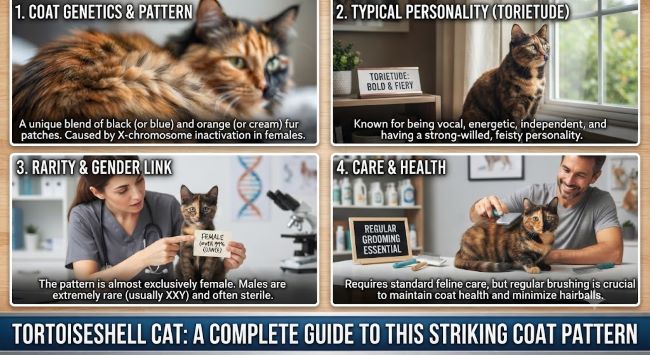
The Genetics Behind Tortoiseshell Coloring
Tortoiseshell coloring is fundamentally a genetic phenomenon tied to the X chromosome, which is why understanding the pattern requires a brief look at the underlying biology. The gene responsible for orange versus black/non-orange coat coloring in cats is located on the X chromosome, and because female cats have two X chromosomes while males have only one X and one Y chromosome, female cats have the genetic opportunity to express both orange and black coloring simultaneously through a process called X-inactivation, where different cells throughout the developing cat’s body randomly “turn off” one or the other X chromosome, creating the patchy, mottled distribution of both colors that defines the tortoiseshell pattern.
This genetic mechanism is the reason tortoiseshell cats are overwhelmingly female — estimates suggest roughly 1 in 3,000 tortoiseshell cats is male, and male tortoiseshells that do occur typically have an unusual chromosomal configuration (most commonly an extra X chromosome, resulting in an XXY configuration rather than the typical male XY), which often comes along with infertility in these rare male tortoiseshell individuals specifically.
Tortoiseshell vs. Calico: Understanding the Difference
These two patterns are frequently confused, and the distinction is worth understanding clearly. True tortoiseshell cats have orange and black (or their dilute cream and blue/gray equivalents) intermixed and brindled together throughout their coat without significant white. Calico cats share the same underlying orange/black genetic mechanism but additionally carry a separate white spotting gene, which creates larger, more distinctly separated patches of color against a white base coat, producing the more blocky, patchy three-color appearance associated with calico cats specifically, as opposed to the more finely intermixed, brindled pattern that characterizes true tortoiseshell coloring without significant white patches.
Coat Pattern Variations Within Tortoiseshell Cats
Standard tortoiseshell. The classic orange and black brindled combination described above.
Dilute tortoiseshell. A genetically diluted version of the same pattern, producing softer cream and blue/gray coloring rather than the more vivid orange and black of standard tortoiseshell cats.
Tortoiseshell point. Found in pointed breeds like Siamese, where the tortoiseshell pattern appears specifically in the breed’s characteristic point coloring (face, ears, paws, tail) rather than across the full body coat.
Patched tabby (torbie). A combination of tortoiseshell coloring with tabby striping or patterning overlaid, producing a particularly visually complex coat combining both the brindled tortoiseshell base coloring and visible tabby markings within the patches.
The “Tortitude” Personality Reputation
Tortoiseshell cats have developed a widespread informal reputation among cat owners and breeders for having a particularly strong, sometimes feisty or independent personality, often affectionately referred to as “tortitude” within cat-owning communities. While this reputation is genuinely widespread and consistently reported anecdotally across many tortoiseshell owners, it’s worth noting that this isn’t a scientifically established or formally researched personality trait directly tied to coat coloring genetics in the way the coloring itself has clear genetic mechanisms — rather, it represents a strong pattern of anecdotal owner experience and cultural belief within the cat-owning community that, regardless of its precise scientific basis, has become a genuinely persistent and widely shared characterization specifically associated with this coat pattern.
Some informal research and surveys conducted on this specific topic have found correlational patterns supporting at least some basis for the broader reputation, though establishing definitive causation between coat coloring genetics specifically and personality traits remains an area without the kind of rigorous, established scientific consensus that exists for the coloring genetics themselves.
Breed Associations
Tortoiseshell coloring isn’t a specific breed in itself, but rather a coat pattern that can appear across numerous different cat breeds, including domestic shorthairs and longhairs (where it’s particularly common), along with appearing in various purebred breeds including Persians, Maine Coons, British Shorthairs, and Cornish Rex cats, among others, since the underlying genetic mechanism producing tortoiseshell coloring isn’t tied to any single specific breed’s genetic lineage.
Care Considerations
From a practical care standpoint, tortoiseshell cats don’t require meaningfully different care compared to cats of other coat colors and patterns, since the coloring itself is purely a coat pigmentation characteristic without associated health implications specific to the pattern itself. Standard cat care considerations — appropriate diet suited to their age and activity level, regular veterinary checkups, dental care, and appropriate environmental enrichment — apply to tortoiseshell cats the same as they would to any other cat, regardless of coat pattern.
Given the strong, sometimes more independent personality reputation associated with the pattern, prospective tortoiseshell owners may want to research this anecdotal characteristic specifically when considering adoption, though it’s worth remembering that individual cat personality varies enormously regardless of coat pattern, and any specific tortoiseshell cat’s actual temperament will depend on their individual genetics, early socialization experiences, and environment far more than coat coloring alone.
For broader context on selecting and caring for a cat with specific nutritional needs that complement their individual characteristics and activity level, Acana highest protein indoor dry cat food covers a detailed look at a specific premium cat food option worth considering as part of your broader care planning for any indoor cat, tortoiseshell or otherwise.
Key Takeaways
- Tortoiseshell coloring results from a genetic mechanism tied to the X chromosome, where female cats’ two X chromosomes allow simultaneous expression of both orange and black coloring through random X-inactivation across different cells during development
- This genetic mechanism makes tortoiseshell cats overwhelmingly female, with male tortoiseshells occurring in roughly 1 in 3,000 cases, typically associated with an unusual XXY chromosomal configuration and often accompanying infertility
- Tortoiseshell differs from calico specifically through the absence of a separate white spotting gene: true tortoiseshell shows intermixed, brindled orange and black coloring without significant white, while calico adds distinct white patches to the same underlying color pattern
- Variations include standard tortoiseshell, dilute tortoiseshell (cream and blue/gray), tortoiseshell point in pointed breeds, and torbie (tortoiseshell combined with tabby patterning)
- The “tortitude” personality reputation is widely and consistently reported anecdotally among owners, though it lacks the same rigorous scientific establishment as the genetics behind the coloring itself
- Tortoiseshell coloring appears across many different breeds rather than constituting its own breed, and doesn’t carry any coat-pattern-specific health or care implications beyond standard cat care considerations