Scottish Fold: Breed Guide, Personality, and Health Realities
The folded ears made the Scottish Fold famous, and they are the most important thing to understand before bringing one home. Everything traces to a single genetic mutation: the owl-like face, the internet fame, and health realities responsible owners take seriously. This guide covers the breed honestly: where it came from, what living with one is actually like, and the medical picture that anyone considering the breed deserves to know upfront.
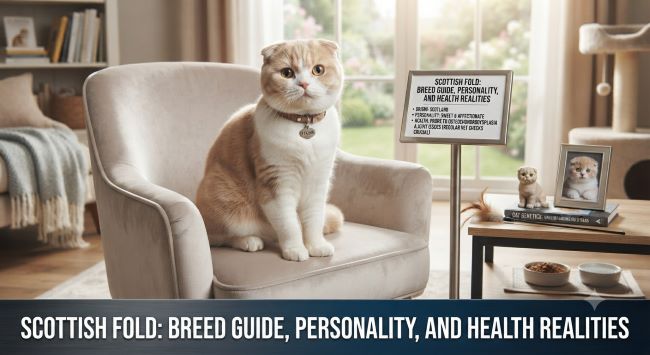
Origins and the Folded Ear
The breed traces to a single cat named Susie, a white barn cat with unusual folded ears discovered on a farm in Scotland in 1961. A local shepherd noticed her, and selective breeding from her descendants produced the breed we know today.
The fold comes from a dominant genetic mutation affecting cartilage throughout the body, not just the ears. The cartilage does not develop with normal firmness, which causes the ear to fold forward and down. Kittens are born with straight ears, and the fold appears (in cats that inherit it) around three to four weeks of age.
Not every kitten in a litter has folded ears. Those with straight ears are called Scottish Straights, share the same temperament and appearance otherwise, and are essential to responsible breeding programs.
Appearance and Types
Scottish Folds are medium-sized cats, typically 6 to 13 pounds, with round heads, large round eyes, and short necks that create the distinctive owl-like look.
Ear fold varies in degree:
- Single fold: ears bend forward slightly
- Double fold: ears fold more tightly against the head
- Triple fold: ears press flat against the skull, the most dramatic version
Coat length varies too. Short-haired Scottish Folds are the classic version, while long-haired ones (sometimes called Highland Folds) carry a plush, flowing coat. Colors and patterns span nearly the full feline range.
Temperament: What Living With One Is Like
The personality is the reason the breed keeps winning people over:
- Affectionate without being demanding. Scottish Folds want to be near their people, often following them room to room, but they are not typically loud or clingy.
- Calm and adaptable. They handle household changes, apartment living, and new routines better than many breeds.
- Playful into adulthood. They keep kitten-like interest in toys and games longer than average.
- Quiet. Their vocalizations tend to be soft chirps and trills rather than loud meowing.
- Good with families and other pets. Generally tolerant of children, dogs, and other cats when introduced properly.
- The famous sitting posture. Many sit upright on their haunches in what owners call the “Buddha position,” which is charming and also, in some cases, a posture cats adopt for joint comfort.
They are not lap-glued cats for everyone, and individual personality varies, but the breed’s reputation for easygoing companionship is well earned.
The Health Reality Every Owner Should Know
This section matters more than any other in a Scottish Fold guide, and glossing over it does prospective owners no favors.
The same cartilage mutation that folds the ears affects cartilage throughout the body, and it is associated with osteochondrodysplasia, a developmental abnormality of bone and cartilage. In affected cats, this can cause painful arthritis, particularly in the tail, ankles, and knees, sometimes appearing early in life.
The severity varies. Cats with two copies of the gene (from breeding two folded-ear parents) are affected far more severely and reliably, which is why responsible breeding pairs a folded-ear cat only with a straight-eared cat, never fold-to-fold. Even so, cats with one copy can develop joint issues.
Because of this, some veterinary bodies and breed registries in various countries have restricted or discouraged breeding the folded-ear trait, and the ethical debate around the breed is genuine and ongoing.
What this means practically:
- Buy only from breeders who never pair fold to fold and who provide health documentation on the parents.
- Watch for signs of joint pain: reluctance to jump, stiff gait, a thickened or inflexible tail, and reduced activity.
- Establish veterinary care early with a vet familiar with the breed, and discuss joint monitoring.
- Consider adoption. Scottish Folds and Fold mixes appear in rescues, and adopting means supporting a cat rather than the breeding of the trait.
Other health considerations common to the breed include polycystic kidney disease and hypertrophic cardiomyopathy, both worth screening for. Typical lifespan runs 11 to 15 years with good care.
None of this is a reason to dislike the cats themselves, which are wonderful companions. It is a reason to buy carefully, monitor attentively, and work with a veterinarian throughout the cat’s life.
Care and Daily Life
Grooming. Short-haired Folds need weekly brushing; long-haired versions need brushing several times a week to prevent mats. The ears require specific attention: the fold reduces air circulation, so check and gently clean them weekly for wax buildup or signs of infection.
Exercise and enrichment. Interactive play sessions, puzzle feeders, and climbing options keep them healthy. For cats showing joint sensitivity, low-height platforms and ramps beat tall cat trees.
Nutrition. Indoor cats need calorie management to avoid weight gain, which is doubly important for a breed prone to joint issues, since extra weight loads already-vulnerable joints. High-protein indoor formulas suit the breed’s needs well, and comparing options like Acana Highest Protein Indoor Dry Cat Food against your vet’s guidance is a reasonable starting point for building an indoor feeding plan.
Environment. They adapt well to apartments and indoor-only living, which is the safest arrangement for the breed given joint considerations.
Is a Scottish Fold Right for You?
The honest summary: this is a gentle, quiet, adaptable, deeply affectionate cat with a distinctive look and a genuine health burden attached to the trait that makes it distinctive. Anyone considering one should buy only from breeders following fold-to-straight practices, budget for potential joint care, commit to veterinary monitoring, and seriously consider adopting a Fold or Fold mix in need of a home. Approached that way, the breed rewards its owners with one of the easiest and most companionable cats in the domestic feline world.
Key Takeaways
- The Scottish Fold traces to a single Scottish barn cat named Susie in 1961; folded ears come from a dominant cartilage mutation.
- Kittens are born straight-eared, with the fold appearing at three to four weeks in cats carrying the gene; straight-eared littermates are Scottish Straights.
- Temperament is calm, quiet, affectionate, playful into adulthood, and generally good with children and other pets.
- The cartilage mutation is associated with osteochondrodysplasia, which can cause painful arthritis, especially in tail, ankles, and knees.
- Fold-to-fold breeding produces far more severe disease; buy only from breeders pairing fold with straight, and request health documentation.
- Watch for reluctance to jump, stiff gait, and a thickened tail as early signs of joint problems, and establish vet care early.
- Clean the folded ears weekly, since reduced airflow raises infection and wax buildup risk.
- Manage weight carefully with high-protein indoor nutrition, since extra pounds load already-vulnerable joints; typical lifespan is 11-15 years.