How to Fix Slow Cooker Recipes: Solving the Most Common Problems
Slow cookers promise convenience — dump ingredients in, walk away, come home to dinner — but the reality of slow cooker cooking involves more nuance than the appliance’s marketing suggests. Watery sauces, bland flavor, overcooked vegetables, or undercooked meat are all common frustrations that lead people to abandon their slow cooker after a few disappointing results. The good news is that nearly every common slow cooker problem has a specific, fixable cause once you understand what’s actually happening inside the appliance during the long cooking process.
Problem: Watery or Thin Sauces and Liquids
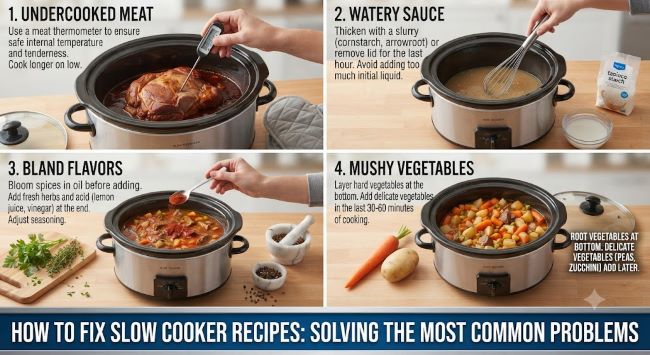
This is probably the single most common slow cooker complaint, and it happens because slow cookers, unlike stovetop cooking, don’t allow liquid to evaporate during cooking since the lid stays sealed throughout. Any liquid you add at the start, plus the liquid released from meat and vegetables as they cook down, stays in the pot the entire time rather than reducing.
How to fix it: Use less liquid than a traditional stovetop or oven recipe would call for, since you’re not accounting for evaporation loss. As a general rule, reduce the liquid in a converted recipe by about a third to half compared to what a non-slow-cooker version would specify. If you’ve already made a batch that turned out too thin, remove the lid for the final 30-60 minutes of cooking time to allow some evaporation, or thicken the sauce directly with a cornstarch slurry (cornstarch mixed with cold water, stirred in during the final 30 minutes) or by removing some liquid and reducing it separately on the stovetop before returning it to the pot.
Problem: Bland or Flat-Tasting Food
Slow cooking can mute and flatten flavors compared to high-heat cooking methods, partly because the low, consistent heat doesn’t create the same browning and caramelization (the Maillard reaction) that develops deep flavor in stovetop or oven cooking, and partly because flavors that would concentrate through evaporation in other methods instead stay diluted in the retained liquid discussed above.
How to fix it: Brown meat in a separate pan before adding it to the slow cooker whenever your schedule allows for this extra step — this single change makes a significant flavor difference by developing the caramelized exterior that slow cooking alone can’t replicate. Season more assertively than you might for stovetop cooking, since flavors mute somewhat over the long cooking time, and taste and adjust seasoning toward the end of cooking rather than relying entirely on your initial seasoning to carry through eight hours of cooking. Add fresh herbs, citrus, or other bright finishing touches in the final 15-30 minutes rather than at the start, since delicate flavors can cook out entirely over a long cooking period if added too early.
Problem: Overcooked, Mushy Vegetables
Vegetables, particularly softer ones like zucchini, mushrooms, and leafy greens, can completely break down and turn mushy if added at the start of a long cooking cycle alongside meat that needs the full cooking time.
How to fix it: Add delicate vegetables in the final 30-60 minutes of cooking rather than at the start, reserving only the most sturdy, dense vegetables (carrots, potatoes, turnips) for the full cooking duration. This requires a bit more attention than the fully hands-off “dump and walk away” approach, but produces a significantly better final texture across all the components of the dish.
Problem: Undercooked or Tough Meat
This typically happens for one of two opposite reasons: either the cooking time was too short for the specific cut of meat, or the temperature setting didn’t match what that cut actually needed.
How to fix it: Tougher, well-marbled cuts (chuck roast, pork shoulder, brisket) actually need the long, low cooking time to break down connective tissue into tender, flavorful results — these cuts can be difficult to overcook on low heat and generally benefit from the full 7-8 hour low setting. Leaner cuts (chicken breast, pork loin) cook faster and can become tough and dry if left too long, since they lack the connective tissue and fat that benefits from extended cooking; these are better suited to shorter cooking windows or the high setting for a shorter duration. If meat consistently comes out tough despite adequate cooking time, you may be using a cut better suited to quick cooking methods than slow cooking — chuck roast, not a leaner cut, is generally the better choice for slow cooker beef recipes specifically because of this connective tissue consideration.
Problem: Food on Top Cooks Differently Than Food on the Bottom
Heat distribution in a slow cooker isn’t perfectly even, with the bottom and sides (closest to the heating element) generally cooking faster than the center and top of a full pot.
How to fix it: Layer ingredients with this in mind — denser items that take longer to cook (root vegetables, larger cuts of meat) generally do well at the bottom, while items needing less cooking time go toward the top, added later if your schedule allows. Stirring partway through cooking, if you’re able to check on the dish, also helps redistribute heat and ensures more even cooking throughout.
Problem: Recipe Times Don’t Match Your Specific Slow Cooker
Not all slow cookers cook at the same actual temperature despite having the same “low” and “high” labeled settings, since models vary by manufacturer, age, and wattage. A recipe written for one slow cooker model may produce different results in yours.
How to fix it: The first time you make a new recipe in your specific slow cooker, check on it periodically rather than trusting the stated time blindly, and take notes on how your particular appliance performs relative to recipe instructions. Over time, you’ll develop a sense of whether your slow cooker tends to run hot or cool relative to standard recipe expectations, letting you adjust future recipes accordingly without repeated trial and error.
Problem: Dairy-Based Recipes Curdling or Separating
Dairy products like milk, cream, and some cheeses can curdle or separate when exposed to the long, sustained heat of slow cooking, producing an unappetizing grainy or separated texture.
How to fix it: Add dairy ingredients toward the very end of cooking, generally in the final 15-30 minutes, rather than including them with the initial ingredients at the start of the cooking cycle. This is a near-universal rule for slow cooker recipes involving cream, milk, sour cream, or soft cheeses.
General Tips for Better Slow Cooker Results
Resist lifting the lid frequently during cooking, since each time you do, the appliance loses significant heat that takes considerable time to recover, meaningfully extending your actual cooking time beyond what the recipe specifies. Cut ingredients into relatively uniform sizes so they cook at a consistent rate rather than ending up with some pieces overcooked and others undercooked. Don’t overfill the slow cooker beyond about two-thirds to three-quarters full, since overfilling affects both cooking time and heat distribution throughout the pot.
For broader food preparation and budgeting strategies that work well alongside efficient slow cooker meal planning, how to reduce food spending covers practical approaches to grocery shopping and meal prep that pair naturally with slow cooker cooking, since slow cooker recipes are often a genuinely cost-effective way to use less expensive cuts of meat and bulk ingredients efficiently.
Key Takeaways
- Watery sauces happen because slow cookers don’t allow evaporation: reduce liquid by a third to half compared to stovetop recipes, or thicken with a cornstarch slurry near the end of cooking
- Bland flavor results from the lack of high-heat browning and flavor dilution from retained liquid: brown meat separately first, season more assertively, and add fresh herbs or bright finishing touches near the end rather than at the start
- Delicate vegetables turn mushy if added at the start of a long cooking cycle: add them in the final 30-60 minutes while reserving only sturdy vegetables like carrots and potatoes for the full cooking time
- Tougher, well-marbled cuts (chuck roast, pork shoulder) actually benefit from long slow cooking; leaner cuts (chicken breast, pork loin) become tough if cooked too long and need shorter cooking windows
- Dairy ingredients should always be added in the final 15-30 minutes of cooking, since extended heat exposure causes curdling and separation
- Every slow cooker model runs slightly differently despite identical labeled settings: check new recipes periodically the first time you make them in your specific appliance to calibrate expectations
- Avoid lifting the lid frequently during cooking, since each instance causes significant heat loss that meaningfully extends actual cooking time beyond the recipe’s stated duration