How to Get Rid of Smile Lines: What Works and What Doesn’t
Smile lines, also called nasolabial folds, are the creases that run from the sides of the nose down toward the corners of the mouth. They’re one of the first visible signs of facial aging that people notice and want to address. The challenge is that the beauty and skincare market is full of products claiming to eliminate them while the science behind most of those claims is thin at best. This guide covers what actually causes smile lines, which approaches genuinely help, what realistic expectations look like, and which professional treatments deliver real results.
What Causes Smile Lines
Understanding the cause determines which solutions actually make sense. Smile lines develop from a combination of factors:
Volume loss. As you age, the fat pads in the midface shrink and descend. This loss of volume in the cheeks creates a shadow and fold at the nasolabial area because the skin above it no longer has the same support structure. This is a structural issue, not just a skin surface one, which is why topical creams have a fundamental limitation when it comes to addressing it.
Collagen and elastin decline. Collagen gives skin its firmness and elastin allows it to snap back. Both decline with age. Skin that’s lost collagen and elastin doesn’t bounce back the way it did in youth, and repeated facial movements (smiling, talking, eating) create permanent creases over time.
Repeated muscle movement. Every time you smile, the muscles around your mouth contract and fold the skin. Over thousands of repetitions across years, this creates a persistent crease.
Sun damage. UV exposure accelerates collagen breakdown and damages skin structure. People with significant cumulative sun exposure tend to develop more pronounced smile lines earlier.
Genetics and lifestyle. Genetics determine how quickly you lose facial volume and collagen. Smoking, poor sleep, dehydration, and high sugar intake all accelerate the structural changes that contribute to smile lines.
What Doesn’t Work (and Why)
Before covering what helps, it’s worth being clear about the limitations of what the market sells most aggressively.
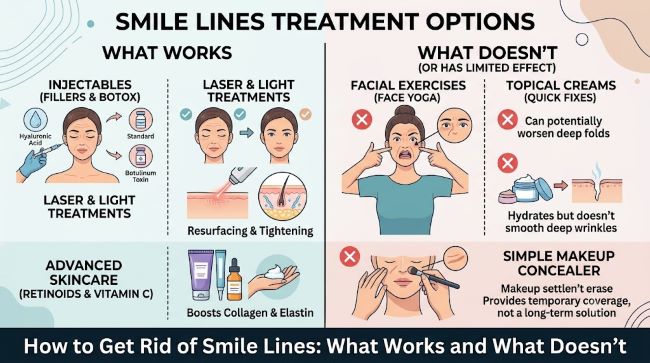
Facial exercises. The theory that exercising facial muscles reduces wrinkles sounds logical but doesn’t hold up well in practice. The muscles around the nasolabial fold are already among the most exercised in the face: they contract every time you smile or speak. More movement doesn’t reduce the crease; it tends to deepen it over time.
Most topical creams marketed as wrinkle erasers. A cream cannot restore lost facial fat volume, rebuild collagen that’s already been lost to the degree that would noticeably lift a nasolabial fold, or undo sun damage. Ingredients like retinol can genuinely improve skin texture and support collagen synthesis over time, but they address surface quality, not structural volume loss.
Gua sha and facial massage. Temporarily increases circulation and may reduce puffiness, but does not meaningfully address the structural causes of smile lines. The temporary appearance change after massage is real; the lasting structural effect is not.
What Actually Helps: Skincare
Within the realistic scope of topical skincare, a few ingredients have genuine evidence behind them:
Retinoids (retinol, tretinoin). Retinoids are the most evidence-backed topical ingredient for skin aging. They stimulate collagen synthesis, accelerate cell turnover, and improve skin texture over time. A prescription-strength tretinoin cream used consistently produces measurable improvements in skin quality, though it will not eliminate a deep nasolabial fold. Over-the-counter retinol is less potent but still beneficial with regular use.
Sunscreen. Prevention matters more than cure. Daily broad-spectrum SPF 30 or higher prevents further UV-driven collagen breakdown, which is the single most impactful thing you can do to slow the progression of smile lines and all other forms of sun-related skin aging. This applies year-round, not just in summer.
Vitamin C serum. Supports collagen synthesis and provides antioxidant protection. Most effective when used in the morning before sunscreen. Stable formulations (L-ascorbic acid at 10-20% concentration or ascorbyl glucoside) are most likely to deliver results.
Hyaluronic acid moisturizer. Hydration doesn’t remove smile lines but plumped, well-hydrated skin makes them less visible. Consistent use of a good moisturizer is supportive even if it’s not transformative.
What Actually Works: Professional Treatments
For people who want to meaningfully reduce the appearance of smile lines rather than just improve the surrounding skin quality, professional treatments are where the results live.
Dermal fillers. Hyaluronic acid filler injected into the nasolabial fold or into the cheeks to restore midface volume is the most effective non-surgical approach for how to get rid of smile lines. Volume restoration in the cheeks lifts the fold from above. Direct fold injection softens the crease itself. Results are immediate, last twelve to eighteen months depending on the product and metabolism, and are reversible if you’re unhappy with the outcome (hyaluronidase dissolves HA filler). This is performed by dermatologists, plastic surgeons, and trained aesthetic nurses.
Botox and neuromodulators. More effective for dynamic wrinkles (forehead lines, crow’s feet) caused by muscle movement than for the nasolabial fold, which is primarily structural. Some injectors use small amounts of neuromodulator to relax muscles around the fold as a complementary treatment, but it’s not typically the primary approach for smile lines specifically.
Laser resurfacing. Fractional CO2 or erbium laser treatments stimulate significant collagen remodeling and improve skin texture and tightness. They don’t address volume loss but improve the quality of the skin overlying the fold. Requires downtime of several days to two weeks depending on depth of treatment.
Microneedling with or without radiofrequency. Stimulates collagen production through controlled micro-injuries. Multiple sessions produce gradual improvement in skin quality and mild tightening. Less aggressive than laser with less downtime but also less dramatic results.
Thread lifts. Dissolvable threads inserted under the skin to physically lift the tissue. Results vary and the evidence base is less robust than for fillers or laser. Worth discussing with a board-certified dermatologist or plastic surgeon before pursuing.
Realistic Expectations
How to get rid of smile lines completely is not a realistic goal for most people without significant surgical intervention, and even surgery (mid-facelift) addresses the structural causes rather than eliminating the lines entirely. The more practical goal is meaningful reduction: softer, less prominent folds that don’t draw attention.
Combining consistent skincare (retinoid, SPF, vitamin C) with one or two professional treatments produces the most comprehensive result. Fillers address the structural volume component. Laser or microneedling addresses the skin quality component. Maintenance sunscreen prevents further damage.
For other personal care topics worth researching alongside smile line treatments, how long does a lash lift last is a different aesthetic treatment, but the same principle of understanding what a treatment can and can’t do before booking applies.
Key Takeaways
- Smile lines (nasolabial folds) are caused by a combination of midface volume loss, collagen and elastin decline, repeated muscle movement, and sun damage: they are primarily structural, not just surface issues
- Topical creams cannot restore lost facial volume: retinoids improve skin quality over time, but they don’t address the underlying structural cause of a deep fold
- Daily broad-spectrum SPF is the single most impactful preventive measure: it slows further UV-driven collagen loss and is effective year-round
- Hyaluronic acid dermal fillers are the most effective non-surgical treatment: volume restoration in the cheeks lifts the fold from above, and direct fold injection softens the crease
- Laser resurfacing and microneedling with RF improve skin quality and stimulate collagen but don’t replace volume: best used in combination with fillers for comprehensive results
- Botox is less effective for nasolabial folds than for dynamic wrinkles: it’s a secondary tool for this area, not the primary approach
- Realistic goal is meaningful reduction, not complete elimination: combining consistent skincare with periodic professional treatments produces the most sustained improvement