Does Sunscreen Prevent Tanning? What Actually Happens to Your Skin
If you’ve ever applied sunscreen diligently and still come home from a beach day with a tan, you’ve already experienced the answer to this question. Sunscreen reduces tanning but does not completely prevent it. Understanding why requires a basic understanding of how sunscreen works, how tanning happens, and what SPF numbers actually mean in practice. This guide covers all of it clearly.
How Tanning Works
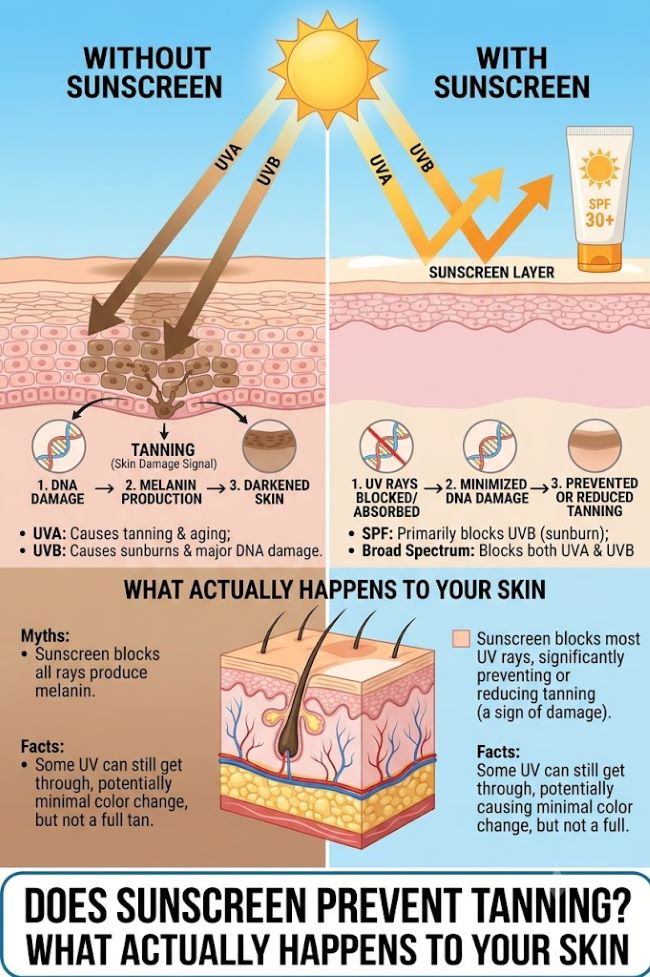
A tan is your skin’s response to UV (ultraviolet) radiation damage. When UV rays penetrate the skin, they damage DNA in skin cells. The body responds by triggering melanocytes (pigment-producing cells) to produce more melanin, the pigment that gives skin its color. That increased melanin is the tan you see.
This is not a protective adaptation in the romantic sense: it’s a damage response. The darker pigmentation provides some additional UV absorption to limit further damage, but the tan itself is evidence that damage has already occurred, not evidence that your skin successfully blocked the UV.
UV light comes in two main types relevant to sunscreen and tanning:
UVB rays are the primary cause of sunburn. They affect the outer layer of the skin and are the rays that SPF ratings primarily address.
UVA rays penetrate deeper into the skin, cause longer-term aging damage, and contribute significantly to tanning. They pass through glass and are present throughout the day regardless of cloud cover or season.
What Sunscreen Does
Sunscreen works by absorbing or reflecting UV radiation before it reaches the deeper layers of the skin. Chemical sunscreens (containing active ingredients like avobenzone, octinoxate, or oxybenzone) absorb UV rays and convert them to heat. Physical or mineral sunscreens (zinc oxide, titanium dioxide) reflect UV rays away from the skin.
SPF (Sun Protection Factor) measures how much UVB radiation a sunscreen blocks relative to unprotected skin. The math:
- SPF 15 blocks approximately 93% of UVB rays
- SPF 30 blocks approximately 97% of UVB rays
- SPF 50 blocks approximately 98% of UVB rays
- SPF 100 blocks approximately 99% of UVB rays
Notice that no SPF blocks 100% of UVB rays. Even SPF 100 allows 1% of UVB radiation through. On a day with significant UV index, that 1% can still cause a tan and some degree of skin damage over extended exposure.
Does Sunscreen Prevent Tanning?
Sunscreen significantly reduces tanning but does not fully prevent it. Here’s why:
No sunscreen blocks 100% of UV rays. Even a perfectly applied SPF 50 allows 2% of UVB rays through. Over hours at the beach in strong sun, that 2% is enough to stimulate melanin production and produce a tan.
Sunscreen is rarely applied perfectly. Studies consistently show that most people apply sunscreen at 20-50% of the recommended amount. The FDA’s standard for SPF testing uses 2 mg/cm² of skin: most people apply closer to 0.5-1 mg/cm². Under-application significantly reduces effective protection. A sunscreen applied at half the recommended amount performs much closer to its SPF divided by four, meaning SPF 50 might effectively act like SPF 12.
UVA protection is not fully reflected in SPF ratings. Standard SPF ratings primarily measure UVB protection. UVA rays also contribute to tanning. Broad-spectrum sunscreens address both UVA and UVB, but the UVA protection offered even by broad-spectrum sunscreens doesn’t eliminate UVA exposure.
Sunscreen wears off. Most sunscreens need reapplication every two hours, and immediately after swimming or sweating. Any time the sunscreen is depleted, unprotected UV exposure accumulates.
Incidental UV exposure adds up. Even in shade or on overcast days, UVA rays penetrate and contribute to gradual tanning.
Why You Still Tan Even With High SPF
The combination of factors above explains why tanning still occurs despite sunscreen use:
- A small percentage of UVB always gets through
- UVA exposure contributes to tanning and isn’t fully blocked
- Most people under-apply, making effective SPF lower than labeled
- Reapplication timing gaps leave skin temporarily unprotected
- Extended time in the sun accumulates even small UV exposure
The result is that most people using sunscreen correctly will tan more slowly and less intensely than without sunscreen, and will burn much less. But a complete absence of any tan is unlikely with normal outdoor activity.
Can You Prevent Tanning Completely?
Complete prevention of tanning requires:
Very high SPF (50+) broad-spectrum sunscreen, properly applied at the correct amount and reapplied every two hours. This is the single most important variable.
Protective clothing. UPF-rated clothing (swimwear, long sleeves, hats) physically blocks UV rays more completely than sunscreen alone. A UPF 50 garment blocks 98% of UV radiation.
Staying in the shade. Shade doesn’t block all UV (reflections and scattered light still reach skin) but dramatically reduces direct exposure.
Avoiding peak UV hours. UV intensity peaks between 10 AM and 4 PM. Limiting outdoor exposure during these hours reduces cumulative UV regardless of sunscreen use.
Even with all of these measures, some UV reaches the skin and some melanin response may occur. The practical goal of sunscreen is significant UV reduction and sunburn prevention, not absolute zero UV exposure.
Does Tanning Through Sunscreen Mean the Sunscreen Failed?
Not necessarily. If you tanned despite using sunscreen but didn’t burn, the sunscreen was doing its primary job: preventing the acute UV damage that causes sunburn. Tanning can occur from UV exposure levels that don’t produce sunburn, particularly through UVA exposure that the SPF rating doesn’t fully capture.
The appropriate conclusion is not that sunscreen doesn’t work: it’s that sunscreen reduces UV damage significantly but doesn’t eliminate it, and that other protective measures (clothing, shade, timing) complement sunscreen for more complete protection.
The Dermatology Perspective
Dermatologists are clear that any tan represents UV-induced DNA damage. There is no such thing as a “safe” or “healthy” tan from a skin health perspective. The melanin response to UV is a wound response, not a protective adaptation.
This doesn’t mean avoiding all sun: vitamin D synthesis requires UV exposure and sun has mood and health benefits. But the idea that a tan indicates healthy skin or a successful beach day without skin damage is not supported by how the biology actually works.
Key Takeaways
- Sunscreen significantly reduces tanning but does not prevent it completely: no sunscreen blocks 100% of UV rays, and even correctly applied high-SPF sunscreen allows some UV through
- A tan is a melanin damage response: the body produces more pigment after UV-induced DNA damage as a partial protective measure, meaning any visible tan indicates UV damage has occurred
- SPF 30 blocks about 97% of UVB rays, SPF 50 blocks about 98%: the difference between high SPF values is smaller than most people assume
- Most people apply 20-50% of the recommended sunscreen amount, significantly reducing effective protection from the labeled SPF
- UVA rays (which penetrate deeper, cause aging, and contribute to tanning) aren’t fully represented in standard SPF ratings: broad-spectrum sunscreens address both UVA and UVB but don’t eliminate UVA exposure
- Complete tanning prevention requires: properly applied high-SPF broad-spectrum sunscreen reapplied every two hours, UPF-rated clothing, shade, and avoiding peak UV hours
- Tanning despite sunscreen doesn’t mean the sunscreen failed: if you didn’t burn, it reduced the most damaging UV exposure even if it didn’t eliminate tanning entirely