Annuals That Bloom All Summer: The Best Options for Non-Stop Color
Summer gardens live or die by their annuals. Perennials come and go in waves, but a well-chosen annual blooms from planting time until the first frost without taking a break. The challenge is that not every annual labeled as a summer flower earns that description: some bloom heavily in spring, slow in summer heat, then pick up again in fall. True annuals that bloom all summer keep going through July and August when the heat is at its worst. This guide covers the best performers, what they need, and how to keep them producing.
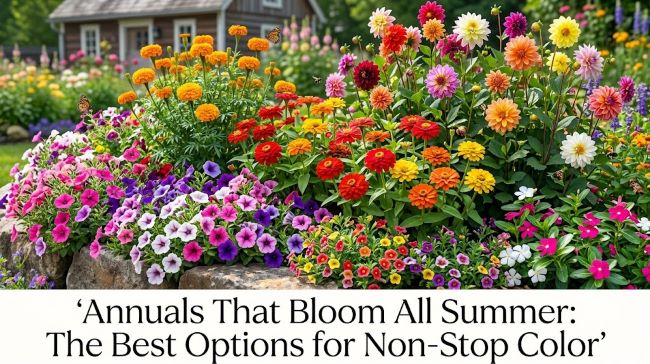
What Makes a True Summer-Blooming Annual
An annual completes its entire life cycle in one growing season. It germinates, grows, flowers, sets seed, and dies within a single year. For gardeners, this means buying new plants each season but also means you can change your garden’s design every year.
The best annuals that bloom all summer share a few characteristics: heat tolerance, the ability to continue flowering without requiring specific temperatures to trigger blooms, and response to deadheading (removing spent flowers) that keeps the plant producing new buds. Some modern cultivars have been bred specifically for continuous blooming without deadheading, which is useful in low-maintenance situations.
The Best Annuals for Non-Stop Summer Color
Zinnias
Zinnias are arguably the best heat-tolerant annuals that bloom all summer available to gardeners in most climates. They thrive in full sun and hot weather, becoming more productive as temperatures climb. They’re drought-tolerant once established, come in a nearly unlimited range of colors (white, yellow, orange, red, pink, purple, bicolor, striped), and produce flowers on sturdy stems that work equally well in the garden and as cut flowers.
Zinnias bloom from midsummer until hard frost. They’re direct-sown into the garden after the last frost date: scatter seeds in full sun, thin to 6-12 inches apart, water until established, and let them go. Pinching out the central stem when seedlings reach 12 inches produces bushier plants with more stems. Regular cutting or deadheading prevents the plant from channeling energy into seed production.
Best for: full sun, heat, drought tolerance, cutting gardens, pollinator attraction.
Marigolds
French marigolds (Tagetes patula) and African marigolds (Tagetes erecta) both deliver continuous blooms through the entire summer with minimal attention. They’re pest-resistant (the foliage odor deters many insects), drought-tolerant once established, and available in an enormous range of heights from 6-inch border plants to 36-inch statement plants.
Marigolds start blooming early and don’t stop until frost. They’re some of the easiest annuals that bloom all summer for new gardeners: plant in full sun, water regularly until established, deadhead spent flowers, and they perform. They also work as companion plants in vegetable gardens where their pest-deterring properties are a bonus.
Best for: beginners, vegetable garden companions, container planting, full sun.
Impatiens
For shady gardens, impatiens are the classic answer to summer color. Standard impatiens (Impatiens walleriana) produce a carpet of flowers in pink, red, orange, white, coral, and lavender through the entire summer in partial to full shade, asking almost nothing in return except consistent moisture.
New Guinea impatiens are larger-flowered and tolerate more sun than standard impatiens. SunPatiens are a hybrid specifically bred for full sun performance and are significantly more heat-tolerant than standard varieties.
Impatiens are ideal for north-facing beds, under tree canopy, and in shaded containers where most other summer annuals fail.
Best for: shade, consistent moisture, containers, north-facing beds.
Petunias
Wave petunias and spreading petunias are among the longest-blooming annuals available. Modern petunia varieties have been specifically bred for continuous flowering and self-cleaning (they don’t require deadheading because spent flowers drop on their own). Spreading petunias cover ground quickly and trail beautifully from containers and hanging baskets.
Petunias need full sun and regular fertilization: they’re heavy feeders and will slow their bloom production without supplemental fertilizer every two weeks during the growing season. In extreme heat above 95°F they may pause briefly, but they recover when temperatures moderate.
Best for: containers, hanging baskets, cascading from window boxes, full sun with regular feeding.
Lantana
Lantana is one of the most heat and drought-tolerant annuals that bloom all summer. It thrives in hot, dry conditions that would stress most other summer annuals, produces clusters of small flowers in multicolored combinations (yellow-orange, pink-yellow, purple-white), and attracts butterflies and hummingbirds throughout the season.
In frost-free climates lantana is a perennial shrub, but in most of the continental US it’s used as an annual. It requires full sun and well-drained soil. Once established it needs very little water, making it exceptional for hot, dry sites where irrigation is limited.
Best for: heat, drought, pollinator gardens, difficult dry sites.
Calibrachoa (Million Bells)
Calibrachoa produces flowers that look like tiny petunias and blooms continuously without deadheading from spring until frost. It’s specifically well-suited to containers and hanging baskets where its trailing habit and non-stop color make it invaluable. It comes in a wide color range including bicolors and is available in upright and trailing forms.
Like petunias, calibrachoa benefits from regular fertilization. It’s self-cleaning and requires minimal attention beyond watering and feeding.
Best for: containers, hanging baskets, window boxes, self-cleaning blooms.
Vinca (Catharanthus)
Annual vinca (Catharanthus roseus, distinct from the perennial Vinca minor ground cover) is one of the most reliably heat-tolerant annuals that bloom all summer. It thrives in heat and humidity, resists drought once established, and produces pinwheel flowers in red, pink, white, coral, and bicolor combinations. In the hottest, most humid parts of the South where other annuals struggle, vinca keeps performing.
It’s self-cleaning and requires virtually no deadheading. Full sun, well-drained soil, and it handles summer conditions that challenge most other annuals.
Best for: heat, humidity, hot Southern climates, full sun, low maintenance.
Begonias
Wax begonias (Begonia semperflorens) produce small flowers continuously from spring to frost in sun or partial shade. They’re one of the few annuals that bloom all summer that genuinely perform in both sun and shade, though they prefer some protection from intense afternoon sun in very hot climates.
Dragon Wing begonias are a larger-growing variety with drooping wing-shaped leaves and cascading clusters of flowers, excellent for containers.
Best for: versatile sun or shade, containers, border edging, consistent performance.
How to Keep Summer Annuals Blooming
Deadhead regularly. Removing spent flowers prevents the plant from shifting energy into seed production. For most annuals, deadheading every 5-7 days maintains the bloom cycle. Modern self-cleaning varieties don’t require this.
Fertilize consistently. Container annuals need feeding every 1-2 weeks with a balanced liquid fertilizer or slow-release granular. In-ground annuals benefit from monthly feeding.
Water correctly. Inconsistent watering (drought-stressed then overwatered) stresses plants and interrupts blooming. Water deeply and regularly, allowing the soil surface to dry slightly between waterings.
Cut back if needed. If an annual becomes leggy in midsummer (long stems, few flowers), cutting it back by one-third refreshes it and triggers new growth and blooming within 2-3 weeks.
Key Takeaways
- The best annuals that bloom all summer include zinnias, marigolds, impatiens, petunias, lantana, calibrachoa, vinca, and begonias: all deliver continuous color from planting until frost
- True summer bloomers are heat-tolerant and continue flowering through July and August rather than slowing in peak summer heat
- Deadheading spent flowers is the single most effective practice for maintaining continuous bloom on most annuals
- Shade gardens rely on impatiens and begonias: for sun, zinnias, marigolds, lantana, and vinca are the most reliable performers through extreme heat
- Container annuals need fertilizing every 1-2 weeks: without consistent feeding, heavy-blooming annuals slow production regardless of how well everything else is managed
- Modern self-cleaning cultivars of petunias and calibrachoa eliminate the deadheading requirement and maintain bloom without intervention
- Cutting leggy midsummer annuals back by one-third refreshes them and restores bloom production within 2-3 weeks