
5 Essential Services Every Certified Fire Watch Guard Provides During an Outage
With the failure of the life safety systems in your building due to a burst sprinkler line, malfunctioning control panel, or electricity maintenance, you leave yourself vulnerable to undetected fire risks.
During these times, engaging the services of a fire watch guards will help provide the physical attention required to maintain the safety of the occupants of your building and keep your building code-compliant with fire marshal orders.
What does a fire watch entail? According to strict guidelines from the National Fire Protection Association (NFPA 601 and NFPA 241), a professional fire watch is much more than just another warm body in the hallway.
Here are the 5 essential services every certified fire guard delivers during a system impairment or high-risk outage.
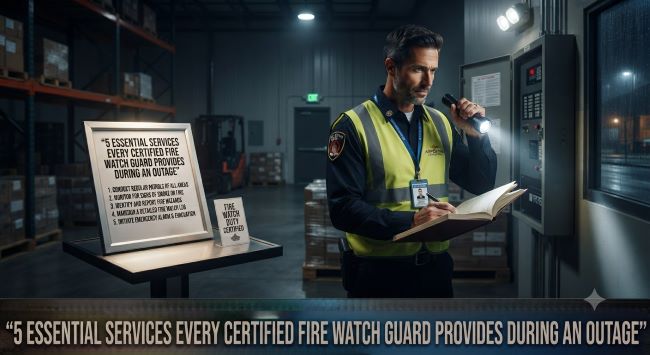
1. Continuous Physical Patrols and Hazard Surveillance
When automatic smoke detectors and heat sensors go offline, physical human observation becomes your primary warning mechanism. Certified guards from The Fast Fire Watch Company walk designated routes across every affected zone of your facility, actively searching for early signs of danger.
Strict Patrol Frequency Protocols
The actual interval at which fire watch guard patrols should occur is dictated by your local Authority Having Jurisdiction (AHJ) or local Fire Marshal.
Patrols typically follow rigid timing schedules:
- Every 15 Minutes: This is needed for high-hazard areas, hot work operations, as well as occupied medical and residential premises.
- Every 30 to 60 Minutes: This is common practice for typical commercial property, warehouses, and office buildings.
On their patrols, guards search for any visible smoke, unusual electrical buzzing sounds, and burning smells in difficult-to-reach places such as mechanical rooms, stairwells, and utility chases.
2. Active Hazard Mitigation and Fire Prevention
Fire watch personnel do not simply wait for a fire to occur, but instead are on constant alert seeking to identify and respond to any source of ignition which could potentially interact with a combustible material.
Key On-Site Prevention Checks
As part of each shift, certified individuals follow strict OSHA and NFPA prevention protocols:
- Clearing Emergency Exits: Ensuring that fire doors, exit paths, and stairwells remain clear for quick evacuation.
- Hot Work Monitoring: Overseeing welding, grinding, and torch cutting operations according to NFPA 51B standard and performing a cool-down watch for up to 30 to 60 minutes after completion.
- Equipment Inspection: Ensuring that portable fire extinguishers are full, tagged and placed at appropriate intervals.
- Housekeeping Audits: Finding and reporting all hazardous accumulations of trash, wood waste, or flammable chemicals near any heat sources.
In case of any hot work or construction hazards, employing certified guards from The Fast Fire Watch Company will help you comply with local fire code requirements without disturbing your business.
3. AHJ-Compliant Documentation and Log Management
If a Fire Marshal inspects your facility during a system outage, your verbal word is not enough. You must provide clear, timestamped proof that physical patrols were conducted without interruption.
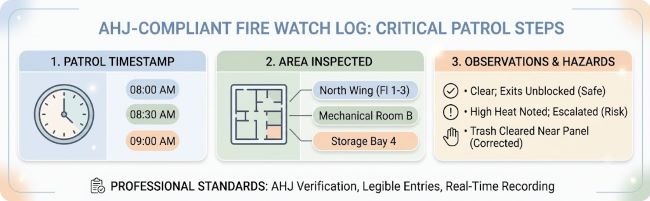
Essential Fire Watch Patrol Log Book Requirements
A professional service maintains detailed records satisfying all fire watch patrol log book requirements for local code enforcement and insurance underwriters:
- Exact entry and exit timestamps for every patrol round.
- Names and signature verification of the active fire guard on duty.
- Specific building zones, floors, and rooms inspected.
- Any identified hazards, safety infractions, or maintenance issues.
- Modern digital GPS tracking data and photo proof for complete accountability.
4. Single-Task Focus Under NFPA Code Standards
A common mistake property managers make is assigning fire watch duties to existing security guards, maintenance workers, or front-desk staff.
Under NFPA 601 and OSHA regulations, fire watch guards are legally prohibited from performing dual-duty tasks. A fire guard cannot answer phone calls, monitor access control gates, or clean common areas. Their sole responsibility is watching for ignition and protecting life safety. This total focus ensures immediate hazard detection without split-second distractions.
5. Emergency Evacuation and 911 Escalation
When an actual fire breaks out during an alarm impairment, local building horns may not sound, and automated signals will not reach central dispatch. The Fast Fire Watch Company serves as the vital human bridge between the emergency and first responders.
Standard Fire Watch Emergency Response Procedures
Fire professionals adhere to previously outlined fire watch emergency protocols:
- Emergency 911 Call: Reaching out to local emergency authorities immediately, giving exact location coordinates and details about the fire.
- Building Evacuation Start: Informing occupants personally by using bullhorns, air horns, or even going around and telling individuals face to face.
- Incipient Fire Extinguishing: Employing hand-held fire extinguishers to put out the fire while it is incipient, in case it can be done safely before help arrives.
- Fire Truck Guiding: Going out to meet fire trucks from the main entrance and guiding them to the fire spot.
Frequently Asked Questions
What kinds of gear does a fire watch guard employ?
The qualified guard from The Fast Fire Watch Company employs safety gear like a flashlight, air horn, walkie-talkie/cellphone, fire extinguisher, log book, and personal protective gear including a high visibility vest, hard hat, and steel-toe boots in construction sites.
Can a normal security guard be used as a fire watch guard?
Only when the security guard is relieved of all security duties. As per NFPA standards, the fire guard needs to be 100 percent dedicated to fire observation. A guard who performs both security and fire watch is in violation of life safety codes.
How many fire watch guards are needed for a building outage?
This would depend on building size, vertical structure, and time for completion of patrol as per the requirement of your Fire Marshal. If one fire watch guard cannot walk his patrol route in the stipulated time period (e.g., 15 or 30 minutes), more guards need to be assigned.
Conclusion: Ensuring Continuous Life Safety Compliance
Professional Fire Watch services offer much more than just security guard coverage—they provide a proactive and organized fire safety process that secures human lives, preserves structures from destruction, and fulfills the fire marshals’ needs. With regular patrols and GPS tracking, along with instant calling to 911, fire guards keep your business protected whenever there’s a failure in your automated processes. Awareness about what’s included in the package of basic fire watch services ensures the security of your property no matter what the situation.