The Rise of Borderless Tech Teams: What It Means for Innovation
The old picture of everyone on a software team working side by side in the same office? That’s disappearing faster than most people expected.
These days, lots of tech companies are building products with engineers scattered across several countries and time zones. You might have a product manager in Berlin, backend devs in Poland, DevOps folks in Brazil, and AI engineers dialing in from Argentina. All in on the same projects, working as one team.
But this isn’t just about remote work catching on. It’s a much bigger shift in how companies grow engineering teams and chase technical talent worldwide.
As hiring pressure continues to grow, organizations are increasingly adopting remote staff augmentation models to expand engineering teams more quickly without relying entirely on local recruitment markets. For many companies, borderless teams are becoming less of an experiment and more of a long-term operating model.
The focus now isn’t on where people are sitting; it’s on finding the best talent and delivering quickly.
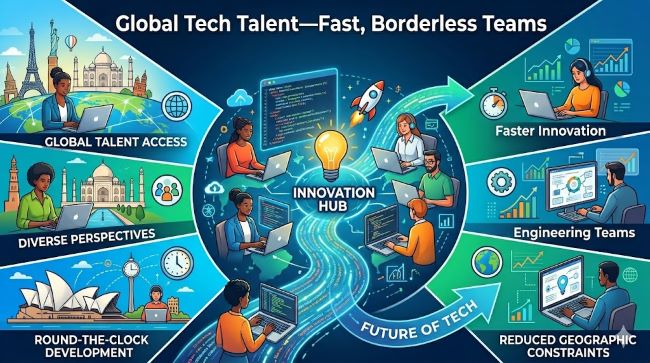
How to Tap Into Global Tech Talent—Fast
Honestly, the main reason global engineering teams are exploding is pretty obvious: local hiring just doesn’t cut it anymore.
Demand for good software engineers keeps outpacing supply, especially in big tech hubs. Try hiring for AI, cybersecurity, cloud infrastructure, or data engineering—recruiters face longer wait times and salary wars.
Startups and midsize companies feel this pain the most. Projects get pushed out because it takes forever to fill key roles. The people you do have get stretched too thin, and initiatives stall while everyone scrambles to find that one elusive expert.
That’s why companies are recruiting internationally. Instead of being stuck with the local candidates, they suddenly have the whole world to choose from—and a much bigger pool of talent.
Remote work tools have made this shift a lot easier. Cloud workflows, project management platforms, and async communication let teams collaborate smoothly, even if nobody’s ever been in the same room.
Now, companies aren’t just chasing lower costs. They’re chasing access to niche engineers, specialized skills, and more capacity than the local market can offer.
Borderless Teams and Faster Innovation
One of the coolest surprises with distributed teams? Sometimes they speed up innovation instead of slowing everything down.
It used to be that innovation happened when teams brainstormed in the same room. But it turns out you can move fast and stay creative across time zones.
With engineers spread around the globe, development becomes almost nonstop. As one team in Europe wraps up for the day, someone in Latin America is just getting started—they pick up where the others left off. That keeps things moving, especially for big products.
Diversity helps, too. Developers from different countries bring their own ways of thinking, which shakes up discussions and sometimes challenges old assumptions. That makes for better technical decisions.
Distributed teams need to document everything, operate transparently, and communicate well. It takes more discipline up front, but over time, everyone’s got better access to knowledge than they would with just office chatter and hallway meetings.
How to Grow Engineering Teams Without Getting Stuck
Scaling a team fast enough to match new product demands—this gives most CTOs headaches.
Recruiting takes too long, especially if you need people with hard-to-find skills. Building full teams in-house across every specialty just isn’t practical for most companies.
That’s where flexible models come in. A lot of teams now mix core employees with remote, external engineers. You can ramp up for a big project—like a cloud migration or an AI rollout—without overhauling your whole hiring process every time.
This approach means you don’t end up with bloated teams after a big push, but you get the muscle you need when you need it. Plus, hybrid teams can work really well when done right: internal folks lead the vision, while distributed specialists add extra firepower.
Organizations like nCube help companies build and manage these global teams, especially across Europe and Latin America. Being able to scale quickly—sometimes that’s the advantage that wins the market.
Managing the Tricky Parts
Borderless teams offer big upsides but come with their own set of challenges.
Communication changes a lot. Gone are the days of quick hallway chats. You need clear documentation, good processes, and consistent communication discipline to keep things running.
Covering multiple time zones means teams need shared windows to talk and clear roles so things don’t fall through the cracks while others sleep.
The companies that make this work double down on transparency. They standardize the way people work, document decisions, and keep teams from depending on each other for every little thing.
Culture matters too. Some worry remote teams feel less connected. In reality, the dynamic just shifts. Successful remote-first companies take culture seriously: strong onboarding, regular check-ins, leadership presence, and open sharing are the norm.
And then there’s security. When teams work around the globe, companies need solid access controls, security monitoring, and reliable ways to keep sensitive data safe no matter where it’s accessed.
If a business struggles with distributed teams, it’s often because its processes aren’t mature enough to handle the demands of remote work.
What’s Next for Global Software Teams?
Borderless teams aren’t just changing how tech companies organize—they’re changing what “the office” even means.
For engineers, location flexibility is becoming table stakes. Companies are catching on and building organizations around talent and delivery, not just zip codes.
The rise of AI will only push this further. Tools that automate documentation, code reviews, or testing make it even easier for distributed teams to deliver.
That old split between “in-house” and “offshore” teams is fading away. The best companies build integrated, global teams where results matter more than location.
The most successful companies treat distributed collaboration as a core part of how they work, not just something to get by with.
The Bottom Line
Global tech teams used to be an experiment. Not anymore—they’re quickly becoming the foundation of modern software development.
As the race for talent heats up and products get more complex, going global helps companies move faster and grow smarter than sticking with traditional hiring.
But building a high-performing distributed team takes more than just finding engineers anywhere on the map. You need strong processes, communication, leadership, and systems built specifically for this way of working.
The companies nailing those details are getting ahead. They unlock access to world-class talent, scale with agility, and innovate without boundaries.
For software, the future’s looking more borderless every day—and that’s already changing how great technology gets built worldwide.