Make a Table Comparing Memory Foam vs Hybrid Mattresses: Full Breakdown and Buying Guide
Mattress shopping produces a specific kind of decision paralysis. You know you need something better than what you have, you have a rough budget in mind, and then you hit the showroom floor or the product page and find yourself reading about coil counts, foam densities, and zoned support systems that all blur together. The most common split people face is memory foam vs hybrid, and the comparison deserves more than a quick chart. This guide makes a table comparing memory foam vs hybrid mattresses and then explains what every row in that table actually means for how you sleep, so you can make the decision with clarity rather than guessing.
What Each Mattress Type Actually Is
Before comparing them, it helps to be precise about what you are comparing.
Memory foam mattresses consist entirely of foam layers. The top comfort layer is memory foam, which is viscoelastic: it softens with your body heat and molds to your shape under pressure, then slowly returns to its original form when pressure is removed. Below the comfort layer sits a transition foam layer, and the base is a dense support foam that gives the mattress its structural integrity. No springs, no coils, no metal components.
Hybrid mattresses combine a foam comfort system with a coil support core. The top layers use foam (including memory foam, latex, or other materials) for comfort, but instead of a foam base, they sit on a pocketed coil system. Each coil is individually wrapped in fabric, allowing them to respond to pressure independently. This is what separates hybrids from older innerspring mattresses, which use connected coil systems that transfer movement across the whole mattress.
A hybrid memory foam mattress specifically uses memory foam as the top comfort material above the coil base, which is the most common hybrid construction and what most people picture when they hear “hybrid.”
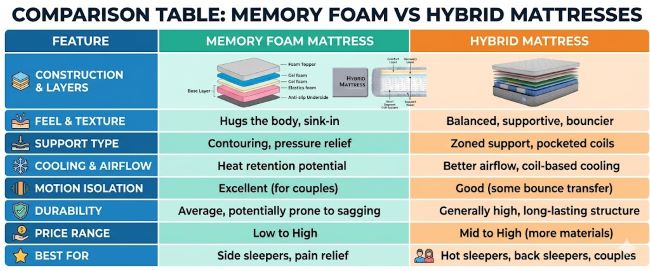
Memory Foam vs Hybrid Mattress: The Full Comparison Table
| Feature | Memory Foam | Hybrid Mattress |
|---|---|---|
| Construction | All-foam layers | Foam comfort layers + pocketed coil base |
| Feel | Deep contouring, slow response | Contouring on top, bouncier response overall |
| Motion isolation | Excellent | Good (better than innerspring, less than pure foam) |
| Cooling | Varies (standard foam traps heat; gel/copper-infused better) | Better airflow through coil base |
| Edge support | Poor to moderate | Good to excellent |
| Bounce/responsiveness | Low | Moderate to high |
| Noise | Silent | Minimal (pocketed coils rarely squeak) |
| Durability | 7-10 years average | 8-12 years average |
| Weight | Lighter | Heavier (coils add significant weight) |
| Price | $300-$1,500 for quality | $600-$2,500 for quality |
| Best for | Side sleepers, couples, light/medium body weight | Back/stomach sleepers, hot sleepers, heavier body weight |
| Worst for | Hot sleepers (traditional foam), heavy sleepers | People with tight budgets, those who dislike any bounce |
Motion Isolation: Memory Foam Wins
If you share a bed with someone who moves at night, motion isolation is the feature that most directly affects your sleep quality. Memory foam absorbs movement at the point of pressure. When your partner rolls over, you do not feel it on your side.
Hybrid mattresses handle motion better than traditional innerspring mattresses because pocketed coils respond independently, but they still transfer more movement than pure foam. If one of you gets up at night or changes position frequently, you will notice it more on a hybrid.
For couples where one person is a restless sleeper, memory foam is the clearer choice on this metric.
Cooling: Hybrid Has the Structural Advantage
This is one of the most important what are the negatives to a hybrid mattress questions people ask in reverse: what is the negative of memory foam? The honest answer is heat retention.
Traditional memory foam is a closed-cell material. It traps body heat because there is no airspace within the foam for heat to dissipate. This was the original memory foam’s most criticized property, and manufacturers have addressed it through various means: open-cell foam construction, gel infusions, copper or graphite particles mixed into the foam, and phase-change cover materials. These improvements help, but they do not fully close the gap with a hybrid.
Hybrid mattresses have a physical airflow advantage. The coil core is roughly 6 to 8 inches of open space. Air moves through the coils as you move during sleep, dissipating body heat. Hot sleepers who have tried memory foam and found it uncomfortably warm frequently switch to hybrids and notice an immediate difference.
If you sleep hot, this single factor should carry significant weight in your decision.
Edge Support: Hybrid Wins Clearly
Edge support is how well a mattress holds up when you sit or sleep near the edge, rather than at the center. It matters in two ways: how much usable sleep surface you actually have, and how easy it is to get in and out of bed.
Memory foam mattresses compress significantly at the edge. If you sit on the side of a foam mattress, you sink deeply, which can make getting up difficult. If you sleep near the edge, you may feel like you are rolling off. This is one of the clearest what are the negatives to a hybrid mattress answers when applied to foam instead: poor edge support is a genuine foam mattress limitation.
Hybrid mattresses have a reinforced perimeter coil structure that holds its shape at the edges. You can sit on the edge of a hybrid without the mattress compressing completely, and sleeping near the edge is more stable. For people who share a bed and need to use the full mattress surface, or for people who have difficulty getting up from low surfaces, this is a practical advantage.
Pressure Relief and Body Contouring
Memory foam is the better pressure reliever, specifically at the shoulders, hips, and knees. Its slow-response viscoelastic properties allow it to fill in the natural curves of the body and distribute weight across a larger surface area, which reduces pressure at joints. Side sleepers benefit from this most because their shoulder and hip generate concentrated pressure against the mattress.
Hybrid mattresses also contour to the body through their foam comfort layers, but the coil base provides a firmer, more responsive foundation. This is better for back and stomach sleepers, who need support that keeps the spine aligned rather than deep contouring that can cause the midsection to sag into the mattress.
Are memory foam mattresses good for back sleepers? They can be, specifically medium-firm memory foam models, but hybrid mattresses are more reliably supportive for back and stomach sleeping because the coil base resists compression more effectively under the heavier midsection.
What Are the Negatives to a Hybrid Mattress?
This question comes up enough that it deserves its own section. Hybrid mattresses have real drawbacks:
Price: Quality hybrids cost more than quality foam mattresses at equivalent construction standards. The coil system adds manufacturing cost, and that gets passed to the consumer. You can find budget hybrids below $800, but the coil quality in that range is often mediocre. Quality hybrids start closer to $1,200 to $1,500.
Weight: Hybrid mattresses are significantly heavier than foam mattresses, often by 20 to 40 pounds for a queen size. Moving one requires two people and some effort. If you rotate your mattress regularly or move frequently, this is a genuine inconvenience.
Motion isolation vs. foam: As covered above, hybrids do not isolate motion as well as pure foam. For light sleepers sharing a bed, this is a real negative.
Potential for noise over time: Pocketed coils are quiet when new, but coil systems can develop noise as they age. Well-made hybrids last 10 to 12 years without noise issues, but cheaper coil systems may start creaking within a few years.
Hybrid vs Memory Foam: Who Should Buy Which
Choose memory foam if:
- You sleep on your side
- You share a bed with a partner who moves at night
- You are on a tighter budget (quality foam costs less than quality hybrids at comparable construction)
- You have joint pain at shoulders, hips, or knees
- You are a lighter sleeper (under 130 lbs) who needs pressure relief rather than firm support
Choose a hybrid mattress if:
- You sleep on your back or stomach
- You sleep hot and have found foam mattresses uncomfortable
- You need strong edge support (getting in/out of bed, using the full mattress surface)
- You are a heavier sleeper (over 230 lbs) who needs the coil base for adequate support
- You prefer a mattress with some bounce and responsiveness rather than the “stuck in the mattress” feeling of slow-response foam
- You have a partner with different sleep preferences and need a mattress that works for two different sleep styles
Hybrid Mattress Price vs. Value: What to Budget
The foam vs hybrid mattress price gap is real but the value comparison depends on construction quality, not just category.
A $400 memory foam mattress and a $400 hybrid are both likely to be low-quality for their category. The budget goes further in foam because you are not paying for coils.
For a quality purchase:
- Memory foam: Budget $700 to $1,200 for a queen that will last 8 to 10 years from a reputable brand
- Hybrid matress: Budget $1,200 to $1,800 for a queen with quality pocketed coils and foam comfort layers
Brands with strong track records in both categories include Purple, Saatva, Helix, Bear, and Nectar. Most offer trial periods of 100 nights or more, which matters because mattress feel changes as foam breaks in over the first 30 to 60 days.
Good design thinking applies to purchasing decisions just as much as to products themselves, and understanding how to evaluate options clearly matters whether you are choosing software or a mattress. The home environment a mattress exists in connects to how interior design affects quality of life. And for anyone tracking a major home purchase budget across multiple items, expense tracking tools keep the total spend visible.
Key Takeaways
- Memory foam vs hybrid is primarily a choice between superior motion isolation and pressure relief (foam) vs. better cooling, edge support, and responsiveness (hybrid).
- The comparison table above covers 12 features side by side. The most decision-relevant ones are cooling (hybrid wins), motion isolation (foam wins), edge support (hybrid wins), and pressure relief (foam wins).
- What are the negatives to a hybrid mattress? Higher price, significantly heavier weight, slightly more motion transfer than foam, and potential for coil noise over time.
- Are memory foam mattresses good? Yes, especially for side sleepers, couples with one restless sleeper, and anyone with joint pressure issues. They struggle in heat retention and edge support.
- Hybrid vs memory foam for sleeping position: side sleepers generally do better on foam, back and stomach sleepers generally do better on hybrids.
- For heavier body weights (230+ lbs), a hybrid mattress provides better long-term support. Foam mattresses can develop body impressions faster under higher sustained pressure.
- Budget at least $700 for quality memory foam and $1,200 for a quality hybrid at queen size. Anything significantly below those thresholds involves meaningful construction compromises.
- Both types come with trial periods from major brands, which is the single most important purchase protection available for a product you cannot fully evaluate in a showroom.