
Express Employment
Looking for work can feel slow and confusing, especially if you need a job quickly. That’s why many people turn to Express Employment, one of the largest staffing networks in North America. It connects job seekers with temporary, part time, and full time roles in fields from manufacturing to office work.
This guide explains what Express Employment is, how it works, what job seekers and employers can expect, and whether it’s the right fit for you.
What Is Express Employment?
Express Employment is the common name for Express Employment Professionals, a franchise based staffing company headquartered in Oklahoma City, Oklahoma. Each office is locally owned, but all offices share the same brand, tools, and support system.
Express matches job seekers with businesses that need workers. Some roles last a few hours or days. Others turn into permanent jobs. The company says it helps more than half a million people find work each year, and it operates in the United States, Canada, South Africa, Australia, and New Zealand.
A Short History
According to a company history published by 1851 Franchise, Express started in 1983. Founders Bob Funk, Bill Stoller, and Jim Gray had worked together at Acme Personnel Services, which had recently gone bankrupt. With a small bank loan and eight offices in Oklahoma, Oregon, and Colorado, they launched Express Temporary Services.
The company grew fast:
| Year | Milestone |
|---|---|
| 1983 | Express Temporary Services is founded |
| 1999 | Sales pass $1 billion |
| 2021 | About 586,000 people employed worldwide that year |
| 2024 | More than 860 locations worldwide |
| 2026 | Express keeps adding new franchise owners under CEO Bob Funk Jr. |
Over its history, Express says it has helped more than 10 million people find jobs.
How Express Employment Works
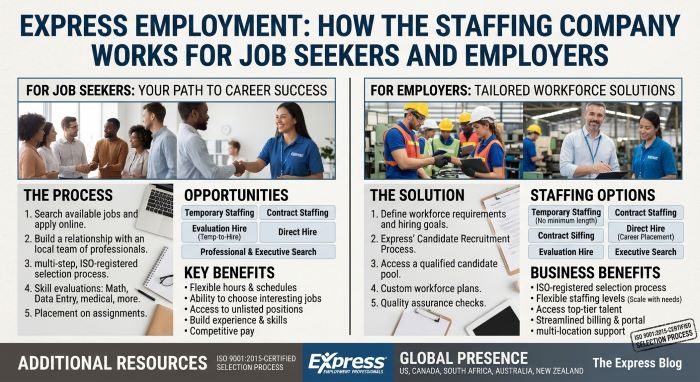
Express works as a staffing agency. Businesses tell Express what kind of workers they need, and Express recruits, screens, and places candidates. For temporary roles, Express is the official employer of record. That means it handles payroll, tax withholding, and workers’ compensation insurance for its associates.
Here’s how the process usually works for job seekers:
- Apply online through the Express website or visit a local office.
- Interview with a recruiter, who asks about your skills, experience, and goals.
- Complete paperwork, including any required tests or checks for specific jobs.
- Get matched when a client company has a role that fits you.
- Accept or decline the offer. You’re free to say no.
- Start working, with Express handling your pay.
According to Express, assignments can last from four hours to several months, and some lead to full time roles with the client company.
Services Offered
Express offers several types of placements:
| Service | What it means | Best for |
|---|---|---|
| Temporary staffing | Short term roles of any length | Seasonal work, busy periods, quick income |
| Contract staffing | Project based work with a set end date | Specialized or skilled roles |
| Evaluation hire | Temp to hire roles that may become permanent | Workers who want a trial run |
| Direct hire | Permanent jobs placed directly with an employer | Long term career moves |
| Professional search | Recruiting for higher level roles | Managers, executives, specialists |
Express also runs a separate brand, Express Healthcare Staffing, for roles in hospitals, clinics, and long term care.
Industries Express Serves
Express places workers in many fields, including:
- Manufacturing and production
- Warehousing, logistics, and supply chain
- Office and administrative work
- Healthcare and social assistance
- Finance and accounting
- Information technology
- Construction and skilled trades
Many of its jobs are light industrial roles like forklift operator, assembler, and warehouse associate, but it also fills office, customer service, and professional positions.
Is Express Employment Free for Job Seekers?
Yes. Express says job seekers are never charged a fee to find a job. Like most staffing firms, Express earns money from the businesses that hire through it.
Employers usually pay an hourly bill rate, which includes the worker’s pay plus a markup. That markup covers payroll taxes, insurance, and Express’s recruiting and screening costs. For direct hire placements, the local office sets a fee based on the role and market.
Staffing Agency vs. Employment Agency
People often use these terms as if they mean the same thing, but there are small differences:
| Feature | Staffing agency | Traditional employment agency |
|---|---|---|
| Main focus | Temporary and contract workers | Permanent job placement |
| Who employs the worker | The agency, during assignments | The hiring company |
| Who pays the fee | The client business | Usually the client business |
| Speed | Often very fast | Can take longer |
Express does both. It works as a staffing firm for temporary jobs and as an employment agency for direct hire roles. That mix gives job seekers more options.
Pros and Cons for Job Seekers
Pros
- Free to use: No fees for job seekers.
- Fast placements: Some people start within days.
- Variety: You can try different jobs and industries.
- Path to full time work: Many temp roles turn into permanent jobs.
- Local support: Recruiters know the local job market.
Cons
- Uncertain hours: Temporary roles can end with little notice.
- Benefits vary: Benefits for temporary workers are often limited compared with full time staff and depend on the office and assignment.
- Experiences differ by office: Since offices are franchised, service quality can vary.
- Pay may be lower: Some temp roles pay less than similar direct hire jobs.
Reading local reviews and asking your recruiter clear questions can help you avoid surprises.
Pros and Cons for Employers
Businesses use Express Employment Professionals for several reasons:
- Speed: They can fill openings quickly during busy seasons.
- Lower risk: Evaluation hire lets them test workers before hiring.
- Less paperwork: Express handles payroll and taxes for temp workers.
- Flexibility: They can adjust staff levels as demand changes.
The tradeoff is cost. Bill rates include a markup, so temporary staff can cost more per hour than direct employees.
Temporary Work vs. Other Ways to Earn
Temporary staffing is just one way to work. If you want extra income on your days off, our guide to Weekend Jobs covers flexible roles that fit around a weekday schedule.
Some people also weigh staffing work against freelancing. Freelancers set their own rates and clients but handle their own taxes and insurance. To compare the two paths, see Freelancing Vs. Traditional Employment.
Building Skills for Better Placements
Workers with certifications often get better assignments and higher pay. Forklift certification, OSHA safety training, and computer skills can all help. Students and career changers can also build job ready skills through career and technical education programs like iCEV, which offers online courses and industry certifications in fields like agriculture, business, and skilled trades.
Tips for Job Seekers Using Express
- Update your resume before you apply, and list any certifications.
- Be honest about availability. Recruiters can match you better when they know your schedule.
- Stay in touch. Call or check in with your office regularly.
- Show up on time. Reliability often leads to more assignments and full time offers.
- Ask questions. Learn about pay, hours, dress code, and safety rules before you start.
- Use the app. Express offers online tools to see job openings and manage your account.
How to Find an Express Office
Express has hundreds of offices across the US and Canada. To find one:
- Visit the Express website and use the office locator.
- Enter your city or ZIP code.
- Call ahead or walk in during business hours.
Many offices post open jobs online, so you can see what’s available before you visit.
Franchise Opportunities
Express also sells franchises. According to 1851 Franchise, the traditional franchise model requires an initial investment of about $144,000 to $220,000, including a $40,000 franchise fee. The company reported adding dozens of new franchise owners in 2026, with priority markets in California, Texas, Ohio, Georgia, Maryland, Pennsylvania, and Ontario.
Who Should Use Express?
Express can be a good fit if you:
- Need work quickly
- Want to try different industries
- Are new to the workforce or returning after a break
- Prefer flexible or short term roles
- Hope to land a full time job through a trial period
It may be less ideal if you need guaranteed hours or full benefits from day one.
Quick Facts
- Founded in 1983 in Oklahoma City
- Operates in five countries
- Helps more than half a million people find work each year
- Free for job seekers
- Offers temporary, evaluation hire, direct hire, and professional search services
Frequently Asked Questions
Is Express Employment a legitimate company? Yes. Express Employment Professionals has operated since 1983 and runs hundreds of franchised offices.
Do I have to pay Express to find a job? No. Express says job seekers are never charged a fee.
Who pays me when I work through Express? For temporary roles, Express is your employer of record and handles your pay.
Can a temp job turn into a full time job? Yes. Evaluation hire roles are designed for that, and other temp roles sometimes lead to permanent offers.
What kinds of jobs does Express offer? Jobs in manufacturing, warehousing, office work, healthcare, IT, finance, and more.
Final Thoughts
Express Employment gives job seekers a free, fast way to find work, from short temp roles to permanent careers. For employers, it offers a flexible way to fill jobs without the full cost of hiring. Like any staffing firm, results depend on your local office, so ask questions, stay in touch with your recruiter, and use each assignment to build your skills and reputation.
Key Takeaways
- Express Employment is the common name for Express Employment Professionals, a franchise staffing company founded in 1983.
- It helps more than half a million people find work each year across five countries.
- Job seekers never pay a fee; employers pay an hourly bill rate.
- Services include temporary, contract, evaluation hire, direct hire, and professional search.
- Express works as both a staffing agency and an employment agency.
- Temporary roles can lead to full time jobs, but hours and benefits vary.
- Certifications and reliability help workers land better assignments.