
Density Dependent vs Density Independent Factors Explained
Why don’t populations of rabbits, deer, or bacteria grow forever? Something always keeps them in check. Ecologists call these limits “limiting factors,” and they fall into two main groups: density dependent and density independent.
This guide explains density dependent vs density independent factors in simple terms, with real world examples you can use for class, exams, or curiosity.
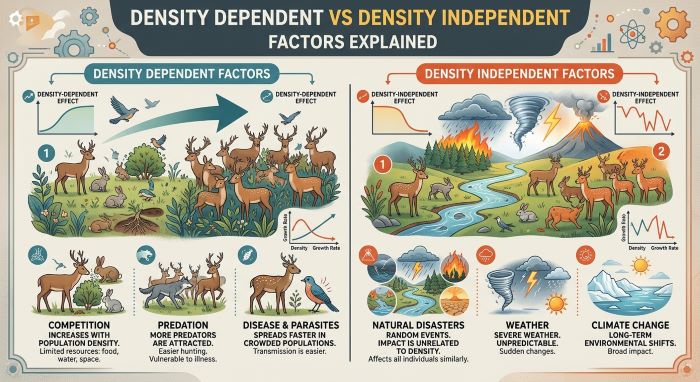
The Short Answer
- Density dependent factors affect a population more strongly as it gets more crowded. Examples include disease, competition, and predation.
- Density independent factors affect a population the same way no matter how crowded it is. Examples include natural disasters, weather, and pollution.
In short: density dependent factors depend on how many individuals live in an area. Density independent factors don’t.
What Is Population Density?
Population density is the number of individuals living in a certain area. For example, 50 deer per square mile is a higher density than 10 deer per square mile. When density is high, individuals live closer together, compete more, and spread diseases more easily.
Density Dependent vs Density Independent at a Glance
| Feature | Density Dependent | Density Independent |
|---|---|---|
| Depends on crowding? | Yes | No |
| Type of factor | Mostly biotic (living) | Mostly abiotic (nonliving) |
| Effect grows with population size? | Yes | No |
| Examples | Disease, competition, predation, parasites, waste buildup | Floods, droughts, wildfires, extreme cold, pollution |
| Effect on growth curve | Leads to an S shaped (logistic) curve | Causes sudden crashes |
| Predictability | Fairly predictable | Often unpredictable |
| Role in carrying capacity | Keeps population near carrying capacity | Can drop populations far below it |
Density Dependent Factors
Density dependent factors become stronger as a population grows. They’re mostly biotic, meaning they involve living things.
1. Competition
When a population grows, individuals must share limited food, water, space, and mates. More individuals mean more competition. Some won’t get enough resources to survive or reproduce.
Example: In a crowded forest, deer compete for limited plants. Weaker deer may starve in winter.
2. Predation
Predators often hunt more when prey is plentiful. As prey populations rise, predator populations can grow too, which then pushes prey numbers back down.
Example: The famous snowshoe hare and Canada lynx cycle in Canada. When hare numbers rise, lynx numbers follow, then both fall.
3. Disease and Parasites
Diseases spread faster when individuals live close together. Crowding makes it easier for viruses, bacteria, and parasites to jump from host to host.
Example: Chronic wasting disease spreads more easily in dense deer herds.
4. Waste and Toxins
In crowded conditions, waste builds up and can poison the environment.
Example: In a flask of yeast, alcohol and waste products build up as the population grows, eventually slowing growth.
5. Stress and Behavior
Crowding can cause stress, aggression, and lower birth rates in some animals.
Example: Lab studies on crowded rodents have shown more aggression and fewer surviving young.
Density Independent Factors
Density independent factors affect a population no matter how large or small it is. They’re usually abiotic, meaning nonliving.
1. Natural Disasters
Floods, hurricanes, earthquakes, tsunamis, and volcanic eruptions can wipe out large parts of a population at once.
Example: A flood destroys ground nesting bird nests along a river, whether there are 10 nests or 100.
2. Weather and Climate
Extreme heat, cold, drought, or storms can kill organisms regardless of density.
Example: A hard freeze kills many insects in a region, no matter how many there are.
3. Wildfires
Fires burn through habitats and kill plants and animals in their path.
Example: A wildfire destroys a forest, affecting squirrels, birds, and trees equally whether the area was crowded or not.
4. Human Activities
Pollution, pesticides, habitat destruction, and dams can harm populations regardless of their size.
Example: An oil spill kills seabirds and fish across a coastline.
How They Affect Population Growth
Ecologists often describe two kinds of growth:
- Exponential growth (J curve): A population grows faster and faster when resources are unlimited.
- Logistic growth (S curve): Growth slows as the population approaches its carrying capacity, the maximum number the environment can support.
Density dependent factors are what bend the J curve into an S curve. As the population grows, competition, disease, and predation increase, slowing growth until it levels off near carrying capacity.
Density independent factors don’t bend the curve smoothly. Instead, they cause sudden drops, which can happen at any point.
Can a Factor Be Both?
Sometimes, yes. The line between density dependent vs density independent isn’t always clear.
Example: During a harsh winter (density independent), animals in a crowded population may have less shelter and food available (density dependent). So more die than in a sparse population.
Shelter is a classic case. If there are only a few safe caves, a cold snap kills more animals when the population is high, because many can’t find shelter.
Real World Examples Table
| Situation | Factor Type | Why |
|---|---|---|
| Flu spreads in a crowded city | Density dependent | Spreads faster with more contact |
| Hurricane destroys coral reef | Density independent | Damage doesn’t depend on fish numbers |
| Wolves hunt more elk as elk increase | Density dependent | Predation rises with prey density |
| Drought dries up a pond | Density independent | Affects all frogs equally |
| Plants compete for sunlight | Density dependent | More plants mean more shade |
| Pesticide spray kills insects | Density independent | Kills regardless of population size |
| Parasites spread in a fish farm | Density dependent | Crowding helps parasites spread |
Why It Matters
Understanding density dependent vs density independent factors helps:
- Wildlife managers set hunting limits and protect endangered species.
- Farmers manage pests and plant spacing.
- Public health experts predict how diseases spread in crowded cities.
- Conservationists plan for climate change and natural disasters.
Study Tips
- Ask: “Does crowding make it worse?” If yes, it’s density dependent.
- Living vs nonliving. Density dependent factors are usually living; density independent ones are usually nonliving.
- Remember examples. Disease, competition, predation (dependent). Fire, flood, freeze (independent).
Density Dependent vs Density Independent in Human Populations
Humans are affected by both types of factors too.
Density dependent examples:
- Infectious diseases spread faster in crowded cities
- Competition for housing raises prices in dense areas
- Traffic and pollution increase with population
Density independent examples:
- Earthquakes, hurricanes, and floods affect people regardless of population size
- Heat waves and cold snaps
- Volcanic eruptions
Public health experts use this idea to plan vaccine campaigns, disaster response, and city design.
Density Dependent vs Density Independent: Graph Practice
On exams, you may be asked to read population graphs.
| Graph Shape | Likely Cause |
|---|---|
| Smooth S curve leveling off | Density dependent factors near carrying capacity |
| Up and down cycles with predator lag | Predator prey interaction (density dependent) |
| Sudden sharp drop, then slow recovery | Density independent event like a fire or flood |
| J curve with no leveling | Unlimited resources (no strong limits yet) |
Classic Case Study: Reindeer on St. Matthew Island
In 1944, 29 reindeer were brought to St. Matthew Island in Alaska. With plenty of lichen and no predators, the herd grew to about 6,000 by 1963. Then food ran out from overgrazing (density dependent), and a very harsh winter hit (density independent). The population crashed to just 42 animals. This famous example shows how density dependent vs density independent factors can work together to cause dramatic change.
Quick Review Quiz
- A virus spreads through a crowded rabbit colony. Density dependent.
- A volcano erupts near a bird colony. Density independent.
- Plants in a crowded field get less sunlight. Density dependent.
- A late frost kills young fruit blossoms. Density independent.
Practice sorting examples like these, and the concept will stick.
Key Vocabulary
| Term | Meaning |
|---|---|
| Limiting factor | Anything that restricts population growth |
| Carrying capacity (K) | Maximum population an environment can support |
| Biotic factor | A living part of the environment |
| Abiotic factor | A nonliving part of the environment |
| Logistic growth | Growth that slows and levels off near K |
| Exponential growth | Rapid growth with no limits |
| Population crash | A sudden, sharp drop in numbers |
Learning these terms makes textbook questions, lab reports, and AP Biology or AP Environmental Science exams much easier to handle.
Frequently Asked Questions
Is temperature density dependent or independent? Temperature is usually density independent.
Is food supply density dependent? Yes. Food limits become more serious as more individuals compete for it.
What is carrying capacity? The largest population an environment can support long term.
Are humans affected by these factors? Yes. Disease spread in crowded cities is density dependent, while earthquakes and storms are density independent.
Final Thoughts
The density dependent vs density independent difference comes down to one question: does crowding matter? Density dependent factors like disease, competition, and predation get stronger as populations grow. Density independent factors like floods, fires, and freezes strike no matter the population size. Together, they shape the rise and fall of every population on Earth.
Key Takeaways
- Density dependent vs density independent: the first depends on crowding, the second does not.
- Density dependent factors include competition, predation, disease, parasites, and waste.
- Density independent factors include floods, droughts, wildfires, extreme weather, and pollution.
- Density dependent factors create logistic (S shaped) growth near carrying capacity.
- Density independent factors cause sudden population crashes.
- Some situations, like harsh winters with limited shelter, involve both types.