
Female House Finch vs Sparrow
If you watch a backyard feeder in North America, you’ve probably seen small brown streaky birds and wondered what they are. Two of the most commonly confused are the female house finch and sparrows, especially the house sparrow and the song sparrow.
At first glance, they look almost identical. But once you know a few simple clues, telling a female house finch vs sparrow becomes easy. This guide shows you how.
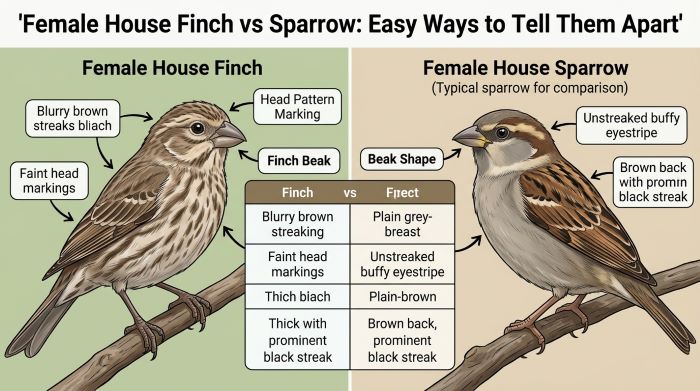
Why They’re So Easy to Confuse
All three birds are:
- Small, about 5 to 6.5 inches long
- Brown and gray with streaks
- Common at bird feeders
- Found in backyards, parks, and cities
The male house finch is easy to spot thanks to his red head and chest. The female, however, is plain brown and streaky, which makes her look a lot like a sparrow.
Female House Finch vs Sparrow at a Glance
| Feature | Female House Finch | House Sparrow (Female) | Song Sparrow |
|---|---|---|---|
| Size | About 5 to 6 inches | About 6 to 6.5 inches | About 5 to 7 inches |
| Overall color | Gray brown | Buff brown with gray | Warm brown and gray |
| Chest | Blurry brown streaks all over | Plain, unstreaked buff gray | Bold streaks with a central spot |
| Face | Plain, no strong markings | Pale buff stripe behind the eye | Bold stripes on the face |
| Back | Plain, lightly streaked | Striped brown, black, and buff | Streaked brown |
| Beak | Short, thick, curved top | Thick, cone shaped, straight | Thin to medium cone |
| Tail | Medium, notched | Medium | Long, rounded, often pumped in flight |
| Wing bars | Faint | One clear white wing bar | None to faint |
| Song | Long, warbling, cheerful | Simple, repeated chirps | Sweet notes and a trill |
Key Field Marks of a Female House Finch
Here’s what to look for on a female house finch:
- Blurry streaks everywhere. Her chest and belly are covered in soft, smudgy brown streaks on a whitish background. The streaks look fuzzy, not crisp.
- Plain face. She has no bold eye stripes or face markings. Her face looks blank and soft.
- Curved beak. Her beak is short and stubby, with a slightly curved top edge, almost like a tiny parrot beak.
- Gray brown tone. Overall, she’s more gray brown than warm brown.
- Often with males. If you see red males nearby, the brown birds with them are likely females.
Key Field Marks of a House Sparrow
House sparrows are not true American sparrows. They were brought from Europe in the 1850s and are now one of the most common birds in North American cities.
A female house sparrow has:
- A plain chest. No streaks. Her belly is smooth buff gray. This is the easiest way to tell her from a female house finch.
- A pale eyebrow stripe. A buff line runs behind each eye.
- A striped back. Her back has bold streaks of brown, black, and buff.
- A straight, cone shaped beak.
- A single white wing bar.
Male house sparrows are easier to recognize, with a gray crown, chestnut sides on the head, and a black bib.
Key Field Marks of a Song Sparrow
Song sparrows are native birds found across much of North America. Look for:
- Bold streaks on the chest that often merge into a dark central spot.
- Strong face stripes, including a dark stripe from the beak down the throat.
- A long, rounded tail that the bird pumps up and down as it flies.
- Warm reddish brown tones on the wings and back.
The Fastest Way to Tell Them Apart
Use this quick checklist:
- Streaky chest + plain face + curved beak = Female house finch
- Plain chest + eyebrow stripe + striped back = Female house sparrow
- Bold streaks + central chest spot + striped face = Song sparrow
In most backyard sightings, the female house finch vs sparrow question comes down to the chest and the face. A streaky chest with a blank face points to the finch.
Behavior Clues
Behavior helps too:
| Behavior | Female House Finch | House Sparrow | Song Sparrow |
|---|---|---|---|
| At feeders | Sits on perches, cracks seeds | Crowds feeders in noisy groups | Often feeds on the ground below |
| Flocking | Small groups, often with red males | Large, chattering flocks | Usually alone or in pairs |
| Habitat | Suburbs, cities, farms | Cities, farms, near buildings | Shrubs, marsh edges, gardens |
| Nesting | Hanging plants, ledges, trees | Holes in buildings, birdhouses | Low shrubs or on the ground |
Listen to Their Songs
Sound is another great clue:
- House finch: A long, cheerful, warbling song that often ends with a buzzy note. Females sing less than males.
- House sparrow: Repeated, simple “chirp” or “cheep” sounds, often in busy groups.
- Song sparrow: A sweet song that usually starts with a few clear notes, then breaks into a trill.
Free apps like Merlin Bird ID from the Cornell Lab of Ornithology can listen to birdsong and suggest which bird is singing.
Other Look Alikes
A few other birds can be confused with a female house finch:
- Female purple finch: Has bold face stripes, including a white eyebrow, and crisper streaks.
- Female Cassin’s finch: Found in the West, with sharper streaks and a longer beak.
- Pine siskin: Smaller, with a thin, pointed beak and yellow wing edges.
Tips for Better Bird ID
- Look at the chest first. Streaked or plain?
- Check the face. Stripes or blank?
- Study the beak. Curved and stubby or straight and conical?
- Note the company. Red males nearby suggest house finches.
- Take a photo. Compare it later with a field guide or app.
Female House Finch vs Sparrow: Seasonal Changes
Plumage can change a little with the seasons, which adds to the confusion.
- Female house finches look much the same all year, though fresh fall feathers may look slightly crisper and browner.
- House sparrows look duller in fall and winter. Males lose some of their bold black bib until spring.
- Song sparrows stay streaky all year, but young birds in summer can look paler and less clearly marked.
Young male house finches also look like females until they develop red color, usually in their first fall. If you see a brown finch with a hint of orange or red on the head, it’s likely a young male.
Female House Finch vs Sparrow: Range Map Basics
| Bird | Where It Lives in North America |
|---|---|
| House finch | Year round across most of the US, southern Canada, and Mexico |
| House sparrow | Year round in cities, towns, and farms almost everywhere |
| Song sparrow | Across most of North America; northern birds migrate south in winter |
House finches were originally western birds. Pet store birds released in New York in the 1940s started an eastern population that spread across the continent.
Feeder Setup for Easy Comparisons
If you want to practice the female house finch vs sparrow ID, set up a simple feeder station:
- Tube feeder with sunflower seeds for house finches.
- Platform or ground tray with millet for sparrows.
- Birdbath to attract all three.
- A shrub nearby for song sparrows that like cover.
Watching them side by side is the best way to learn. After a few weeks, the female house finch vs sparrow differences will jump out at you, even from across the yard.
Quick Photo Checklist
When you snap a picture, try to capture:
- The chest and belly
- The side of the face
- The beak in profile
- The back and wings
- The tail shape
These five views give you everything you need to make a confident ID.
Helping Backyard Birds Stay Healthy
House finches are prone to an eye disease called mycoplasmal conjunctivitis, which causes red, swollen, crusty eyes. It spreads at crowded feeders. To help, clean feeders every one to two weeks with a mild bleach solution (one part bleach to nine parts water), rinse well, and let them dry. If you see sick birds, take feeders down for a week or two so birds spread out.
Frequently Asked Questions
Is a female house finch a sparrow? No. House finches belong to the finch family, while house sparrows belong to the Old World sparrow family.
What does a female house finch eat? Mostly seeds, like black oil sunflower seeds and nyjer, plus some fruit and buds.
Are house sparrows native to North America? No. They were introduced from Europe in the 1800s.
How can I attract house finches? Offer sunflower seeds in tube feeders and provide fresh water.
Final Thoughts
The female house finch vs sparrow puzzle stumps many backyard birders, but the clues are simple. A female house finch has a streaky chest, a plain face, and a curved beak. A female house sparrow has a plain chest and an eyebrow stripe. A song sparrow has bold streaks with a central spot. Once you learn these marks, you’ll spot the difference in seconds.
Key Takeaways
- Female house finch vs sparrow: the finch has a blurry, streaked chest and a plain face.
- Female house sparrows have an unstreaked chest, a pale eyebrow stripe, and a striped back.
- Song sparrows have bold chest streaks with a dark central spot and striped faces.
- House finches have a short, curved beak; sparrows have straighter, cone shaped beaks.
- Red males nearby are a strong clue that brown birds are female house finches.
- Apps like Merlin Bird ID can help confirm sightings by sound and photo.