
Surge Protector vs Power Strip
They look almost the same. Both have a long cord, a row of outlets, and often an on and off switch. But a power strip and a surge protector do very different jobs. Pick the wrong one, and your TV, computer, or gaming console could be at risk.
This guide explains surge protector vs power strip in plain English, so you know exactly what to buy and where to use it.
The Short Answer
A power strip just gives you more outlets. It does nothing to protect your devices from power spikes.
A surge protector gives you more outlets and shields your electronics from voltage spikes that can damage or destroy them.
Every surge protector is a power strip, but not every power strip is a surge protector.
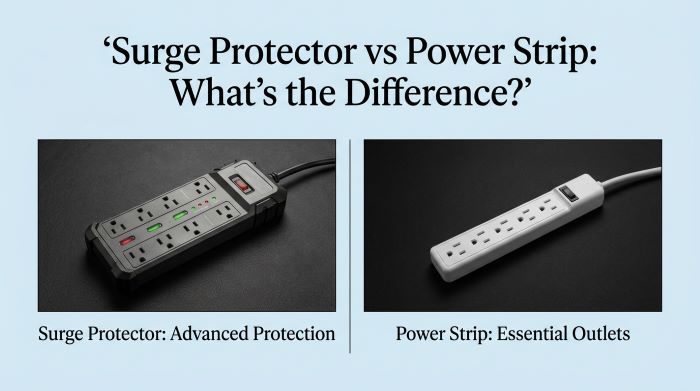
Surge Protector vs Power Strip at a Glance
| Feature | Power Strip | Surge Protector |
|---|---|---|
| Main job | Adds more outlets | Adds outlets and blocks voltage spikes |
| Protects electronics | No | Yes |
| Joule rating | None | Usually 600 to 4,000+ joules |
| Indicator light | Power light only | “Protected” light |
| Price | About $5 to $20 | About $15 to $80 |
| Wears out | Rarely | Yes, protection fades over time |
| Best for | Lamps, fans, chargers | TVs, computers, consoles, routers |
| Typical label | Power strip, outlet strip | Surge protector, UL 1449 listed |
What Is a Power Strip?
A power strip is basically an extension cord with several outlets. Most include a circuit breaker that trips if you plug in too much. That protects the strip and your wiring from overload, but it does not protect devices from sudden voltage spikes.
Power strips are fine for simple things that won’t be harmed by a spike, such as:
- Desk lamps
- Fans
- Holiday lights
- Phone chargers (when you’re not worried about the phone)
- Small kitchen gadgets
What Is a Surge Protector?
A surge protector contains parts, usually metal oxide varistors (MOVs), that sense extra voltage and send it safely to the ground wire. This keeps the spike from reaching your devices.
Surges can come from:
- Lightning strikes near power lines
- Power outages and the moment power returns
- Large appliances like air conditioners or refrigerators turning on and off
- Faulty wiring
- Utility company equipment problems
Most surges are small, but they add up and slowly wear down electronics over time. A big one can fry a device instantly.
Power Strip vs Surge Protector: How to Tell Them Apart
If you’re unsure whether you have a power strip vs surge protector, look for these signs:
- Joule rating printed on the device or box.
- A “Protected” or “Grounded” indicator light.
- UL 1449 listing on the label. This is the safety standard for surge protective devices.
- Packaging that says “surge protector” rather than “power strip” or “outlet strip.”
If there’s no joule rating, it’s almost certainly just a power strip.
Key Specs to Check
Joule Rating
The joule rating tells you how much energy a surge protector can absorb before it wears out. Higher is better.
| Joule Rating | Good For |
|---|---|
| Under 600 | Lamps, small chargers |
| 600 to 1,000 | Phones, printers, small electronics |
| 1,000 to 2,000 | Computers, routers, TVs |
| 2,000+ | Home theaters, gaming PCs, expensive gear |
Clamping Voltage
This is the voltage level at which the surge protector starts working. Lower is better. Look for 330, 400, or 500 volts. A 330 volt rating gives the best protection.
Response Time
This shows how fast the protector reacts. Look for 1 nanosecond or less.
Warranty and Connected Equipment Coverage
Many brands offer coverage for devices damaged while plugged in. Read the fine print, but it’s a nice bonus.
Surge Protectors Wear Out
Here’s something many people don’t know: surge protectors have a lifespan. Each surge uses up some of their joule capacity. After a big hit or years of small ones, they stop protecting your devices but keep supplying power. You won’t notice the difference.
Signs it’s time to replace yours:
- The “Protected” light is off
- It’s more than three to five years old
- You’ve had a big storm or power outage
- It feels hot or smells like burning plastic
Surge Protector for House: Whole Home Protection
A plug in surge protector only guards the devices plugged into it. A surge protector for house wiring, called a whole house surge protector, is installed at your electrical panel or meter. It protects every circuit in your home, including appliances that don’t plug into a strip, like your HVAC system, water heater, and washing machine.
Types of whole house protection:
- Type 1: Installed between the utility line and your main panel.
- Type 2: Installed at the main panel. This is the most common choice for homes.
- Type 3: Point of use devices, such as plug in surge protectors.
A whole house unit usually costs about $100 to $500 for the device, plus a licensed electrician’s labor. The 2020 National Electrical Code began requiring surge protection for new and replaced residential electrical services, so many newer homes already have one.
Best approach: Experts recommend layered protection. Use a surge protector for house wiring at the panel, plus plug in surge protectors for your most valuable electronics. The whole house unit stops large outside surges, while the plug in units catch smaller spikes from inside the home.
Safety Tips
Whether you use a power strip vs surge protector, follow these safety rules:
- Never daisy chain. Don’t plug one strip or surge protector into another.
- Don’t overload. Avoid space heaters, microwaves, and other high wattage appliances.
- Keep cords visible. Don’t run them under rugs or furniture.
- Use outdoor rated strips outside. Indoor strips aren’t made for moisture.
- Replace damaged cords right away.
Where to Use Each One
| Device | Power Strip | Surge Protector |
|---|---|---|
| TV and soundbar | ✓ | |
| Desktop computer | ✓ | |
| Gaming console | ✓ | |
| Wi Fi router and modem | ✓ | |
| Desk lamp | ✓ | |
| Fan | ✓ | |
| Holiday lights | ✓ | |
| Phone charger | ✓ | ✓ (better) |
| Space heater | Neither: plug into a wall outlet |
Surge Protector vs Power Strip: Cost Comparison
Price is often why people choose a basic strip. But the surge protector vs power strip cost gap is small compared with what you’re protecting.
| Option | Typical Cost | What It Protects |
|---|---|---|
| Basic power strip | $5 to $20 | Nothing from surges |
| Entry level surge protector | $15 to $30 | Phones, lamps, small devices |
| Mid range surge protector | $30 to $60 | TVs, computers, consoles |
| Premium surge protector | $60 to $100+ | Home theaters, gaming PCs |
| Whole house unit, installed | A few hundred dollars | Every circuit in your home |
Spending $40 to protect a $1,500 TV or computer is an easy decision.
Buying Checklist
Before you buy, run through this surge protector vs power strip checklist:
- Check the label. Does it say surge protector and list a joule rating?
- Look for UL 1449. This confirms it meets safety standards.
- Count outlets. Buy more than you need right now.
- Check outlet spacing. Wide spaced outlets fit bulky adapters.
- Consider USB ports. Handy for charging phones and tablets.
- Look for a protection light. It tells you when protection is gone.
- Pick the right cord length. Avoid adding extension cords later.
Home Office Setup Example
A smart home office uses both. Plug your computer, monitor, and router into a surge protector with at least 1,000 joules. Plug the desk lamp and fan into a basic power strip. This mix gives you the best of the surge protector vs power strip choice: protection where it counts and savings where it doesn’t. When people ask about power strip vs surge protector setups, this simple split is the easiest answer.
Do You Need One for Every Room?
Not every room needs a surge protector. Focus on rooms with expensive or sensitive electronics, such as the living room, home office, and gaming area. Bedrooms with only a lamp and phone charger can use a basic strip, though a small surge protector is cheap peace of mind. Kitchens are different. Major appliances should plug straight into the wall, and a whole home unit is the best way to protect them.
Frequently Asked Questions
Is a power strip the same as a surge protector? No. A power strip only adds outlets. A surge protector adds outlets and blocks power spikes.
How many joules do I need? At least 1,000 joules for computers and TVs. Go for 2,000 or more for expensive home theater gear.
Can a surge protector stop a direct lightning strike? No device can fully stop a direct strike. Unplug valuable electronics during severe storms.
Do I need a surge protector for my phone charger? Not always, but it’s cheap insurance for an expensive phone.
Final Thoughts
The surge protector vs power strip difference comes down to protection. A power strip adds outlets. A surge protector adds outlets and keeps your electronics safe. For anything valuable, spend a few extra dollars on a quality surge protector, and consider a whole home unit for complete coverage.
Key Takeaways
- Surge protector vs power strip: a power strip adds outlets, while a surge protector also blocks voltage spikes.
- Look for a joule rating, a “Protected” light, and a UL 1449 listing on surge protectors.
- Choose at least 1,000 joules for TVs and computers, and a clamping voltage of 330 to 400 volts.
- Surge protectors wear out; replace them every three to five years or after a big surge.
- A surge protector for house wiring protects every circuit and works best paired with plug in units.
- Never daisy chain strips or plug space heaters into them.