
How to Test Smoke Detectors
A smoke detector sits on the ceiling for years and asks for almost nothing. Then, on the one night it matters, it has seconds to wake you up. The only way to know it will work is to test it. Learning how to test smoke detectors takes about a minute per alarm, and fire safety groups advise doing it once a month.
This guide walks through the test for battery-powered, hardwired, interconnected, and smart alarms. It also covers real smoke tests, cleaning, battery changes, replacement dates, and fixes for common problems such as chirping.
Why Testing Matters
A smoke alarm can fail without any sign. Batteries drain. Dust clogs the sensing chamber. Wires loosen. Sensors wear out with age. An alarm that looks fine on the ceiling may be dead.
According to the National Fire Protection Association, roughly three out of five home fire deaths happen in homes with no smoke alarms or with alarms that do not work. Dead or missing batteries are a leading cause of failure. A working alarm gives you time to get out, and in a modern house fire, that time can be as short as a few minutes.
Quick Answer
- Tell everyone in the home that you are about to test.
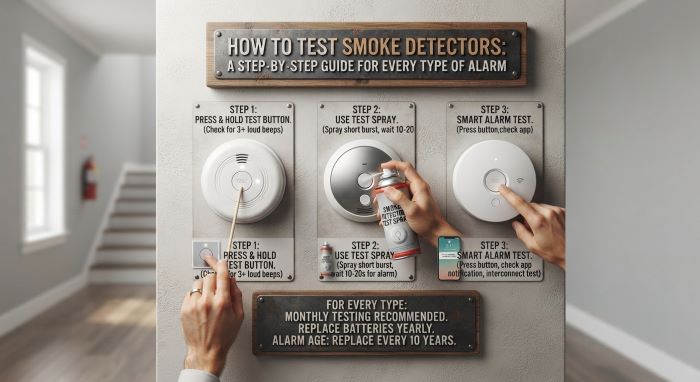
- Press and hold the test button on the alarm for a few seconds.
- Listen for a loud, steady alarm sound.
- Release the button and wait for the sound to stop.
- Repeat for every alarm in the home.
If the sound is weak or missing, replace the battery and test again. If it still fails, replace the alarm.
Know Your Alarm Type
| Type | Power Source | How to Identify It |
|---|---|---|
| Battery powered | 9-volt or AA batteries | A battery door, no wires to the ceiling |
| Sealed 10-year battery | Built-in lithium battery | No battery door, often labeled “10-year” |
| Hardwired with battery backup | Home wiring plus a backup battery | A steady green light and wires behind the unit |
| Interconnected | Wired or wireless link between alarms | When one sounds, all sound |
| Smart alarm | Battery or hardwired, with Wi-Fi | Connects to a phone app |
| Combination smoke and carbon monoxide | Any of the above | Labeled for both hazards |
Smoke alarms also differ in how they sense smoke.
- Ionization alarms respond faster to fast, flaming fires.
- Photoelectric alarms respond faster to slow, smoldering fires.
- Dual-sensor alarms contain both.
Fire safety groups recommend having both kinds of sensing in the home, either with dual-sensor units or a mix of the two types. The steps for how to test smoke detectors are the same for each.
What You Need
- A sturdy step stool or ladder
- A broom handle, if you cannot reach the button safely
- Fresh batteries of the right size
- Ear protection, since alarms are very loud at close range
- A helper, for large homes and interconnected systems
- A vacuum with a soft brush attachment
Step-by-Step: How to Test Smoke Detectors
Step 1: Warn Your Household
Tell everyone that a test is coming. The sound can frighten small children, older adults, and pets. If your alarms connect to a monitored security system, call the monitoring company first or put the system in test mode. Otherwise, the fire department may be sent to your home.
Step 2: Check the Light
Look at the indicator light. Many battery alarms flash a red light about once a minute. Hardwired alarms usually show a steady green light for power. No light at all can mean no power.
Step 3: Press and Hold the Test Button
Stand on a stable stool, or use a broom handle from the floor. Press the test button and hold it. Some alarms respond at once. Others take up to five or ten seconds.
Step 4: Listen
The alarm should give a loud, piercing sound. A standard alarm reaches about 85 decibels at ten feet. Many models beep in a pattern of three. Some speak a message such as “Fire.”
Step 5: Release and Wait
Let go of the button. The sound should stop within a few seconds.
Step 6: Check From Other Rooms
Have a helper stand in the farthest bedroom with the door closed. They should hear the alarm clearly. If they cannot, you need more alarms or an interconnected system.
Step 7: Repeat for Every Alarm
Test each unit on every level. Do not assume that one working alarm means the rest are fine.
Step 8: Record the Date
Write the test date on a calendar or set a monthly phone reminder.
Testing Interconnected Alarms
Many guides on how to test smoke detectors skip this part. In an interconnected system, one alarm that senses smoke sets off all the others. Newer homes are usually built this way.
- Press the test button on one alarm.
- Walk through the home, or ask a helper to confirm that every other alarm sounds.
- Repeat from a different alarm, so you check the link in both directions.
If one unit stays quiet, that unit or its connection has a fault. Check its battery, reseat it on its mounting plate, and test again.
Testing Hardwired Alarms
Hardwired alarms run on household current and keep a backup battery for outages.
- Confirm the green power light is on.
- Press the test button and listen.
- To check the backup battery, some owners switch off the circuit breaker that feeds the alarms and test again. The alarm should still sound on battery power alone. Turn the breaker back on when you finish.
If the green light is off, check the breaker. If the breaker is on and the light is still off, call an electrician.
Testing Sealed 10-Year Alarms
These alarms have a built-in battery that lasts the life of the unit. You cannot replace it. Test them with the button like any other alarm. When the unit reaches the end of its life, it will chirp, and you replace the whole alarm.
Testing Smart Alarms
Smart alarms from brands such as Google Nest, First Alert, and Kidde often test themselves and report results in an app. You should still run a manual test.
- Open the app and look for a safety check or test option, or press the button on the unit.
- Follow the spoken prompts.
- Confirm that your phone receives the alert.
- Check that each alarm in the home takes part.
Keep the app updated, and check that alerts are allowed in your phone’s settings.
Testing Combination Smoke and Carbon Monoxide Alarms
One button tests both functions on most combination units. Hold it until the alarm runs through its patterns. Many give three beeps for smoke and four beeps for carbon monoxide. Read the label on the unit so you know which is which.
Does the Test Button Check the Sensor?
On alarms sold today, the test button checks the circuitry, the battery, and the horn, and on most models it also simulates smoke in the sensing chamber. That makes it a reliable monthly check.
A few times a year, or when you have doubts, you can add a real smoke test.
How to Do a Real Smoke Test
The safest method is canned smoke detector test spray, sold at hardware stores.
- Read the directions on the can.
- Hold the can two to four feet from the alarm.
- Spray a short burst toward the vents.
- Wait up to ten seconds for the alarm to sound.
- Fan the air or press the hush button to clear it.
Do not hold a lit candle, match, or lighter up to the alarm. An open flame near the ceiling is a fire hazard and can damage the unit. Use only products made for testing.
How Often to Test and Maintain
| Task | How Often |
|---|---|
| Press the test button | Once a month |
| Vacuum dust from the vents | Every six months |
| Replace standard batteries | At least once a year, or when the alarm chirps |
| Real smoke test with test spray | Once or twice a year, if desired |
| Replace the whole alarm | Every 10 years from the date of manufacture |
| Replace carbon monoxide or combination alarms | Every 5 to 10 years, as the label states |
A simple habit is to change batteries when the clocks change in spring or fall. Some people test on the first day of each month.
When someone asks how to test smoke alarm units “the right way,” the honest reply is that regular beats perfect. A quick monthly press of the button does more good than a careful test once every few years.
How to Find the Expiration Date
Smoke alarms do not last forever. Sensors lose sensitivity over time.
- Twist the alarm off its mounting plate.
- Look at the back for a date of manufacture.
- Add ten years. If that date has passed, replace the alarm.
- If you find no date, the alarm is likely very old. Replace it.
Write the install date on the side of each new alarm with a marker.
How to Change the Battery
- Open the battery door, or twist the alarm off its base.
- Remove the old battery.
- Insert a new one, matching the plus and minus marks.
- Close the door until it clicks.
- Press the test button.
Use the battery type named on the label. Do not borrow smoke alarm batteries for remotes or toys.
How to Clean a Smoke Alarm
Dust and cobwebs cause false alarms and can block smoke from reaching the sensor.
- Vacuum around the vents with a soft brush attachment.
- Wipe the outside with a dry or slightly damp cloth.
- Never spray cleaners on the alarm.
- Never paint over it.
- Cover alarms during dusty work such as sanding, then uncover them right away.
Where Smoke Alarms Should Be
Testing does little good if alarms are missing from key spots. The National Fire Protection Association advises placing alarms:
- Inside every bedroom
- Outside each sleeping area, such as a hallway
- On every level of the home, including the basement
- On the ceiling or high on a wall, since smoke rises
- At least ten feet from cooking appliances, to cut false alarms
- Away from windows, vents, and fans that can blow smoke aside
Larger homes need more alarms. Local codes may add rules, mainly for new construction and rentals.
Troubleshooting
| Problem | Likely Cause | Fix |
|---|---|---|
| No sound when tested | Dead battery, no power, or a failed unit | Replace the battery or check the breaker. Replace the alarm if it still fails |
| Weak or odd sound | Low battery or a failing horn | Replace the battery, then the alarm |
| Chirp every 30 to 60 seconds | Low battery | Replace the battery |
| Chirping after a new battery | Old alarm, loose battery door, or leftover charge | Reseat the battery, hold the test button for 15 seconds, and check the age |
| Chirping on a sealed unit | End of life | Replace the alarm |
| False alarms while cooking | Too close to the stove | Move the alarm or use one with a hush button |
| False alarms from showers | Steam | Move the alarm away from the bathroom door |
| Random alarms at night | Dust, insects, humidity, or age | Clean it. Replace it if it is old |
| One interconnected unit silent | Bad unit or wiring | Reseat or replace the unit, or call an electrician |
| Green light off | Tripped breaker or loose wiring | Reset the breaker or call an electrician |
Never take out the battery or disconnect an alarm to stop nuisance sounds. Fix the cause. A disabled alarm is the most common reason people are caught without warning.
Safety Tips While Testing
A fall from a stool is a real risk, so learn how to test smoke detectors without getting hurt.
- Use a stable step stool on a flat floor. Do not stand on a chair with wheels.
- Keep three points of contact on a ladder.
- Wear earplugs or cover your ears.
- Use a broom handle or a pole for high ceilings.
- Ask for help if you have balance or mobility limits. Many fire departments and community groups will test or install alarms for older adults and people with disabilities.
Special Situations
Renters. Landlords are generally required to provide working alarms, and tenants are usually expected to test them and report problems. Rules vary by state and city. Tell your landlord in writing if an alarm fails.
People who are deaf or hard of hearing. Special alarms use strobe lights and bed shakers. Test these features along with the sound.
Homes with children. Let children hear the alarm during a test, so they know what it means. Studies suggest that some children sleep through standard alarms, which makes a family escape plan even more important.
Vacation homes and rentals. Test alarms at the start of each stay.
Pair Testing With an Escape Plan
An alarm only buys time. Use it well.
- Draw a map of your home with two ways out of every room.
- Pick a meeting place outside, such as a mailbox or a tree.
- Practice a fire drill twice a year, once during the day and once at night.
- Teach everyone to get low under smoke and to never go back inside.
- Call the fire department from outside.
Frequently Asked Questions
How often should I test my smoke alarms? Once a month.
How long should I hold the test button? Until the alarm sounds, which can take up to ten seconds.
Is the process for how to test smoke alarm units the same for every brand? The basic steps are the same. Check the manual for brand-specific signals.
Can I test with a candle or a match? No. Use the test button or canned test smoke.
Why does my alarm chirp? Most often, the battery is low. On older or sealed units, it can mean the alarm has reached the end of its life.
How long do smoke alarms last? Ten years from the date of manufacture.
Do hardwired alarms need batteries? Most have a backup battery that needs to be replaced unless it is a sealed type.
Do smart alarms need manual tests? Yes. Self-checks help, but a monthly manual test is still advised.
What if the alarm does not sound after a new battery? Replace the alarm.
Will testing call the fire department? Only if your alarms are tied to a monitored system. Call your provider before you test.
Final Thoughts
Knowing how to test smoke detectors is one of the simplest ways to protect your household. Press the button on every alarm once a month. Replace standard batteries at least once a year. Vacuum the vents twice a year. Replace each alarm when it turns ten.
Add a practiced escape plan, and you have covered the basics of home fire safety. If you have not tested in a while, do it today. It takes a few minutes, and now that you know how to test smoke detectors of every type, you can be sure they are ready on the night you need them. Share these steps on how to test smoke alarm units with family and neighbors, too.
Key Takeaways
- The core of how to test smoke detectors is simple: press and hold the test button until the alarm sounds, once a month.
- Test every alarm in the home, and confirm that interconnected alarms all sound together.
- Replace standard batteries at least once a year and whenever an alarm chirps.
- Replace every smoke alarm 10 years after its date of manufacture.
- Use canned test smoke for a real smoke test, and never use an open flame.
- Place alarms in every bedroom, outside sleeping areas, and on every level.
- Never disable an alarm to stop false alerts. Clean it, move it, or replace it.