Memorial Day vs Veterans Day
Every year, Americans pause twice to honor the military. Once in late May and once in November. Many people mix the two holidays up, and some even thank living veterans on the wrong day. That’s an easy mistake, but the difference matters a lot to military families.
This guide breaks down Memorial Day vs Veterans Day in plain English. You’ll learn what each holiday honors, how they started, when they fall, and how to mark each one the right way.
The Short Answer
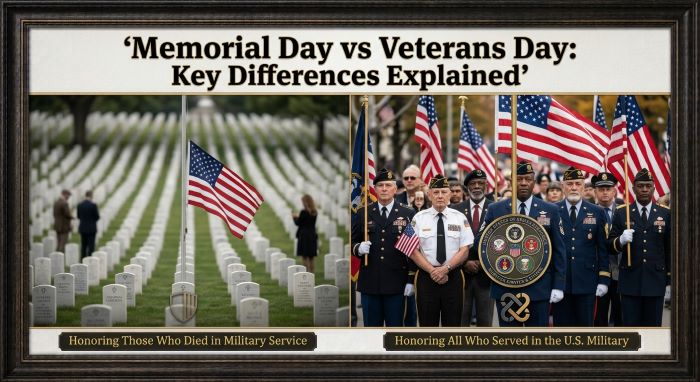
Memorial Day honors the men and women who died while serving in the US military. Veterans Day honors everyone who has served, living or dead, with a special focus on thanking living veterans.
A simple way to remember it: Memorial Day is for remembering. Veterans Day is for thanking.
Quick Comparison Table
| Feature | Memorial Day | Veterans Day |
|---|---|---|
| Who it honors | Service members who died in service | All who served, living and dead |
| Date | Last Monday in May | November 11 every year |
| Mood | Somber, reflective | Grateful, celebratory |
| Started as | Decoration Day (1868) | Armistice Day (1919) |
| Federal holiday since | 1971 (as Memorial Day) | 1938 (as Armistice Day) |
| Common traditions | Grave decorating, flags at half staff until noon | Parades, ceremonies, thanking veterans |
| Symbol | Red poppy | Red poppy and American flag |
| Next date | May 31, 2027 | November 11, 2026 (Wednesday) |
What Is Memorial Day For?
So, what is Memorial Day for? It’s a day to remember the more than one million Americans who have died in the nation’s wars, from the Revolutionary War to recent conflicts. It is a day of mourning, not a celebration of service.
Memorial Day began after the Civil War, which took more lives than any conflict in US history. Communities across the country started decorating soldiers’ graves with flowers each spring. In 1868, General John A. Logan, leader of a Union veterans group, called for a national “Decoration Day” on May 30. Flowers were placed on the graves of both Union and Confederate soldiers at Arlington National Cemetery.
Over time, the name Memorial Day became more common. After World War I, the day grew to honor Americans who died in all wars. In 1968, Congress passed the Uniform Monday Holiday Act, which moved Memorial Day to the last Monday in May starting in 1971. That also made it an official federal holiday.
If you’ve ever wondered what is Memorial Day for beyond barbecues and sales, the answer is simple: it’s for the fallen.
Memorial Day Traditions
- Flags at half staff. The US flag flies at half staff from sunrise until noon, then is raised to full staff.
- National Moment of Remembrance. Americans are asked to pause for one minute at 3:00 p.m. local time.
- Grave decorating. Volunteers place flags on graves at national cemeteries.
- Red poppies. Many people wear poppies, inspired by the World War I poem “In Flanders Fields.”
Veterans Day Meaning
The Veterans Day meaning is gratitude. It’s a day to thank all men and women who have served in the US armed forces, in war or in peacetime. Most of the attention goes to living veterans.
Veterans Day started as Armistice Day. Fighting in World War I stopped on the 11th hour of the 11th day of the 11th month of 1918. President Woodrow Wilson proclaimed the first Armistice Day on November 11, 1919. Congress made it a legal federal holiday in 1938.
After World War II and the Korean War, veterans groups pushed to honor all who served, not just World War I veterans. In 1954, President Dwight D. Eisenhower signed a law changing the name to Veterans Day.
For a few years in the 1970s, Veterans Day moved to a Monday in October. Many Americans disliked the change because November 11 carried so much history. In 1978, the holiday returned to November 11, where it stays no matter what day of the week it falls on.
The Veterans Day meaning is clear in how people celebrate it: parades, school assemblies, free meals for veterans, and simple thank yous.
What Is the Difference Between Memorial Day and Veterans Day?
What is the difference between Memorial Day and Veterans Day? It comes down to three things:
- Who is honored. Memorial Day honors those who died in service. Veterans Day honors all who served.
- The tone. Memorial Day is somber. Veterans Day is grateful and upbeat.
- The date. Memorial Day moves each year (last Monday in May). Veterans Day stays on November 11.
Many veterans say that thanking them on Memorial Day feels a little off. They often use the day to remember friends who didn’t come home. A better Memorial Day message honors the fallen, while a Veterans Day message thanks the person in front of you.
Veterans Day vs Memorial Day: How to Mark Each Day
Knowing Veterans Day vs Memorial Day etiquette helps you show respect the right way.
On Memorial Day:
- Visit a national cemetery or war memorial.
- Join the National Moment of Remembrance at 3:00 p.m.
- Share stories of fallen service members.
- Fly your flag at half staff until noon.
- Avoid saying “Happy Memorial Day” to Gold Star families. “Remembering the fallen today” is more fitting.
On Veterans Day:
- Thank veterans you know for their service.
- Attend a local parade or ceremony.
- Support veteran charities or volunteer at a VA hospital.
- Fly your flag at full staff all day.
- Write letters to veterans in care homes.
Memorial Day vs Veterans Day Dates
| Year | Memorial Day | Veterans Day |
|---|---|---|
| 2026 | May 25 | November 11 (Wednesday) |
| 2027 | May 31 | November 11 (Thursday) |
| 2028 | May 29 | November 11 (Saturday) |
When Veterans Day falls on a weekend, federal workers get the nearest weekday off. In 2028, for example, the federal observance moves to Friday, November 10.
Is Either Day a Paid Holiday?
Both are federal holidays, so federal offices, banks, and post offices close. Schools and private businesses vary. Memorial Day closings are more common, since it always falls on a Monday and kicks off the summer season. Many schools stay open on Veterans Day and hold special assemblies instead.
Armed Forces Day: The Third Military Holiday
There’s a third holiday people sometimes confuse with these two. Armed Forces Day, held on the third Saturday in May, honors people currently serving in the military. So the full picture looks like this:
- Armed Forces Day: Honors those serving now.
- Veterans Day: Honors all who have served.
- Memorial Day: Honors those who died in service.
Other Federal Holidays That Honor Service and Sacrifice
Memorial Day and Veterans Day are two of 11 federal holidays in the United States. Others also honor people who gave their lives to a cause. For example, Dr. Martin Luther King Jr. Day celebrates the civil rights leader’s legacy and is known as a national day of service.
Common Myths
Myth: Memorial Day and Veterans Day are basically the same. Fact: They honor different groups. Mixing them up is the most common mistake people make with Veterans Day vs Memorial Day.
Myth: Veterans Day is spelled “Veteran’s Day.” Fact: The official spelling has no apostrophe. It’s a day for veterans, not a day that belongs to one veteran.
Myth: Memorial Day is just the start of summer. Fact: Sales and cookouts are fine, but the day’s purpose is to honor the fallen.
Memorial Day vs Veterans Day: A Short Timeline
This timeline shows how each holiday grew over time and why the Memorial Day vs Veterans Day line became so clear.
| Year | Event |
|---|---|
| 1868 | First national Decoration Day held on May 30 |
| 1918 | World War I fighting ends on November 11 |
| 1919 | First Armistice Day proclaimed by President Wilson |
| 1938 | Armistice Day becomes a legal federal holiday |
| 1954 | Armistice Day renamed Veterans Day |
| 1971 | Memorial Day moves to the last Monday in May |
| 1978 | Veterans Day returns to November 11 for good |
| 2000 | National Moment of Remembrance created for Memorial Day |
How to Explain Memorial Day vs Veterans Day to Kids
Children often ask what is the difference between Memorial Day and Veterans Day. Keep it simple:
- Memorial Day: “We remember soldiers who died keeping our country safe.”
- Veterans Day: “We say thank you to everyone who served, like Grandpa or a neighbor.”
Hands on activities help the lesson stick. Kids can make paper poppies for Memorial Day, or write thank you cards for local veterans in November. Many schools teach the two holidays with a simple chart, just like the one above.
Why the Memorial Day vs Veterans Day Mix Up Matters
For many veterans, Memorial Day is a hard day. They may be thinking of friends they lost in training or combat. Hearing “thank you for your service” on that day can feel like the focus has shifted away from those who died. Getting the Memorial Day vs Veterans Day difference right is a small way to show you understand what each holiday means to the people it honors. When in doubt, listen first and follow the veteran’s lead.
Both holidays share one goal: making sure service and sacrifice are never forgotten. That’s why learning the difference is worth a few minutes of anyone’s time.
Frequently Asked Questions
Can you say “Happy Memorial Day”? Many people do, but some military families find it odd for a day of mourning. “Have a meaningful Memorial Day” is a gentler choice.
Should I thank a veteran on Memorial Day? It’s kind, but the day is meant for the fallen. Save the thank you for Veterans Day, or simply ask a veteran if there’s someone they’re remembering.
Why is Veterans Day on November 11? It marks the armistice that ended fighting in World War I in 1918.
Which holiday is older? Memorial Day. It began as Decoration Day in 1868, while Armistice Day started in 1919.
Final Thoughts
The Memorial Day vs Veterans Day difference is simple once you know it. Memorial Day is for honoring those who gave their lives. Veterans Day is for thanking everyone who served. Mark each day in its own way, and you’ll show real respect to the people both holidays were created for.
Key Takeaways
- Memorial Day vs Veterans Day comes down to who is honored: the fallen vs all who served.
- Memorial Day falls on the last Monday in May; the next one is May 31, 2027.
- Veterans Day is always November 11; in 2026 it falls on a Wednesday.
- Memorial Day began as Decoration Day in 1868; Veterans Day began as Armistice Day in 1919.
- Flags fly at half staff until noon on Memorial Day and at full staff on Veterans Day.
- Armed Forces Day, in May, honors those currently serving.