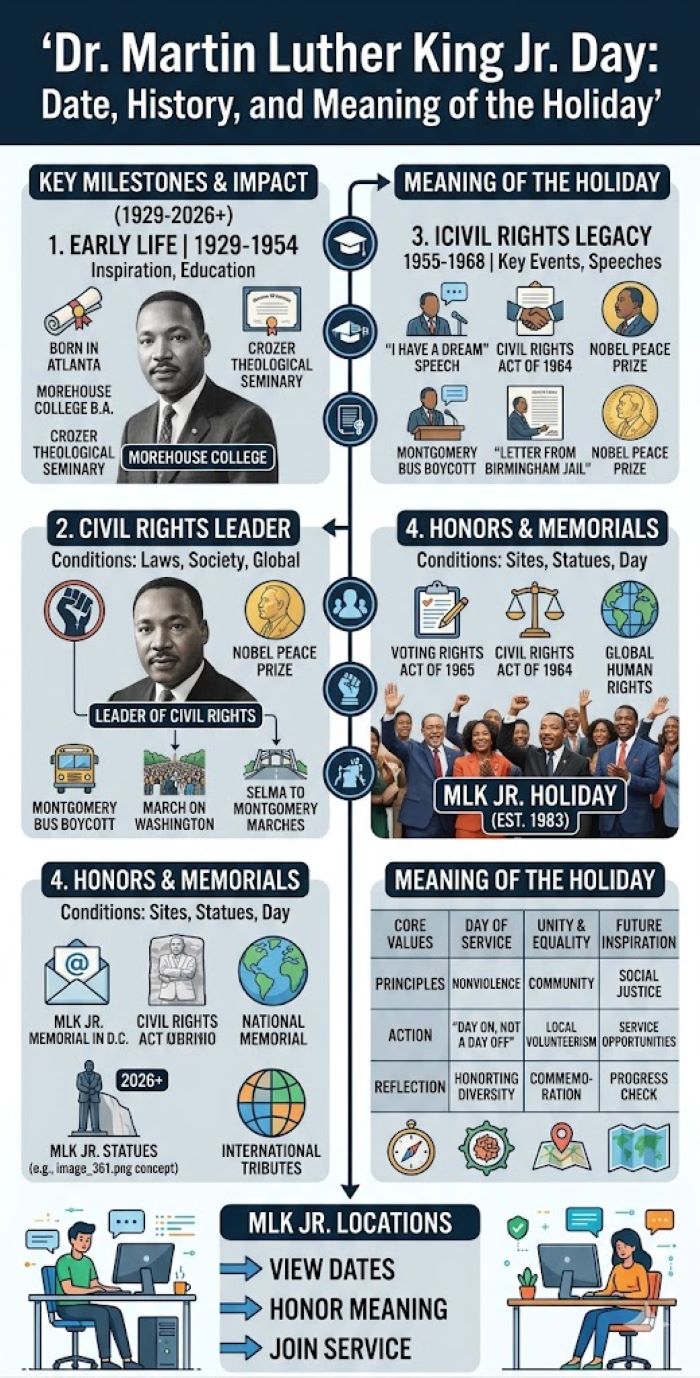
Dr. Martin Luther King Jr. Day: Date, History, and Meaning of the Holiday
Every January, the country pauses to honor one of the most important figures in American history. Dr. Martin Luther King Jr. Day is more than a long weekend. It is a national moment to reflect on the civil rights leader who reshaped the nation through nonviolent activism, and on the work that remains. This guide answers the most common questions people have, from the exact date this year to the history of the holiday and the life of the man it celebrates.
Whether you are planning around the day off, teaching children about its meaning, or simply curious about its origins, here is a clear and complete look at the holiday, the man, and the legacy that keeps drawing people back to his example year after year.
When Is the Holiday in 2026?
The most searched question every January is simply when the holiday falls. So when is MLK Day 2026? It lands on Monday, January 19, 2026. The holiday always falls on the third Monday of January, which keeps it close to the birthday of the man it honors.
People phrase the question many ways, but the answer is the same. When is Martin Luther King Day in 2026? Monday, January 19. When is MLK Day in general? Always the third Monday of January, which shifts the calendar date slightly each year. For comparison, MLK Day 2025 fell on January 20, while Martin Luther King Day 2025 coincided with a presidential inauguration, a rare overlap that drew extra attention that year.
Because it falls on a Monday, the holiday creates a three-day weekend for many Americans. MLK Weekend 2026 runs Saturday, January 17 through Monday, January 19, giving families time to attend events, volunteer, or simply rest. If you are trying to confirm when is MLK Day 2026 for travel or work planning, mark Monday, January 19 on your calendar, and remember that the Martin Luther King Day 2026 date follows the same third-Monday rule every year.
Why the Third Monday of January?
The date is not random. The third Monday was chosen to fall close to the leader’s actual birthday without being fixed to it. This connects to a broader pattern in how the United States schedules holidays.
The Uniform Monday Holiday Act, signed in 1968, moved several federal holidays to Mondays to create reliable three-day weekends. That is why the holiday, like Presidents’ Day and Memorial Day, always lands on a Monday rather than a fixed calendar date. Keeping it near the mid-January birthday preserves the link to the man being honored while giving the country a consistent long weekend.
This scheduling also explains why the date moves each year. In 2025 it was January 20, in 2026 it is January 19, in 2027 it will be January 18, and in 2028 it will be January 17, always the third Monday. So if you ever wonder when is Martin Luther King Day in a future year, the rule, not a fixed number, gives you the answer.
Is MLK Day a Federal Holiday?
A frequent question is whether the day is an official federal holiday, and the answer is yes. So is MLK Day a federal holiday? It absolutely is, and it has been since the 1980s. It is one of eleven federal holidays recognized by the United States government.
Confirming that the day carries federal status matters for practical reasons. On the day, federal offices, courts, and post offices close, mail is not delivered, and most banks shut their doors, though online banking and ATMs still work. The financial markets observe the holiday as well. Many private businesses, however, remain open, including major retailers and grocery stores, so whether you personally get the day off depends on your employer rather than the holiday status itself.
The road to making it a federal holiday was long and hard-fought, which makes its status all the more meaningful. Understanding that history helps explain why the question of its federal recognition carried such weight for so many years before it was finally settled.
The History of the Holiday
The push for a national holiday began almost immediately after the leader’s assassination in 1968. A bill to establish a commemoration was introduced just days after his death, but it faced years of resistance and repeated failures in Congress.
The campaign stretched across fifteen years. Supporters, including King’s family, civil rights organizations, and labor unions, kept the effort alive through petitions, advocacy, and public pressure. Finally, on November 2, 1983, President Ronald Reagan signed the bill into law, establishing the holiday. The first federal observance came in 1986, which means 2026 marks the 40th anniversary of that first celebration.
Even after the federal holiday was established, full national adoption took longer. Some states resisted or combined it with other commemorations, and it was not until the year 2000 that all fifty states officially recognized it. The leader honored by the day holds a unique distinction: he is the only non-president with a federal holiday in his name, a measure of how profoundly his work changed the country.
Who Was Martin Luther King Jr.?
To understand the holiday, you have to understand the man. Martin Luther King Jr. was a Baptist minister and the most prominent leader of the American civil rights movement, known for his commitment to nonviolent resistance as a tool for social change.
Born Michael King Jr. on January 15, 1929, in Atlanta, Georgia, he was later renamed in tribute to the Protestant reformer Martin Luther after his father adopted the name. He grew up in a religious family, excelled academically, and entered the ministry, earning a doctorate in theology. Those early years shaped the moral and spiritual framework that would define his leadership.
Many people search for the MLK birthday because of how close it sits to the holiday. So when is Martin Luther King birthday exactly? He was born on January 15, 1929. The birthday and the holiday are deliberately linked but not identical, since the observance moves to the nearest third Monday rather than landing on January 15 each year. Knowing the actual MLK birthday helps explain why the holiday clusters in mid-January, honoring the date he entered the world even when the official day off falls a few days later.
What Did Martin Luther King Do?
The question of what did Martin Luther King do has a long answer, because his influence spanned more than a decade of pivotal events. He rose to national prominence as the leader of the Montgomery Bus Boycott in 1955 and 1956, a year-long protest against segregated public transportation that ended in a Supreme Court victory.
From there, his work only expanded. His record includes a series of landmark moments: he helped found and lead the Southern Christian Leadership Conference, organized campaigns against segregation across the South, and delivered his most famous address at the 1963 March on Washington, where he spoke movingly about his dream of a nation free of racial injustice. He won the Nobel Peace Prize in 1964, the youngest person at the time to receive it, and his advocacy helped drive the passage of the Civil Rights Act of 1964 and the Voting Rights Act of 1965.
Understanding his full impact also means recognizing the cost. He was arrested dozens of times, faced constant threats, and was assassinated on April 4, 1968, in Memphis, Tennessee, at the age of thirty-nine. His method of nonviolent resistance, drawn partly from the example of Gandhi, became a model for movements around the world. The breadth of his accomplishments is exactly why the country set aside a day in his honor.
How the Day Is Observed
Unlike many holidays focused on rest or celebration, this one carries a call to action. In 1994, Congress designated it a National Day of Service, encouraging Americans to spend the day volunteering and giving back to their communities, an idea often summarized as a day on, not a day off.
Across the country, the day brings a wide range of activities. Communities hold marches, parades, and commemorative ceremonies. Schools and organizations host educational programs about the civil rights movement. Volunteers serve at food banks, schools, parks, and shelters as part of the day of service. Churches and community groups hold events that reflect on the leader’s message and the work still ahead.
This service-oriented spirit sets the holiday apart. Rather than simply marking a historical figure, the day asks people to carry his values forward through concrete action. Many find that volunteering or attending a local event makes the holiday far more meaningful than a day spent at home, turning reflection into participation.
The Many Names of the Holiday
One reason the holiday generates so many searches is that people refer to it by many different names. Officially it carries his full formal name, but in everyday use it goes by a range of shorthand titles.
Most commonly, people simply call it MLK Day, the quickest and most popular shorthand. Others say Martin Luther King Day, or the fuller Martin Luther King Jr. Day. Some shorten it informally to King Day, and a number of people searching online even type Kings Day when looking for this holiday, though that spelling more precisely refers to other observances elsewhere in the world. In Spanish-speaking communities, the day is known as Día de Martin Luther King Jr., reflecting how widely the figure is honored across cultures.
All of these names point to the same federal holiday on the third Monday of January. Whether you search MLK Day, Martin Luther King Day, or Día de Martin Luther King Jr., you will land on the same observance. The variety of names is simply a sign of how deeply the day is woven into American life, recognized across languages and communities under many labels but always honoring the same person and the same legacy.
Finding National Days and Observances
People often discover holidays like this one while browsing daily observances, and a common search is what national day is it tomorrow. There are now hundreds of recognized national days throughout the year, ranging from major federal holidays to lighthearted single-day observances.
If you find yourself checking the calendar of observances, several websites track these day by day, listing everything from federal holidays to quirky food and awareness days. Among all of them, the major federal holidays like this one carry official weight, closing government offices and banks, while most national days are informal and simply offer a reason to celebrate or learn something. So when a search for what national day is it tomorrow turns up a mid-January Monday, there is a good chance the answer is this federal holiday honoring the civil rights leader.
Knowing the difference helps. Federal holidays are established by law and bring closures, while the vast catalog of national days are cultural observances without official status. This holiday sits firmly in the first category, which is why it shapes work schedules, school calendars, and business hours in a way that most national days do not.
Why the Day Still Matters
Decades after it was established, the holiday remains deeply relevant. It is not just a commemoration of the past but an invitation to consider the present. The values at its heart, equality, justice, and nonviolent change, continue to resonate in conversations about fairness and opportunity today.
For families, the day offers a chance to teach children about a pivotal chapter in American history and the people who shaped it. For communities, it provides a shared moment to come together through service and reflection. For the country as a whole, it is a reminder that progress often comes through sustained, peaceful effort rather than a single dramatic event.
That enduring relevance is why the holiday endures and why so many people seek to understand it more fully each January. Honoring the legacy means more than knowing the date. It means engaging with the ideas the leader stood for and considering how they apply to the world now.
Famous Speeches and the Power of His Words
Part of what made the civil rights leader so effective was his extraordinary gift for oratory. Martin Luther King moved millions through speeches and writings that blended moral clarity with soaring language, and his words remain among the most studied in American history.
His best-known address came at the 1963 March on Washington for Jobs and Freedom, delivered from the steps of the Lincoln Memorial before a crowd of more than 200,000 people. Widely known as the “I Have a Dream” speech, it laid out a vision of a nation where children would be judged by their character rather than their race, and it became a defining moment of the movement. Earlier that same year, while jailed for protesting segregation, Martin Luther King wrote his “Letter from Birmingham Jail,” a powerful defense of nonviolent resistance and the moral duty to confront injustice.
These works are why Dr. Martin Luther King Jr. Day is so often marked with readings, recitations, and quiet reflection. Rather than reproduce his speeches, which remain under copyright, schools and communities study their themes and their place in history. Engaging with the ideas behind the words, equality, justice, and peaceful change, is exactly the kind of reflection the holiday was created to encourage.
What Is Open and Closed on the Holiday
Because it is a federal holiday, the day brings predictable closures. On MLK Day 2026, federal government offices, federal courts, and post offices will be closed, and there will be no regular mail delivery. Most banks close as well, though online banking, mobile apps, and ATMs keep working, and the major stock exchanges observe the holiday too.
The private sector is a different story. On MLK Day 2026, many large retailers stay open, including major national chains, along with most grocery stores and pharmacies, though their hours may be adjusted, so checking with your local store is wise. Whether you personally have the day off depends on your employer, since private companies are not required to observe federal holidays even though Dr. Martin Luther King Jr. Day is officially recognized.
Schools and many public institutions typically close, and public transit may run on a holiday or reduced schedule. If you are planning errands, travel, or appointments around the long weekend, it helps to confirm hours in advance, since the mix of closures and open businesses can be confusing. The simplest rule of thumb is that anything government-run will be closed while most everyday shopping stays available.
The Holiday Through the Years
Because the observance follows the third-Monday rule, its calendar date shifts annually, which is why people look it up fresh each year. Glancing across recent and upcoming years shows the pattern clearly.
Martin Luther King Day 2025 fell on January 20, a date that drew unusual attention because it coincided with a presidential inauguration. Martin Luther King Day 2026 lands on January 19. The following year, the holiday moves to January 18, 2027, and then to January 17, 2028, always settling on the third Monday of the month. The date never strays far from the mid-January birthday it honors.
This yearly shift is also why interest spikes each winter as people confirm the exact date. Knowing that Dr. Martin Luther King Jr. Day always falls on the third Monday of January lets you work out any year’s date without looking it up, but the small annual movement keeps the question coming back. Marking it early helps with planning the three-day weekend it reliably creates.
Teaching the Next Generation
For many families and schools, the holiday is a chance to introduce children to a defining chapter of American history. Dr. Martin Luther King Jr. Day offers an age-appropriate entry point into big ideas like fairness, courage, and standing up for what is right.
Teachers often use the day to share the story of Martin Luther King in ways young learners can grasp, focusing on his message of treating everyone equally and solving problems without violence. Picture books, age-appropriate videos, and simple service projects help children connect the history to their own lives. Many schools organize activities in the days leading up to the holiday, since classes are usually out on the day itself.
Parents can extend the lesson at home by talking about kindness and fairness, reading a children’s book about the civil rights movement, or volunteering together as a family. Framing Dr. Martin Luther King Jr. Day as both a celebration and a responsibility helps children understand why the country sets aside a day in his honor, and plants values that last well beyond a single Monday in January.
Ways to Mark the Day Meaningfully
If you want to do more than enjoy the time off, there are many ways to honor the occasion. The most direct is to take part in the National Day of Service by volunteering, whether at a food bank, a shelter, a school, or a community cleanup. Service captures the spirit of the day better than almost anything else.
Beyond volunteering, you might attend a local march, parade, or commemorative event, many of which are free and open to the public. Reading about the civil rights movement, watching a documentary, or supporting organizations that continue this work are quieter ways to engage. Families can talk together about fairness and equality, turning Dr. Martin Luther King Jr. Day into a shared conversation rather than just a date on the calendar. However you choose to spend it, approaching the day with intention is what gives it lasting meaning.
Frequently Asked Questions
When is MLK Day 2026? It falls on Monday, January 19, 2026, the third Monday of January, as it does every year.
Is MLK Day a federal holiday? Yes. It is one of eleven federal holidays, meaning federal offices, courts, post offices, and most banks close, though many private businesses stay open.
What is the actual birthday being honored? The leader was born on January 15, 1929. The holiday falls on the nearest third Monday rather than the exact birthday.
Why does the date change each year? Because the holiday is fixed to the third Monday of January under the Uniform Monday Holiday Act, the calendar date shifts slightly from year to year.
When did it become a federal holiday? President Reagan signed it into law on November 2, 1983, and the first federal observance was in 1986, with all fifty states recognizing it by the year 2000.
Is everything closed on the holiday? Government offices, banks, and mail service close, but many stores, grocers, and pharmacies remain open, often with regular or adjusted hours.
How are people encouraged to spend the day? Since 1994 it has been a National Day of Service, encouraging volunteering and community work rather than only rest.
Key Takeaways
- Dr. Martin Luther King Jr. Day in 2026 falls on Monday, January 19, the third Monday of January, with MLK Weekend 2026 running from Saturday the 17th through that Monday.
- The answer to when is MLK Day is always the third Monday of January, so MLK Day 2025 was January 20 and MLK Day 2026 is January 19, with the date shifting yearly.
- Yes, it is a federal holiday, one of eleven, which closes federal offices, courts, post offices, and most banks while many businesses stay open.
- President Reagan signed the holiday into law in 1983, the first observance came in 1986, making 2026 its 40th anniversary, and all fifty states recognized it by 2000.
- The MLK birthday is January 15, 1929, so when people ask when is Martin Luther King birthday, that is the date, and the holiday is timed to fall near it.
- The question of what did Martin Luther King do spans the Montgomery Bus Boycott, the 1963 March on Washington, the Nobel Peace Prize, and the civil rights and voting rights laws of the mid-1960s.
- Martin Luther King Jr. was a Baptist minister and the foremost leader of the civil rights movement, known for nonviolent resistance, who was assassinated on April 4, 1968.
- The holiday goes by many names, including MLK Day, Martin Luther King Day, Martin Luther King Jr. Day, King Day, the searched variant Kings Day, and Día de Martin Luther King Jr. in Spanish.
- Since 1994 it has been a National Day of Service, so people searching what national day is it tomorrow in mid-January often find this observance, which carries official weight unlike most national days.
- More than a day off, the holiday endures as a call to reflect on equality and justice and to carry the leader’s values forward through community service.