
Long Distance Moving Companies
A cross country move is one of the biggest projects most people ever take on. You’re packing up an entire life, trusting strangers with it, and hoping it all shows up in one piece hundreds or thousands of miles away. The moving company you choose can make that experience smooth or miserable.
That’s why it pays to research long distance moving companies carefully before you sign anything. Prices vary widely, quality varies even more, and the industry has its share of bad actors.
This guide walks you through what long distance movers do, what they cost in 2026, which companies get strong reviews, and how to protect yourself from scams.
What Counts as a Long Distance Move?
Movers usually call a move “long distance” when it covers more than 100 miles or crosses a state line. Moves that cross state lines are called interstate moves, and they follow federal rules set by the Federal Motor Carrier Safety Administration (FMCSA).
Long distance moves differ from local moves in a few important ways:
- Pricing. Local moves are often charged by the hour. Long distance moves are usually priced by weight and distance.
- Timing. Delivery can take days or weeks, and companies give you a delivery window rather than a set time.
- Regulation. Interstate movers must be registered with the FMCSA and follow federal consumer protection rules.
Types of Long Distance Moving Companies
Not every moving company works the same way. Understanding the main types helps you compare quotes fairly.
| Type | How It Works | Pros | Cons |
|---|---|---|---|
| Full service van lines | The company packs, loads, transports, and unloads | Least work for you | Highest cost |
| Independent movers | Local companies licensed for interstate moves | Personal service | Smaller networks |
| Moving brokers | Sell your move to a separate carrier | Can find lower prices | Less control over who shows up |
| Moving containers | A container is dropped off, you pack, they ship it | Flexible and affordable | You do the loading |
| Rental trucks | You rent a truck and do everything | Cheapest option | Hard physical work and driving |
One key tip: always ask whether a company is a mover or a broker. Brokers arrange the move but don’t haul your belongings. They must be registered with the FMCSA and can only use registered movers, but you’ll want to know exactly who will handle your items.
Top Rated Long Distance Moving Companies in 2026
Review sites test and rank movers every year. Here are companies that appear on recent 2026 lists, along with what they’re known for:
International Van Lines. Named best overall by ConsumerAffairs, with binding and non binding quotes and service across all 50 states and international moves.
Allied Van Lines. Rated highly by Move.org for flexibility and no deposit moves, with virtual estimates and shipment tracking.
United Van Lines. A premium full service option with full value protection, binding quotes, and shipment tracking.
Colonial Van Lines. Known for trained crews, binding estimates, and a price match guarantee, though deposits can run up to 40%.
American Van Lines. Offers flat rate pricing, GPS tracked trucks, and climate controlled storage.
Roadway Moving. Praised for customer service and for using its own crews and trucks rather than subcontractors.
PODS. A moving container option rated for affordability. You pack and load, and PODS ships the container.
Quick Comparison
| Company | Best Known For | Deposit | Quote Type |
|---|---|---|---|
| International Van Lines | Overall value | Varies, often about 25% | Binding or non binding |
| Allied Van Lines | Flexibility | None | Varies |
| United Van Lines | Premium full service | None | Binding |
| Colonial Van Lines | Trained crews | Up to 40% | Binding |
| American Van Lines | Storage and flat rates | 10% to 50% | Binding |
| Roadway Moving | Customer service | Undisclosed | Online and phone |
| PODS | Budget friendly containers | Varies | Non binding |
Ratings and deposits change, so confirm details directly with each company. The best long distance moving companies for you will depend on your budget, timeline, and how much help you want.
How Much Do Long Distance Moves Cost?
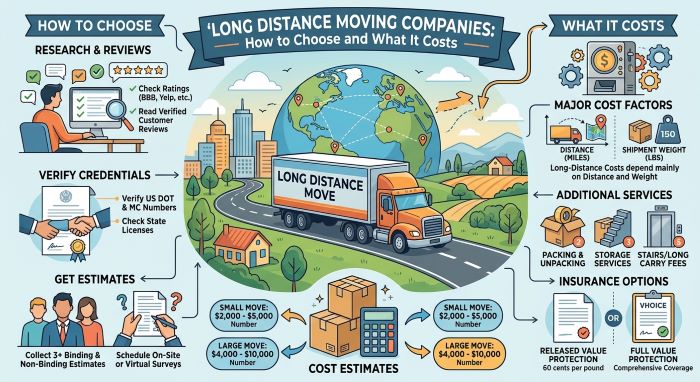
Costs depend mainly on the weight of your belongings and the distance. Here are typical 2026 ranges for a full service move of about 1,000 miles:
| Home Size | Estimated Cost |
|---|---|
| Studio or 1 bedroom | $1,500 to $3,500 |
| 2 bedrooms | $2,500 to $5,500 |
| 3 bedrooms | $3,500 to $7,500 |
| 4 bedrooms | $5,000 to $10,000 |
| 5 or more bedrooms | $7,000 to $14,000 or more |
Cross country household moves with professional movers can reach $7,000 to $14,500 or more. Moving containers often cost $3,000 to $5,000, and rental trucks range from about $1,000 to $5,000 before fuel and lodging.
What Raises the Price
- Peak season. Moving between May and September can cost 20% to 30% more.
- Packing services. Professional packing often adds $300 to $1,000 or more.
- Specialty items. Pianos, pool tables, safes, and artwork cost extra.
- Access problems. Stairs, elevators, long carries, and shuttle trucks add fees.
- Storage. Short term storage between homes increases the total.
- Valuation coverage. Full value protection costs extra but offers better coverage.
Understanding Estimates and Your Rights
Federal rules give you important protections when you hire interstate movers.
Binding vs. Non Binding Estimates
- Binding estimate. You pay the quoted price, as long as you don’t add items or services.
- Non binding estimate. The final price depends on the actual weight. Under federal rules, you don’t have to pay more than 110% of the estimate at delivery. Any extra charges must be billed later, within 30 days.
A binding or “not to exceed” estimate gives you the most price certainty.
Valuation Coverage
Movers must offer two levels of liability:
- Released value protection. Included at no extra cost, but it pays only 60 cents per pound per item. A 10 pound laptop would be covered for just $6.
- Full value protection. Costs extra, but the mover must repair, replace, or pay the current value of lost or damaged items.
Your Rights Booklet
Interstate movers and brokers must give you the FMCSA booklet “Your Rights and Responsibilities When You Move.” Read it before moving day.
Red Flags to Watch For
The moving industry has rogue operators. Watch out for:
- No in home or virtual survey. Accurate estimates require someone to see your belongings.
- Large cash deposits. Be cautious of companies demanding big upfront payments in cash.
- Prices far below others. Lowball quotes often turn into inflated bills on moving day.
- No USDOT number. Interstate movers must be registered. Look up any company at protectyourmove.gov.
- Blank or incomplete paperwork. Never sign documents you don’t understand.
- Holding belongings hostage. Demanding much more than the estimate before unloading violates federal rules.
If something goes wrong, you can file a complaint with the FMCSA online or by calling 1 888 DOT SAFT (1 888 368 7238).
How to Find Long Distance Moving Companies Near Me
When you search for long distance moving companies near me, use these steps to narrow the field:
- Get at least three quotes. Compare prices, services, and estimate types.
- Check registration. Verify each company’s USDOT number and complaint history.
- Read recent reviews. Look for patterns in complaints, especially about delays and surprise charges.
- Ask about subcontractors. Find out whether the company’s own crews will handle your move.
- Get everything in writing. Your estimate, pickup dates, delivery window, and coverage should all be documented.
Local companies that show up when you search long distance moving companies near me can be a great choice too, as long as they’re licensed for interstate moves.
Planning Tips for a Smoother Move
A little planning goes a long way:
- Book early. Reserve your moving company six to eight weeks ahead, or more for summer moves.
- Declutter first. Since cost is based on weight, getting rid of things saves money.
- Pack an essentials box. Keep medications, documents, chargers, and a few days of clothes with you.
- Update your address. File a change of address with the postal service. If you need to visit in person, see this guide to USPS Near Me.
- Think through the details. This guide on Things to Think About Before You Move covers questions people often forget to ask.
Interested in Working in the Industry?
Long distance moves depend on skilled drivers who haul household goods across the country. If you’re curious about that side of the business, this guide to Truck Driving Jobs explains how to start a commercial trucking career.
Final Thoughts
Choosing among long distance moving companies takes time, but it’s worth the effort. Compare several quotes, ask for binding estimates, verify registration, and understand your coverage before moving day. The best long distance moving companies are transparent about pricing, clear about who will move your belongings, and responsive when you have questions. With the right moving company, your next chapter can start without the stress.
Key Takeaways
- Long distance moving companies handle moves over about 100 miles or across state lines, and interstate movers must be registered with the FMCSA.
- Options include full service van lines, independent movers, brokers, moving containers, and rental trucks.
- Highly rated 2026 picks include International Van Lines, Allied, United, Colonial, American Van Lines, Roadway Moving, and PODS.
- A 1,000 mile full service move typically costs $3,500 to $7,500 for a 3 bedroom home, and peak season can add 20% to 30%.
- With a non binding estimate, you don’t have to pay more than 110% at delivery. A binding estimate locks in the price.
- Released value protection pays only 60 cents per pound per item, so consider full value protection for valuable belongings.
- Verify any mover’s USDOT number at protectyourmove.gov, get at least three quotes, and avoid companies that demand large cash deposits.