How to Find Penny Items at Home Depot
You’ve probably seen the videos. Someone walks out of Home Depot with a cart full of light fixtures, faucets, and tools, and the receipt says they paid a few cents. It looks like magic, and it makes a lot of people wonder how to find penny items at Home Depot for themselves.
The truth is less flashy but still interesting. Penny items are real, but they’re rare, unpredictable, and not something Home Depot advertises. Finding them takes patience, a sharp eye, and realistic expectations.
This guide explains what penny items are, how the clearance cycle works, what tags and price endings actually tell you, and how to hunt in a way that’s fair to employees and other shoppers.
What Are Penny Items?
A penny item is a product that rings up at $0.01 at the register. These aren’t sales or promotions. When an item reaches the end of its clearance cycle, Home Depot’s system marks it down to a penny so employees know to pull it from the shelf. Depending on the item, it might be returned to the vendor, donated, or thrown away.
Sometimes, though, those items don’t get pulled. They stay on a shelf, in an overstock bay, or tucked behind newer products. If a shopper finds one and takes it to the register, it may ring up for one cent.
Here’s the important part: Home Depot doesn’t publish a public penny policy, and experiences vary by store. Some shoppers buy penny items without issue. Others have employees decline the sale or pull items from their carts. Go in knowing that a penny item is never guaranteed.
How the Clearance Cycle Works
If you want to know how to find penny items at Home Depot, start with the clearance cycle. Penny items come at the end of the markdown process. Understanding clearance sales helps you spot items that might be close to a penny.
A rough cycle looks like this, though it varies by store and product:
| Stage | Typical Discount | What It Means |
|---|---|---|
| First markdown | About 10% to 25% off | Item is starting to clear |
| Middle markdown | About 30% to 50% off | Worth watching |
| Late markdown | About 60% to 90% off | Close to the end of the cycle |
| Penny | $0.01 | Meant to be pulled from the floor |
Late markdowns often appear weeks or months after the first one, but there’s no official schedule. Items can sell out, get moved, or be pulled at any point.
What Clearance Tags Really Tell You
Clearance tags are one of the best clues when you’re learning how to find penny items at Home Depot, but they’re easy to misread.
Look for the Date and “Was” Price
Real clearance tags usually show a date and a “Was” price, and newer ones often print the word “Clearance.” These details help you see how long an item has been marked down and how deep the discount is.
Don’t Rely on Color Alone
Yellow tags often signal clearance, but some regular promotions also use yellow, and some clearance tags are white. Read the tag instead of judging by color.
Price Endings Aren’t a Secret Code
You’ll find plenty of claims online that a price ending in .06 means another markdown is coming in six weeks, or that .03 means three weeks. These ideas come from old employee forum posts and articles, not current Home Depot policy. Recent guides note that the same ending can mean different things at different stores. Treat price endings as a loose hint at best.
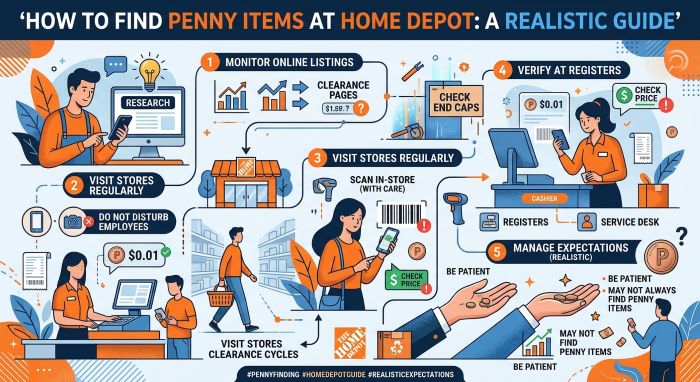
How to Find Penny Items at Home Depot: Step by Step
Now for the practical part. Here’s how to find penny items at Home Depot without wasting hours.
1. Start in the Clearance Areas
Many stores have end caps or shelves with clearance products. Check these first, since deeply discounted items are your best leads.
2. Check High Shelves and Odd Spots
Items that missed being pulled often sit on top shelves, in overstock areas, or mixed in with newer products. Look up, and look behind things.
3. Watch for Discontinued Products
When a product is being replaced by a newer model, the old version often ends up on clearance. Older packaging next to new packaging is a good sign.
4. Use the Home Depot App
The app can show you prices and stock levels at your selected store. Items that show limited stock, “not available in store,” or a much lower price than you expect can be worth checking. Make sure your store is selected so you see local prices.
5. Scan at Self Checkout
The only way to confirm a penny item is to scan it. Many penny hunters take one item to self checkout and scan the barcode on the product packaging, not the shelf tag. If it rings up at $0.01, they buy it. If not, they put it back or ask to return it.
6. Check the Whole Category
When one item in a category turns out to be a penny, others in the same group sometimes are too. Check similar products nearby.
7. Be Patient and Consistent
Penny items show up unpredictably. Regular visits to the same store help you learn its layout, clearance spots, and markdown patterns.
Where Penny Hunters Share Tips
Many shoppers searching for penny items Home Depot stores still carry share tips and Home Depot penny deals in online communities, Facebook groups, and Reddit threads. Some sites post “penny lists” of items that rang up at a penny in certain stores.
Keep in mind:
- Penny status is local. An item that’s a penny in one store may be full price in another.
- Lists go stale fast. Once an item is pulled, it’s gone.
- Paid groups aren’t required. Many tips are free, so be cautious before paying for access.
Etiquette and Fair Play
Penny hunting works best when you respect the store and its employees. Knowing how to find penny items at Home Depot is only half the skill. The other half is knowing how to behave once you do.
- Don’t argue with staff. If an employee says they can’t sell an item, accept it and move on.
- Don’t hide items. Stashing products to buy later is unfair to other shoppers and creates work for staff.
- Don’t clear the shelves. Leaving some items for others keeps the hobby fair.
- Keep the store tidy. Put back anything you don’t buy, and don’t leave a mess in the aisles.
- Know employee rules. Home Depot workers generally can’t buy penny items themselves, so don’t ask them to.
If you’re interested in working at the store yourself, our guide to Home Depot Careers explains the roles, pay, and hiring process.
Other Ways to Save at Home Depot
Penny items are fun, but they shouldn’t be your only savings strategy. Clearance sales offer reliable discounts even when an item hasn’t reached a penny. Other ways to save include:
- Seasonal clearance. Holiday decor, outdoor furniture, and garden supplies are often marked down after each season.
- Special Buy of the Day. Home Depot features a rotating daily deal online.
- Bundle promotions. Tool brands often run “buy one, get one” or free tool offers. For example, check out how Home Depot Ryobi Free Tools promotions work.
- Price matching. Home Depot has a price match policy for identical items from competitors, with some exceptions.
- Pro Xtra rewards. Contractors and frequent shoppers can earn perks through Home Depot’s loyalty program.
These options often save more money over time than chasing rare penny items.
Common Mistakes to Avoid
Learning how to find penny items at Home Depot also means avoiding the most common mistakes:
- Assuming every price ending means something. It doesn’t.
- Scanning the shelf tag barcode. Scan the product’s own barcode instead.
- Buying items you don’t need. A penny item isn’t a deal if it ends up in the trash.
- Expecting guaranteed results. Many trips will turn up nothing.
- Ignoring regular clearance. A 75% off item you’ll actually use is a great deal too.
Is Penny Hunting Worth It?
For some people, tracking penny items Home Depot hasn’t pulled yet is a fun hobby, like a treasure hunt. For others, it’s frustrating. The best approach is to treat penny items as a bonus while you’re already shopping, rather than a guaranteed way to save.
If you enjoy the hunt, Home Depot penny deals can add a little excitement to your trips. Just keep your expectations realistic, follow store rules, and focus on items you’ll actually use.
Final Thoughts
Now you know how to find penny items at Home Depot: start with clearance areas, look for older products and high shelves, use the app to check local prices, and confirm everything with a scan at self checkout. Penny items are rare and never guaranteed, so pair your hunting with regular clearance sales and promotions to make every trip worthwhile.
Key Takeaways
- Penny items are products that ring up at $0.01 because they’ve reached the end of the clearance cycle and are meant to be pulled from the floor.
- Home Depot doesn’t publish a penny policy, and stores may decline to sell penny items.
- Clearance usually moves from small markdowns to deep discounts before an item reaches a penny, but there’s no official schedule.
- Price endings like .06 and .03 are not reliable codes, so focus on the tag date, “Was” price, and actual scan price.
- Check clearance areas, high shelves, overstock spots, and discontinued products, and use the app with your store selected.
- Confirm penny status by scanning the product barcode at self checkout, not the shelf tag.
- Be respectful of staff and other shoppers, and don’t hide or hoard items.
- Clearance sales, seasonal markdowns, and tool promotions often save more than penny hunting alone.