Tomodachi Life Living the Dream Personality Chart
Every Mii on your island has a personality. It shapes how they walk, talk, pose, and react, and it colors the home they live in. In Tomodachi Life: Living the Dream, you set that personality with a row of sliders when you create a Mii. Move the sliders one way, and you get a gentle Sweetie. Move them another way, and you get a bold Maverick.
The game does not tell you which settings lead to which result. That is where a tomodachi life living the dream personality chart helps. This guide explains the sliders, shows the full grid of 16 types, gives simple slider recipes for each one, and answers common questions about changing personalities and compatibility.
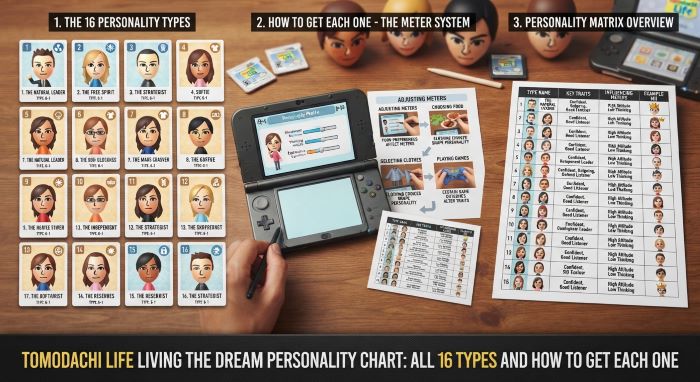
About the Game
Tomodachi Life: Living the Dream is a life simulation game from Nintendo for the Nintendo Switch. It launched on April 16, 2026, as the follow-up to the 2014 Nintendo 3DS game. You fill an island with up to 70 Mii characters based on friends, family, celebrities, or anyone you invent. Then you watch them make friends, fall in love, argue, dream, and ask you for help.
The new game adds deeper Mii customization, island layout tools, and a creative space called Palette House. It keeps the heart of the series: odd, funny moments driven by the characters you create. Personality is one of the main tools you have to shape those characters.
How the Personality System Works
When you create or edit a Mii, the game shows five sliders. Each slider has eight positions.
| Slider | Left End | Right End | Counts Toward Personality? |
|---|---|---|---|
| Movement | Slow | Quick | Yes |
| Speech | Polite | Direct | Yes |
| Energy | Flat | Intense | Yes |
| Attitude (also called Thinking) | Serious | Relaxed | Yes |
| Overall | Normal | Quirky | No |
Four sliders decide the personality. The fifth, Overall, changes how quirky the Mii acts, but guides and fan testing agree that it does not affect which of the 16 types you get.
The game sorts the results into four groups, with four types in each group. That makes 16 personalities in all.
The Formula Behind the Chart
Players worked out the math soon after launch. It is simple once you see it.
- Give each slider a score. The far-left position is 0, and the score rises as you move right, up to 7 or 8 at the far right.
- Add Movement and Speech. This total, from 0 to 15, is the horizontal value.
- Add Energy and Attitude. This total, from 0 to 15, is the vertical value.
- Find the cell. Each total falls into one of four bands: 0 to 3, 4 to 7, 8 to 11, or 12 to 15. The two bands point to one cell on a 4 by 4 grid. That cell is the personality.
Fan analysis notes one quirk. On the Speech and Attitude sliders, the scores skip the number 4, so the eight positions count as 0, 1, 2, 3, 5, 6, 7, and 8. In practice, this means the right half of those two sliders pushes a little harder. The recipes later in this guide work either way.
The Full Personality Chart
Here is the tomodachi life living the dream personality chart as a grid. Names shown are the North American versions.
| Energy + Attitude | Movement + Speech: 0 to 3 | Movement + Speech: 4 to 7 | Movement + Speech: 8 to 11 | Movement + Speech: 12 to 15 |
|---|---|---|---|---|
| 12 to 15 | Sweetie | Cheerleader | Charmer | Go-Getter |
| 8 to 11 | Buddy | Daydreamer | Merrymaker | Dynamo |
| 4 to 7 | Strategist | Perfectionist | Achiever | Visionary |
| 0 to 3 | Observer | Thinker | Rogue | Maverick |
The four groups sit in the four corners.
- Top left: Considerate
- Top right: Outgoing
- Bottom left: Reserved
- Bottom right: Ambitious
The Four Groups at a Glance
| Group (North America) | Name in Europe | Color | Slider Pattern | General Traits |
|---|---|---|---|---|
| Considerate | Easy-going | Yellow | Slow and polite, intense and relaxed | Friendly, gentle, puts friends first |
| Outgoing | Energetic | Red | Quick and direct, intense and relaxed | Lively, passionate, always doing something |
| Reserved | Reserved | Green | Slow and polite, flat and serious | Calm, careful, thoughtful, creative |
| Ambitious | Confident | Blue | Quick and direct, flat and serious | Straight talkers who value getting things right |
A Mii’s home takes on the color of its group, so you can tell personalities apart at a glance as you look across the island.
All 16 Personalities and What They Are Like
Considerate Group
- Sweetie (Softie in Europe): Empathetic and sentimental. Sensitive and in tune with how others feel.
- Buddy (Carer): Trustworthy and kind. Puts friends first.
- Cheerleader (Optimist): Positive, eager, and always smiling.
- Daydreamer (Dreamer): Idealistic and romantic, with their head often in the clouds.
Outgoing Group
- Charmer: Radiant and stylish. Others admire their easy confidence.
- Go-Getter (Adventurer): Bold and captivating. Lights up a room.
- Merrymaker (Bubbly): Cheerful and pleasant. Makes friends with ease.
- Dynamo (Hot-Blooded): Assertive and respected. Trusts their own instincts.
Reserved Group
- Observer (Introvert): Self-sufficient and private. Shows little outward emotion.
- Strategist (Patient): Laid-back, creative, and self-reliant.
- Perfectionist: Imaginative and inspired. Happiest when making something.
- Thinker: Thoughtful and reflective. Good at thinking things through.
Ambitious Group
- Achiever (Busy Bee): Diligent, productive, and efficient.
- Visionary (Leader): Ambitious and willing to take risks. Full of energy.
- Rogue (Individualist): Smart and not shy about it.
- Maverick (Headstrong): A determined self-starter who cuts their own path.
How to Get Each Personality: Slider Recipes
You do not need to do the math each time. Use four simple settings for each pair of sliders.
- Low: Both sliders at the far left, position 1 or 2.
- Mid-low: One slider at position 3 and the other at position 4.
- Mid-high: One slider at position 5 and the other at position 6.
- High: Both sliders at the far right, position 7 or 8.
Positions are counted from the left, 1 through 8.
| Personality | Movement and Speech | Energy and Attitude |
|---|---|---|
| Sweetie | Low | High |
| Cheerleader | Mid-low | High |
| Charmer | Mid-high | High |
| Go-Getter | High | High |
| Buddy | Low | Mid-high |
| Daydreamer | Mid-low | Mid-high |
| Merrymaker | Mid-high | Mid-high |
| Dynamo | High | Mid-high |
| Strategist | Low | Mid-low |
| Perfectionist | Mid-low | Mid-low |
| Achiever | Mid-high | Mid-low |
| Visionary | High | Mid-low |
| Observer | Low | Low |
| Thinker | Mid-low | Low |
| Rogue | Mid-high | Low |
| Maverick | High | Low |
These recipes turn the tomodachi life living the dream personality chart into settings you can copy in seconds. Each one aims for the middle of its band, so a small slip of one position will rarely change the result.
Because only the totals matter, you can trade points between the two sliders in a pair. A Mii with Movement far right and Speech far left lands in the same column as one with both sliders in the middle. This lets you fine-tune how a Mii moves and speaks while you keep the personality you want.
Step by Step: Setting a Personality
- Open the Mii creator, or select a Mii and choose to edit it.
- Go to the personality screen.
- Pick the personality you want from the chart.
- Set Movement and Speech with the recipe for its column.
- Set Energy and Attitude with the recipe for its row.
- Set the Overall slider to taste. It will not change the type.
- Confirm, and check the result the game shows.
- If the result is off by one cell, nudge one slider a step and check again.
Regional Name Differences
The game uses different names in North America and Europe. The types are the same underneath.
| North America | Europe |
|---|---|
| Sweetie | Softie |
| Buddy | Carer |
| Cheerleader | Optimist |
| Daydreamer | Dreamer |
| Charmer | Charmer |
| Go-Getter | Adventurer |
| Merrymaker | Bubbly |
| Dynamo | Hot-Blooded |
| Observer | Introvert |
| Strategist | Patient |
| Perfectionist | Perfectionist |
| Thinker | Thinker |
| Achiever | Busy Bee |
| Visionary | Leader |
| Rogue | Individualist |
| Maverick | Headstrong |
Guides do not always agree on which name belongs to which region, so check the names your own copy shows. If a tomodachi life living the dream personality chart you find online uses unfamiliar names, this table will help you match them.
What Personality Changes in the Game
According to Nintendo Life’s guide, personality affects two main things.
- Behavior. Miis of different types react, sit, stand, and inspect things in different ways. They also interact with other Miis differently.
- House color. Each home matches the color of the Mii’s group.
Other guides add that a new Mii receives a starting outfit and room in its group’s color, which you can change later. Fans have also noted that this game leans less on group-wide habits than the 3DS game did. Small individual traits, called Little Quirks, now add much of the variety.
Can You Change a Personality Later?
Yes. Select the Mii, choose Edit Mii, and pick Personality Type. You can move the sliders and confirm a new result at any time. Nothing is locked in, so feel free to experiment.
Does Personality Affect Friendship and Romance?
This is the most common question, and the careful answer is “a little, but not as a rule.”
- Personality shapes how a Mii talks and behaves.
- Fan guides report that Miis in the same group tend to become friends more easily.
- Personality does not lock who a Mii can fall in love with. Any type can pair with any other.
- The in-game compatibility tester weighs other factors too, such as birthdays.
Nintendo has not published the exact rules, so treat compatibility claims from fan sites as observations, not guarantees. If two Miis you want together are not clicking, time, shared activities, and gifts matter more than a perfect type match.
Tips for a Balanced Island
- Mix the groups. An island with all four colors has more varied scenes.
- Do not over-plan. Surprises are the point of the game.
- Base Miis on real people. Set sliders to match how the person truly acts, and see which type the game picks.
- Use all 16. Completionists can fill one Mii into each cell of the grid.
- Pair opposites. A calm Observer next to a loud Go-Getter can produce great moments.
- Revisit later. If a Mii’s behavior does not fit the person, adjust the sliders.
How It Compares With the 3DS Game
Nintendo Life reports that the 16 types in the new game line up with the 16 from the 3DS version, and that the hidden numbers appear to match. What changed is the naming. Most types have new names, and the group names differ by region. If you remember the old game’s Independent or Outgoing groups, you will find familiar behavior under new labels.
Common Mistakes
- Using the Overall slider to change the type. It has no effect on the result.
- Assuming each slider matters alone. The game adds them in pairs.
- Setting all sliders to the middle and expecting a “neutral” type. The middle of the grid still belongs to a named personality.
- Reading a chart from the wrong region. Check the names against the table above.
- Forgetting the right-side boost. On Speech and Attitude, right-half positions may count for a bit more, so a setting near a border can tip into the next cell.
Frequently Asked Questions
How many personalities are in Tomodachi Life: Living the Dream? There are 16, split into four groups of four.
Which sliders decide the personality? Movement, Speech, Energy, and Attitude. The Overall slider does not count.
How do I read a tomodachi life living the dream personality chart? Add Movement and Speech to find the column. Add Energy and Attitude to find the row. The cell where they meet is the type.
What is the rarest personality? No type is rare. You choose each one with the sliders. Corner types such as Sweetie, Go-Getter, Observer, and Maverick need the most extreme settings.
Can two Miis have the same personality? Yes. You can give the same type to as many Miis as you like.
Can I change a Mii’s personality after creating it? Yes, through Edit Mii and Personality Type.
Do personalities affect who dates whom? Not strictly. Any types can form a couple.
Are the personalities the same as in the 3DS game? They appear to match one for one, with new names.
What do the house colors mean? Yellow marks the Considerate group, red marks Outgoing, green marks Reserved, and blue marks Ambitious.
Final Thoughts
The personality system looks mysterious, but it comes down to two sums and a grid. Add Movement and Speech, add Energy and Attitude, and find the cell where the totals meet. With the tomodachi life living the dream personality chart in this guide, you can create any of the 16 types on the first try.
Use the recipes to build the cast you want, then let the island surprise you. Change sliders when a Mii does not feel right, and try types you would not normally pick. Keep this tomodachi life living the dream personality chart nearby the next time you add a new resident, and enjoy the chaos that follows.
Key Takeaways
- Tomodachi Life: Living the Dream has 16 personalities in four groups: Considerate, Outgoing, Reserved, and Ambitious.
- Four sliders decide the type: Movement, Speech, Energy, and Attitude. The Overall slider does not count.
- The tomodachi life living the dream personality chart is a 4 by 4 grid. Movement plus Speech sets the column, and Energy plus Attitude sets the row.
- Low totals on both axes give Reserved types, and high totals on both give Outgoing types.
- Names differ between North America and Europe, but the 16 types are the same.
- You can change a Mii’s personality at any time through Edit Mii.
- Personality shapes behavior and house color, but it does not lock friendships or romance.