How Cyclist and Motorcyclist POV Footage Is Rewriting Fault in Car-vs-Rider Crashes
A cyclist gets clipped by a right-turning SUV. The driver tells the responding officer she signaled, checked, and the rider came out of nowhere. The officer sketches the scene, notes the driver’s account, and writes the cyclist as partially at fault.
Two weeks later, a lawyer plays the helmet cam back frame by frame: no signal, no head check, and the rider was in the bike lane a full six seconds before impact. The sketch didn’t survive the footage.
That kind of contradiction used to be rare. Today it is more common, because a growing share of riders roll with a camera on the helmet, the bars, or the tail. The video is short, ugly, and unflattering to somebody, and it is quietly changing how fault gets assigned in crashes between cars and the people who ride around them.
Why Rider POV Footage Cuts Differently Than a Dashcam
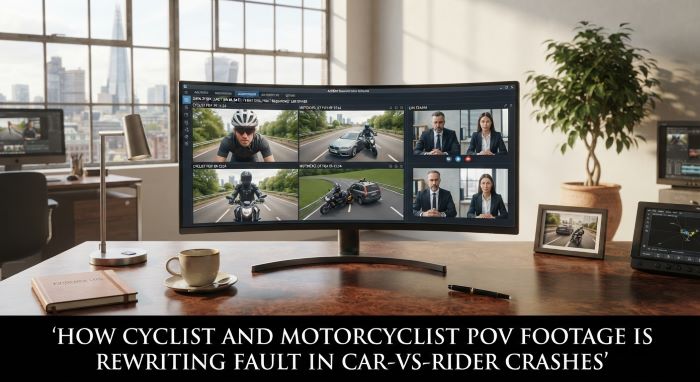
Dashcam footage from a car looks out at the world. Helmet and handlebar cameras look with the rider, which turns out to matter more than it sounds. The lens moves where the rider’s eyes move, so a jury can see the head check, the lane position, the hand signal, and the exact moment the driver’s front bumper enters the frame.
That perspective tends to answer the questions motorcycle and bicycle cases usually come down to: right-of-way at the intersection, lane position, closing speed, and whether the rider was lit and visible enough to undercut the standard “I never saw them” defense. Decades of crash research keep pointing at the same underlying problem in car-versus-motorcycle collisions: drivers often do not perceive the rider in time. Helmet cam footage is, in a sense, some of the first evidence that shows exactly what the driver failed to see.
The Police Sketch Is a Draft, Not a Verdict
Crash reports carry weight with insurers, but they are not the last word on fault. Officers usually arrive after the fact, work from what the parties tell them, and diagram a scene they did not witness. When a report and a clear video disagree, the video is often the harder thing to argue with.
Getting that video treated as evidence is a separate step. Under the federal rules most state courts mirror, video has to be authenticated before it comes in, meaning someone has to establish that the clip actually shows what it claims to show and has not been altered. Rule 901 lays out the basic standard, and it is usually satisfied by the rider testifying to the camera, the mount, the ride, and the download.
In practice, that means the file has to stay in its original format, with metadata intact, and it should not be trimmed, stabilized, or reposted through a platform that re-encodes it.
What Riders Should Actually Do With the Footage
The instinct after a crash is to pull the card, watch the clip, and start sending it to people. That’s where good evidence gets weaker. A short discipline keeps the video usable:
- Preserve the original file. Copy the raw file off the card without editing. Keep a second copy on a drive you do not touch.
- Skip the social edit. Trimming and re-encoding can strip the timestamps and give the other side something to attack.
- Note what the camera missed. Road conditions, signal timing, and driver statements at the scene are all context the lens did not catch. Write them down while the memory is fresh.
- Get the report, then compare. Order the crash report as soon as it is available and read it against the footage. Discrepancies are exactly what a lawyer will want to see first.
The economics of rider crashes make the video especially valuable. Motorcyclists remain dramatically more likely to be killed or seriously injured per mile than people in cars, according to NHTSA data, which means the medical exposure in a serious case is usually large and the fight over fault correspondingly hard. A clean clip can change what a claim is worth, and it often changes it before anyone files anything.
When It Is Time to Stop Editing and Start Calling
Not every close call needs a lawyer, but a crash with real injuries, a disputed report, or an insurer already leaning toward shared fault is the moment to bring one in. An experienced personal injury attorney can help preserve the footage properly, subpoena the driver’s phone and vehicle data before it ages out, and make sure the video is presented in a way a court will accept.
The helmet cam has quietly become one of the more useful witnesses a rider can bring. It doesn’t get rattled on cross, it doesn’t misremember the light, and it doesn’t care what the driver told the officer.
Handled with care, it can turn a sketch on a clipboard back into what it often was: one person’s best guess about a few seconds nobody else saw clearly.