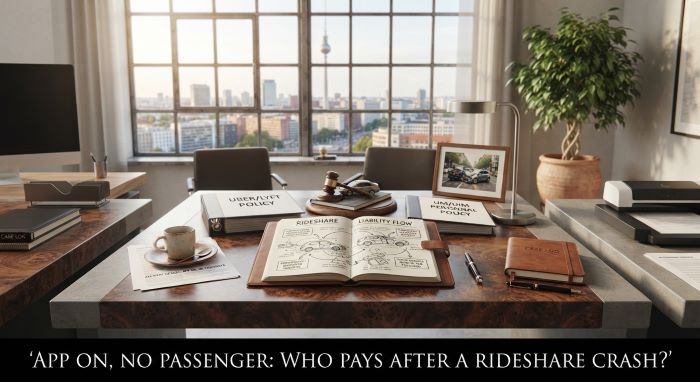
App On, No Passenger: Who Pays After a Rideshare Crash?
Who pays when a rideshare driver crashes with the app on but nobody in the back seat? It depends on which of three insurance “periods” the driver was in when the bumpers met, and the middle one is the ugliest. If the app was open and the driver was waiting for a ping, that’s Period 1. The personal auto policy usually won’t help, and the rideshare company’s coverage is stripped down to a bare minimum.
This matters more than it used to, because plenty of freelancers now drive for Uber or Lyft in the dead hours between design gigs, delivery runs, or client meetings. The app stays on across town. Crashes in that window don’t fit neatly into either box, and insurers know it.
Case 1: The Driver Was Logged In, Just Waiting
This is the classic Period 1 crash. The app is on, no ride has been accepted, and the driver rear-ends someone at a light. The Insurance Information Institute lays out the three-period framework regulators built around exactly this scenario, and Period 1 is where the coverage runs thinnest.
During Period 1, Uber and Lyft typically provide contingent liability only, and the limits look modest next to the seven-figure policy that kicks in once a ride is accepted. There’s no collision or comprehensive. If the driver’s own car is totaled, that’s their problem unless they bought a rideshare endorsement.
For an injured third party, those limits sound generous until a hospital bill lands. A serious injury involving an overnight stay and surgery can burn through the per-person limit in a hurry.
Case 2: The Ping Came In Seconds Before Impact
The moment a driver accepts a ride, coverage jumps to Period 2 and liability limits balloon to something closer to a real commercial policy. That’s why the exact timestamp on the acceptance matters so much.
Insurers have a clear incentive to argue the crash happened a few seconds earlier than the driver remembers. Classifying the wreck as Period 1 instead of Period 2 can be the difference between a bare-minimum payout and full coverage. If you’re the injured party, or the driver, don’t accept anyone’s version of the timeline without pulling the app data yourself.
That data exists. Uber and Lyft log the state of the app second by second. A lawyer who handles rideshare and auto claims can subpoena those records before they get overwritten or conveniently summarized in a way that favors the carrier.
Case 3: The Freelancer Who Never Told Their Insurer
Plenty of part-time drivers assume their regular auto policy has them covered until a passenger climbs in. That’s not true. Almost every personal auto policy contains a livery or public conveyance exclusion that voids coverage the moment the car is being used to carry passengers for a fee, and many insurers read “app on” as the start of that use.
The fix is a rideshare endorsement, sold by most major carriers for a few dollars a month. It bridges Period 1 and covers the difference between what a personal policy would pay and the much higher deductible on the TNC’s commercial coverage. Freelancers who drive between other jobs are the exact people who need it, and often the ones who skip it because the app is “just a side thing.”
Case 4: The Passenger Was in Another Car
Period 1 crashes don’t only hurt rideshare drivers. The pedestrian in the crosswalk, the cyclist in the bike lane, the family in the minivan; any of them can end up as the injured party. When they file a claim, they run into the same coverage cliff.
A few things to check early, before an adjuster starts steering the narrative:
- App status at impact. Was the driver logged in when the collision happened, and had a ride already been accepted? The rideshare company has this to the second.
- The driver’s personal policy. If they carried a rideshare endorsement, coverage may stack on top of the TNC’s contingent policy.
- Your own underinsured motorist coverage. When the at-fault driver’s limits run out, this is often what fills the rest of the bill.
- State-specific TNC rules. Requirements vary by jurisdiction; some states mandate higher Period 1 floors than others.
Case 5: The Endorsement That Would Have Prevented All of This
The cleanest solution for a driver is boring: buy the rideshare endorsement before you need it. It closes the Period 1 window on the personal-policy side and can absorb the difference between a modest personal deductible and the much larger one that kicks in if the crash falls into Period 2 or 3.
For everyone else, the takeaway is simpler. If you’re hit by a car with an Uber or Lyft decal in the window, the first question isn’t whether the driver was working. It’s which period they were in when the bumpers met, and that answer decides almost everything about what you can recover.