Why Anyone Needs a Real Estate Chatbot in the First Place
A buyer finds your listing at 9:40 on a Tuesday night. They have one question about the service charge. They send it. Nobody is in the office.
By Wednesday morning that buyer has messaged four other listings and booked a viewing with whoever answered first.
That is the whole business case, and we would rather state it plainly than dress it up. Property inquiries arrive in the evening, on weekends, and at the exact hours when your team is not working. The agency that answers at 9:41 gets the viewing. The one that answers at nine the next morning gets a polite message saying the buyer has arranged something else.
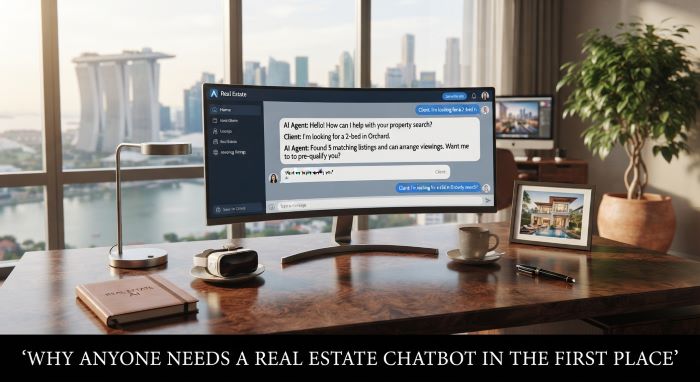
The gap is not a staffing problem
You could hire someone to sit on the inbox until midnight. Nobody does, because the economics are absurd for what is mostly one-line answers about availability.
That is the gap a real estate chatbot is meant to fill. Not the interesting work. The eleven hours of dead air around it.
Most of the questions already have answers
Here is the part that makes this worth doing. The service charge is written down. The floor plan exists. The payment schedule is in a PDF somebody emailed around in March.
The information is not missing. It is just unreachable at ten at night, which from the buyer’s side looks identical to missing.
What an AI Chatbot for Real Estate Actually Does
Strip away the marketing and an AI chatbot for real estate does four things. Everything else is a variation on one of them.
Answers listing and availability questions
Is the three-bed still available. What is the service charge. Can I see the floor plan. What is the tenure.
These are the messages that make up most of an inbox, and they all have answers sitting in material you already maintain. A real estate chatbot crawls your listing pages or reads the documents you upload, then answers from that. The answer cites where it came from, so anyone reviewing the conversation can check it.
Books viewings without three forwards
Someone asks to view on Sunday. Today that message gets forwarded to the agent who covers the property, who is off, who forwards it to someone else.
A chatbot for real estate agents handles the booking directly, which removes the two forwards and the day and a half they take.
Explains the area, the tenure, and the boring parts
Schools, parking, transport, lease length, what the monthly costs actually come to. These questions come before the viewing, not after, and they decide whether the viewing happens at all.
Hands over when it should
The fourth thing is the one people forget, and it is the one that matters most. When the question goes past what the chatbot knows, it escalates to a human with the transcript attached.
The agent picks up a conversation that already has a name, a property, a budget, and a question. Nobody asks the buyer to repeat themselves.
Using a Chatbot for Real Estate Lead Generation and Qualification
An agent spends forty minutes at a viewing before discovering the buyer has no mortgage in principle and a budget forty percent under asking. That afternoon is gone and it is not coming back.
Qualification belongs at the start, not the end
The questions that matter early are not intrusive. Budget range. Timeline. Cash or finance. Whether they have something to sell first.
A lead qualification chatbot for real estate asks those at the point the buyer is already engaged and typing, which is the only moment they will happily answer. Collected then, they let a negotiator walk into a viewing already knowing who they are meeting.
Capture beats chase
Using a chatbot for lead generation in real estate is less about generating anything new and more about not losing what already arrived. A name and a number captured at 9:41 on Tuesday is worth more than the same details chased down on Thursday.
Every conversation becomes a record. Who asked, about what property, with what budget, and whether anyone followed up.
What AI agents for real estate lead qualification cannot judge
They can collect facts. They cannot read a buyer. Whether someone is serious, nervous, or three weeks from a decision is a human judgment and it stays one.
Treat the qualification as a filled-in form that arrives before the meeting, not as a verdict on the buyer.
Where a Real Estate Chatbot Should Live
Someone who messaged you on WhatsApp expects a WhatsApp reply. Sending them to a web form is asking them to start over, and most will not bother.
A WhatsApp chatbot for real estate is not a separate product
This trips people up. A WhatsApp chatbot for real estate should not be a second setup with its own knowledge and its own answers that slowly drift away from what the website says.
One knowledge base, answering on every channel. When the service charge changes, you change it once.
Facebook and Instagram carry more property traffic than people admit
A Facebook chatbot for real estate covers the inquiries that come off boosted listing posts, which in most agencies is a real slice of the volume and the one nobody has an owner for.
Instagram is the same story. The listing gets posted, the questions land in a DM, and the DMs get checked when someone remembers.
The website widget is still where the serious buyers are
Someone on your site looking at a specific property is further along than someone reacting to a post. That is the conversation worth answering fastest.
What a Chatbot for Real Estate Sales Should Never Touch
Being clear about the limits is what makes the rest of this defensible, so we will be blunt about ours.
Anything with money or legal weight stays human
Negotiation. Offers. Mortgage advice. Tenancy terms. Anything anyone signs.
A tool that reaches into those is creating risk you do not need, and the time it saves is not worth what it costs the one time it goes wrong.
It must decline rather than guess
This is the single question to ask any vendor. What happens when the answer is not in my material?
The correct behavior is escalation. Not a plausible sentence assembled from nothing. Buyers make large decisions on small details, and a confident wrong number about a lease length is not a small error, it is a conversation with your compliance person.
It is coverage, not replacement
Nobody who is good at selling property should be worried about this. The work being absorbed is the one-line availability answer at midnight, which no agent has ever enjoyed.
Setting Up a Real Estate Chatbot Without an IT Project
Most agencies never fix any of this because it sounds like a six-month project with a consultant attached. It is closer to an afternoon.
Start from the questions you are sick of
Write down the twenty questions your team answers every week. That list is the specification. If a tool answers those twenty accurately from your own material, it covers most of what arrives after hours.
Feed it what you already have
Listing pages, brochures, that FAQ document from two years ago. Crawl the pages or upload the files. You are not writing new content, you are making existing content reachable.
Interrogate it before a buyer does
Ask it the awkward ones yourself. The questions with numbers in them. If the answers are wrong, the problem is usually a gap in your own documentation, which is worth finding either way.
Read the conversations
The questions coming in are a list of what your listings fail to explain. That is useful on the weeks when nothing sells.
How Agentency Runs an AI Chatbot for Real Estate
We built Agentency around the limits described above, so it is only fair to show how they hold up in practice.
It answers from your listings, with the source attached
You crawl the listing pages, upload the PDFs, or paste the text you already maintain. Every answer points back to the document it came from.
Before any buyer sees it, the built-in test chat lets you ask the questions your team is tired of and check each answer against its source.
It says it does not know
When the retrieval quality gate finds nothing relevant, the agent does not improvise. It tells the buyer it does not have that answer and offers a person instead.
That is the vendor question from earlier, answered the boring way. Which is the right way.
It checks live records and asks before acting
Availability changes faster than brochures do. Through a Call Action, the agent can look up a live listing record from the API you already run, instead of trusting a PDF from March.
High-risk actions can be set to require an explicit confirmation from the visitor before anything fires. Nothing consequential happens on a guess.
It books, qualifies, and hands over with the transcript
The agent books viewing slots, asks the buyer and tenant qualification questions, and captures the applicant’s details. When a negotiator takes over, they get a warm brief with the full transcript attached.
The buyer does not repeat themselves. The negotiator does not start from a blank screen.
One knowledge base on every channel
The same agent answers on the website widget, a public chat link, WhatsApp, Instagram, Messenger, Telegram, SMS, and the other channels on your plan. It replies in the language the buyer writes in, from the same knowledge base, so you are not maintaining a separate agent for each market.
Change the service charge once, and every channel has it.
Do real estate chatbots actually convert, or just deflect?
Both, and the second one is underrated
Deflection is the boring half and the half that pays. Every availability question answered without a person is time returned to the people doing the selling.
Conversion comes from speed. The buyer who gets an answer in seconds books the viewing, and the one who waits until morning books it somewhere else.
Will it invent facts about my listings?
Only if you pick one that is allowed to
Ask how answers are grounded. A real estate chatbot working from your uploaded material and citing sources behaves very differently from one improvising around a general model.
Insist on seeing what happens when it does not know something. That single test tells you more than any demo.
How long before it is live?
An afternoon, if the material exists
The work is gathering documents, not configuration. Agencies with tidy listing pages are running the same day. Agencies whose information lives in six inboxes take longer, and discover why along the way.
What does it cost to run?
Ask about the pricing model, not the headline number
The thing to check is whether you pay per conversation. A busy month should not produce a surprise, and pricing that scales with volume punishes you exactly when things are going well.
Agentency charges a flat rate per agent with no per-resolution fee, which is worth comparing against whatever else you are quoted.
The Part Worth Remembering
Property is a first-response business. Everything above is detail.
Questions arrive when your office is closed. The answers already exist in your own material. The distance between those two facts is where the deals go, and closing it does not require better listings, a bigger portal package, or more staff.
It requires the answers to be available at the moment somebody asks. That is all an AI chatbot for real estate is for.
Agentency is an AI chatbot builder that answers from the material you give it, across WhatsApp, Instagram, Messenger, SMS, and the web. You can try it at Agentency.
About the Author
Omar El Bahr is a Senior Digital Growth Specialist at Agentency, where he leads SEO, content strategy, and organic growth across international markets. He is a Forbes Communications Council contributor and has written for Entrepreneur on business communication and digital strategy.