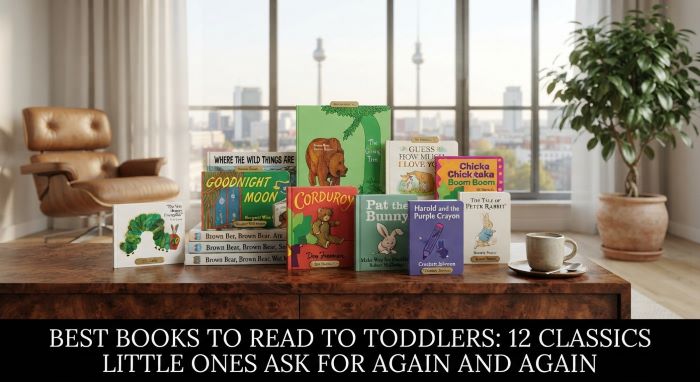
Best Books to Read to Toddlers: 12 Classics Little Ones Ask for Again and Again
Anyone who has spent time with a toddler knows the phrase “again, again!” You finish a book, close the cover, and a small hand pushes it right back at you. That enthusiasm is a gift. Reading aloud during the toddler years builds vocabulary, early listening skills, and a lifelong love of stories, and it is one of the easiest, most rewarding things you can do together. The hard part is choosing, since the children’s section is enormous and not every book holds a toddler’s attention. This guide rounds up the best books to read to toddlers, why each one works, and how to make story time something you both look forward to.
Why reading to toddlers matters so much
The years between one and three are a period of explosive language growth. Toddlers pick up new words at an astonishing pace, and they learn most of them by hearing language used in context. Books expose children to words they rarely hear in everyday conversation, from “caterpillar” to “enormous” to “squelch.”
Reading together also builds skills that go far beyond vocabulary:
- Listening and attention: Following a story trains focus, a little longer each time.
- Early literacy: Toddlers learn that print carries meaning and that pages turn left to right.
- Emotional connection: Snuggling up with a book is calming and builds a warm routine.
- Emotional language: Stories give children words for feelings like happy, scared, and proud.
- Imagination: Pictures and stories invite toddlers to predict, pretend, and wonder.
The good news is that you do not need to teach anything formally. Simply reading with warmth and enthusiasm, every day, does most of the work.
What makes a great toddler book
The best books to read to toddlers share a few qualities that match how young children think and play:
- Repetition and rhythm: Repeated phrases let toddlers predict and join in.
- Bright, clear pictures: Bold illustrations with simple backgrounds hold attention.
- Short text: A few lines per page suits short attention spans.
- Interaction: Flaps, holes, textures, and questions invite little hands to participate.
- Durability: Board books survive chewing, grabbing, and enthusiastic page turning.
- Familiar themes: Animals, bedtime, vehicles, food, and family connect to a toddler’s world.
With that in mind, here are twelve of the best books to read to toddlers, loved by little ones and easy for parents to read for the hundredth time.
The 12 best books to read to toddlers
1. Brown Bear, Brown Bear, What Do You See? by Bill Martin Jr., illustrated by Eric Carle
This is often the first book toddlers “read” on their own, because the rhythm is so predictable. Each animal sees the next one, in a chant that builds as you go: “Brown Bear, Brown Bear, what do you see? I see a red bird looking at me.” Eric Carle’s bold, tissue-paper collage animals are easy for young eyes to recognize.
It teaches colors and animals, and the repetition lets toddlers fill in the words long before they can read. Expect to know it by heart within a week.
Best for: Ages 1 to 3, first book for learning colors and animals.
2. The Very Hungry Caterpillar by Eric Carle
A tiny caterpillar eats through one apple, two pears, three plums, and a wild Saturday feast before becoming a beautiful butterfly. The little holes punched through the pages invite toddlers to poke their fingers through, and the story sneaks in counting, days of the week, and foods.
The transformation at the end delights children every time. It is one of the most beloved picture books ever published for good reason.
Best for: Ages 1 to 4, counting, food, and interactive fun.
3. Goodnight Moon by Margaret Wise Brown, illustrated by Clement Hurd
A little bunny says goodnight to everything in the great green room: the moon, the cow jumping over the moon, the kittens, the mittens, and “goodnight nobody.” The gentle rhythm and quiet ending make it the perfect bedtime book. The room slowly darkens across the pages, mirroring a child settling down to sleep.
Toddlers love hunting for the little mouse that appears on each spread.
Best for: Ages 1 to 3, calming bedtime routines.
4. Where’s Spot? by Eric Hill
Spot the puppy is missing, and toddlers get to lift the flaps to find him. Is he behind the door? Inside the clock? Under the stairs? Each flap hides a surprise animal, building anticipation until Spot finally turns up in his basket.
Lift-the-flap books are pure magic at this age, and this one is a classic that teaches object permanence, the understanding that things still exist when hidden.
Best for: Ages 1 to 3, lift-the-flap interaction.
5. Dear Zoo by Rod Campbell
A child writes to the zoo asking for a pet, and the zoo sends one animal after another, each too big, too fierce, or too naughty, until finally they send the perfect puppy. Each animal hides behind a flap shaped like its crate, so toddlers guess what is inside before lifting it.
The simple repeated pattern and the satisfying ending make it a favorite for years.
Best for: Ages 1 to 3, animals and guessing games.
6. Chicka Chicka Boom Boom by Bill Martin Jr. and John Archambault, illustrated by Lois Ehlert
The lowercase letters of the alphabet race each other up a coconut tree until the whole tree tumbles down. The bouncy, rhythmic text is almost impossible to read without adding a little rhythm to your voice, and Lois Ehlert’s bold, bright art pops off the page.
It introduces the alphabet in a way that feels like a song, not a lesson.
Best for: Ages 2 to 4, letters and rhythm.
7. Llama Llama Red Pajama by Anna Dewdney
Baby Llama is tucked into bed but gets anxious when Mama Llama goes downstairs. His worry grows into a full “Llama drama” until Mama returns to reassure him that she is always nearby, even when she is not in the room. The rhyming text is fun to read aloud, and the story speaks directly to bedtime separation worries.
It is a gentle way to talk about feelings and reassurance.
Best for: Ages 2 to 4, bedtime and separation anxiety.
8. Little Blue Truck by Alice Schertle, illustrated by Jill McElmurry
A friendly little blue truck beeps hello to all the farm animals on his way down the road. When a big, bossy dump truck gets stuck in the mud, it is the little truck and his animal friends who help. The animal sounds give toddlers plenty to join in with, and the message about kindness and friendship lands gently.
Best for: Ages 1 to 4, animal sounds, vehicles, and kindness.
9. Don’t Let the Pigeon Drive the Bus! by Mo Willems
The bus driver has to step away and asks readers one thing: do not let the pigeon drive the bus. The pigeon then pleads, bargains, and throws a full tantrum trying to convince you. Toddlers love shouting “No!” at the pigeon, which makes this one of the most interactive read-alouds out there.
The pigeon’s tantrum also mirrors toddler emotions in a way kids instantly recognize.
Best for: Ages 2 to 5, interaction and big feelings.
10. We’re Going on a Bear Hunt by Michael Rosen, illustrated by Helen Oxenbury
A family sets off on a bear hunt, wading through swishy grass, a splashy river, squelchy mud, and a dark forest, chanting as they go. The sound words are irresistible for toddlers, and many families act out the motions together.
The tense, funny chase at the end makes it a story kids want to act out again and again.
Best for: Ages 2 to 5, sound words and movement.
11. Pete the Cat: I Love My White Shoes by Eric Litwin, illustrated by James Dean
Pete the Cat loves his white shoes, and when he steps in strawberries, blueberries, and mud, they change color. But Pete never gets upset. He just keeps singing his song. The catchy, repeated tune and the laid-back message about rolling with changes make it a hit.
It teaches colors and a healthy attitude toward mistakes.
Best for: Ages 2 to 5, colors, singing, and resilience.
12. The Gruffalo by Julia Donaldson, illustrated by Axel Scheffler
A clever mouse walks through the deep dark wood, outwitting a fox, an owl, and a snake by inventing a monster called the Gruffalo, only to meet the real one. The rhyming text is a joy to read aloud, and the gentle suspense suits older toddlers ready for a slightly longer story.
Best for: Ages 2 to 5, rhyme and gentle suspense.
Quick comparison table
| Book | Author | Age range | Best feature |
|---|---|---|---|
| Brown Bear, Brown Bear | Bill Martin Jr. / Eric Carle | 1 to 3 | Predictable chant, colors |
| The Very Hungry Caterpillar | Eric Carle | 1 to 4 | Holes, counting, food |
| Goodnight Moon | Margaret Wise Brown | 1 to 3 | Calming bedtime rhythm |
| Where’s Spot? | Eric Hill | 1 to 3 | Lift-the-flap surprises |
| Dear Zoo | Rod Campbell | 1 to 3 | Animal flaps |
| Chicka Chicka Boom Boom | Martin and Archambault | 2 to 4 | Alphabet rhythm |
| Llama Llama Red Pajama | Anna Dewdney | 2 to 4 | Bedtime reassurance |
| Little Blue Truck | Alice Schertle | 1 to 4 | Animal sounds, kindness |
| Don’t Let the Pigeon Drive the Bus! | Mo Willems | 2 to 5 | Shout-along fun |
| We’re Going on a Bear Hunt | Michael Rosen | 2 to 5 | Sound words, acting out |
| Pete the Cat: White Shoes | Eric Litwin | 2 to 5 | Song and resilience |
| The Gruffalo | Julia Donaldson | 2 to 5 | Rhyme and suspense |
Matching books to your toddler’s age
Toddlers change fast, and the best books to read to toddlers shift as they grow:
- Around 12 to 18 months: Sturdy board books with bright pictures, flaps, and textures, like Where’s Spot? and Dear Zoo. Pointing and naming matter more than finishing the story.
- Around 18 to 24 months: Repetitive, predictable books like Brown Bear, Brown Bear and Goodnight Moon, where toddlers start filling in words.
- Around 2 to 3 years: Rhythmic, interactive stories like Chicka Chicka Boom Boom, Little Blue Truck, and Don’t Let the Pigeon Drive the Bus!
- Around 3 years and up: Slightly longer stories with a plot, like The Gruffalo and We’re Going on a Bear Hunt.
Follow your child’s lead. If they want the same book every night for a month, that repetition is exactly how they learn. The best books to read to toddlers are often the ones they choose themselves, so let them pick from the shelf whenever you can.
Tips for reading aloud to toddlers
How you read matters as much as what you read. These habits turn story time into a rich learning experience:
- Use voices and expression. Growl like the bear, whisper the quiet parts, and get dramatic.
- Point and name. Point to pictures and ask, “Where is the duck?”
- Pause for participation. Stop before a repeated phrase and let your toddler fill it in.
- Ask simple questions. “What do you think is under the flap?” invites thinking.
- Let them turn pages. Giving them control keeps them engaged.
- Do not force the ending. If they wander off, it is fine. Short, happy sessions beat long, frustrating ones.
- Make it routine. A daily reading time, especially at bedtime, builds anticipation and security.
Even the best books to read to toddlers land better when the reader is relaxed and having fun, so do not worry about doing it perfectly.
Building a love of reading beyond these classics
These twelve titles are a strong foundation, but the joy of children’s books is that there is always something new to discover. Newer releases bring fresh characters, diverse families, and modern takes on timeless themes. This roundup of the Best Children’s Books 2025 is a great place to find recent favorites as your toddler grows into bigger stories.
Books are also one of the gentlest ways to help young children understand feelings. When Llama Llama worries or the pigeon throws a tantrum, you have a natural opening to talk about big emotions. If you want to strengthen those skills in yourself as a parent, the Best Books for Emotional Intelligence offer insight into helping children name and manage their feelings.
Reading aloud is also communication practice for the whole family. The back-and-forth of pointing, asking, and answering builds the foundations of conversation. Parents who want to sharpen how they talk and listen with their kids might enjoy the Best Books for Communication Skills, since the same principles of patience and active listening apply to little ones too.
Building a home library on a budget
You do not need to spend a fortune to fill your shelves with the best books to read to toddlers. A few ideas:
- Visit your public library. Many have toddler story times and let you borrow stacks of board books for free.
- Buy used. Thrift stores and library sales often have classic board books for a dollar or two.
- Swap with friends. Trade books with other parents when your child outgrows a set.
- Ask for books as gifts. Grandparents and friends often love giving favorite titles from their own childhood.
- Rotate your shelf. Keep a few books out and swap them every week or two so old favorites feel new again.
The bottom line
Reading to toddlers is one of the simplest, most powerful things you can do for their development and your connection. The best books to read to toddlers use rhythm, repetition, bright pictures, and interaction to hold short attention spans and invite little ones to join in. Classics like Brown Bear, Brown Bear, The Very Hungry Caterpillar, Goodnight Moon, and Where’s Spot? are perfect starting points, while Don’t Let the Pigeon Drive the Bus! and The Gruffalo grow with your child. Read with expression, let your toddler lead, make it a daily routine, and do not worry about reading the same book a hundred times. That repetition is exactly how a lifelong reader is born.
Key Takeaways
- Reading aloud to toddlers builds vocabulary, listening skills, early literacy, emotional language, and a warm daily bond.
- The best toddler books use repetition, rhythm, bright pictures, short text, and interactive elements like flaps and holes.
- Classic first picks include Brown Bear, Brown Bear, The Very Hungry Caterpillar, Goodnight Moon, Where’s Spot?, and Dear Zoo.
- Older toddlers enjoy interactive and rhyming stories like Don’t Let the Pigeon Drive the Bus!, We’re Going on a Bear Hunt, and The Gruffalo.
- Match books to your child’s age, starting with sturdy board books and moving toward longer stories with a plot around age three.
- Read with voices and expression, pause for your toddler to fill in words, let them turn pages, and keep sessions short and happy.
- Build a home library affordably through public libraries, used books, swaps with friends, and rotating your shelf.