Best AI Detector for Content Teams, Editors, and Publishers in 2026: 8 Tools That Scale Past One Article
An editor’s problem with AI content and AI writing is not moral. It is operational.
Forty freelance drafts arrive on a Monday, the style guide says human written content only, and nobody has budget to read every paragraph twice. So the question is not “does AI writing exist in our pipeline?” (it does) but “which AI detector tool can detect AI at volume, inside the tools we already use, without flagging our best writers?”
That last clause matters more than it looks. Every AI checker produces false positives, and an AI detector that flags one in ten human written articles will cost you writers, not just time.
False positives on polished human written text are the most expensive error a content team can make. The eight AI tools below are ranked for editorial teams, agencies, and publishers who need an AI detection score that fits a workflow: Google Docs, a Chrome extension, an API, a plagiarism checker in the same scan, and pricing that makes sense at 200 articles a month.
Prices are current at the time of publication and may change; check each vendor’s site before committing budget to any AI checker.
The best AI detector for content teams in 2026 combines sentence highlights, a plagiarism checker, and a way to run AI checks where writers work: Google Docs, a browser extension, or an API. Eliten’s AI Content Detector leads for fast, private checks with a plain-language verdict; Originality.ai, Copyleaks, Winston AI, and Pangram cover bulk scanning and team workflows.
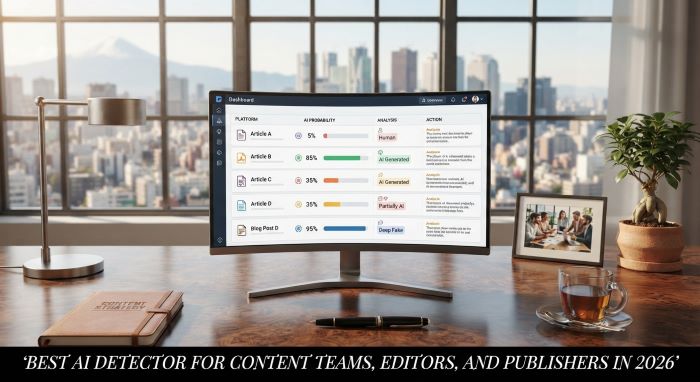
What editors actually need from AI detection tools
Most “best AI detector” lists rank AI tools on accuracy claims. For a content team, that is the wrong first filter, because every vendor claims 98% or better and none of those figures survive contact with edited, mixed, or paraphrased text.
Most detection tools also fail the same way on the same text. We ranked on six things instead.
Where the AI check runs. Copying text out of a document into a text paste box is fine for one article. It is not fine for forty. AI detection tools that run inside Google Docs, through a browser extension, or via an API rank higher.
Sentence highlights. A single AI score from an AI detector tool for a 2,000-word article is useless to an editor.
You need to know which paragraphs look like AI generated writing so you can send precise feedback. Highlighting also exposes false negatives: passages the tool missed that an editor can spot from sentence length and rhythm alone.
A plagiarism checker in the same pass. Most editorial teams already run one alongside their AI tools. Tools that do both from one scan save a step and a subscription.
False positive rate on professional writing. Clear, structured, well-edited copy is exactly what AI detectors misread as AI text, for the same reason academic writing gets flagged. Tools that produce false positives on polished human written content are worse than no tool at all.
Cost per word. Detection at volume is priced by credits, words, or scans. We compared every plan at roughly 1,000 words per article, because that is how content tools get used.
Team features. Seats so the tool works for more than one editor, shared reports, audit trails, scan history, and other features such as multiple languages. A managing editor should be able to see what was checked and when.
Comparison: AI detection tools for editorial teams
| Tool | Best for | Runs in Google Docs or browser | Plagiarism checker | Entry pricing |
| Eliten AI Content Detector | Fast, private single-article checks | No | No | Sign up with starter tokens; paid plans on the site |
| Originality.ai | Publishers scanning at volume | Yes | Yes | Pay-as-you-go $30 for 3,000 credits; Pro $14.95/month |
| Copyleaks | Multilingual teams and API workflows | Yes | Yes | Personal plans in the mid-teens per month annual |
| Winston AI | Scanned and image-heavy content | No | Yes | Essential around $10/month annual |
| Pangram | Lowest false positive risk on human written text | Both | Yes (paid) | Individual around $20/month |
| GPTZero | Writers on Google Docs, writing history | Both | Yes (paid) | Free tier; Essential from about $8.33/month annual |
| Grammarly | Authorship records inside the editor | Both | Yes (paid) | Detector available without an account; Authorship on all plans |
| ZeroGPT | Quick spot checks, no account | No | Paid tiers | Pro around $9.99/month |
1. Eliten AI Content Detector
Eliten’s AI Content Detector is the tool an editor reaches for when a draft reads slightly too smooth and there are ten minutes to decide.
Paste text or upload the file, click “Check for AI”, and you get an AI score with a plain-language verdict: human written, mixed, or likely AI. The report highlights the sentences that look machine-generated inside otherwise human written text, so feedback to the writer can point at paragraph four rather than at a percentage.
Best for
Editors, content leads, and small agencies who check drafts one at a time and want the AI score explained in words, with a fix in the same place.
Why it makes the list
Two things set Eliten apart for content work. First, the verdict is built for decisions: the result tells you whether editors and publishers are likely to accept the text as original, not just how “AI-like” it scores.
Second, if the flagged passages need rewriting, the Humanizer sits in the same chat, so an editor can check, revise the highlighted sentences into the brand’s voice, and re-check without switching tools. It is the only one of these tools where detection and AI humanizing live in one window.
The AI detection model looks for the shared patterns of current AI models (ChatGPT, Gemini, Claude) rather than promising to catch each one by name.
Pasted text is not permanently stored or used to train AI models, so client drafts stay private. Each check handles up to 5,000 characters, roughly 800 words.
Pricing
Sign up takes a minute and comes with starter tokens; paid plans start from the tiers on Eliten’s pricing page. Check the site for current figures.
Watch for: there is no API, no browser extension, and no batch upload, so this is a per-article AI checker, not one of the pipeline tools. Long articles are checked in two or three passes.
2. Originality.ai
Originality.ai was built for exactly this audience: publishers, agencies, and SEO teams that need to detect AI at volume and prove to clients that they did. It combines an AI checker, a plagiarism checker, a readability score, and a fact-checking aid in one scan, with a Chrome extension for Google Docs and WordPress.
Best for
Content agencies and publishers scanning hundreds of articles a month who need tools with shareable reports and an audit trail per writer.
Why it makes the list
The workflow features are the strongest in this list. Full-site scans check an entire domain by URL. Team management shows who scanned what, and shareable reports give clients evidence. The extension lets an editor check a Google Doc without leaving it, and the AI detection model covers multiple languages.
Originality.ai has also led several third-party tests on raw AI output in the past year. The same tests show false positives on human written text, especially formal or heavily structured human content.
Pricing
Pay-as-you-go is $30 for 3,000 credits; one credit scans 100 words, about $1 per 1,000 words, double with the plagiarism checker. The Pro subscription is $14.95 per month ($12.95 annual) for 2,000 credits a month, roughly 200,000 words.
Enterprise, at $179 per month, adds unlimited seats and full API access. Check the site for current figures.
Watch for: there is no permanent free version, credits do not roll over on subscriptions, and full API access sits on the top tier. Writers also report aggressive scoring, so pair a high AI score with the highlighted sentences before acting.
3. Copyleaks
Copyleaks came to AI detection from a decade of plagiarism checking, and for teams that publish in several languages it is the most complete package here. One scan covers AI content, plagiarism, and even source code, in dozens of languages, with an API that is available on ordinary paid tiers rather than locked behind an enterprise contract.
Best for
Multilingual publishers, localisation teams, and developers who want to build AI detection into a CMS or submission pipeline without bolting on more tools.
Why it makes the list
The API is the differentiator. Copyleaks lets a small team wire AI detection into a content pipeline without a sales call, which most other tools on this list do not.
The highlighting is clear, the plagiarism side is mature, and the browser extension covers Google Docs. Enterprise tiers add CMS integrations, audit logs, and per-seat admin.
Pricing
Copyleaks uses unified credits that reset monthly. Personal tiers start in the mid-teens per month on annual billing, higher month to month, and the Pro tier for teams runs into the high double digits. Check the site.
Watch for: detection of paraphrased AI content, or text run through tools such as Undetectable AI, drops sharply in independent tests, as it does for every detection tool. Credits that expire monthly punish teams with uneven publishing schedules.
4. Winston AI
Winston AI sells to marketing teams and publishers on one feature the other tools skip: OCR that reads scanned documents and images. For a content team that receives PDFs, screenshots, or scanned contributor pieces, that OCR alone can justify the subscription, and it is the only tool here that offers it.
Best for
Editorial teams handling PDFs, image-based submissions, and AI-generated illustrations alongside human written text.
Why it makes the list
Winston AI returns a sentence-level prediction map, exports PDF reports, runs a plagiarism checker on the same credits, and adds AI image detection for visuals at no extra cost on paid tiers. Higher tiers include up to five team seats and then unlimited members, plus the HUMN-1 badge some publishers display as a human written content signal.
Pricing
Credits are the unit: one credit per word to detect AI, two per word for plagiarism checking. A 14-day trial includes 2,000 credits.
Essential is around $10 per month on annual billing ($18 monthly) for 80,000 credits, Advanced around $16 ($29 monthly) for 200,000, and Elite around $26 ($49 monthly) for 500,000. Check the site for current figures.
Watch for: Winston AI advertises 99.98% accuracy. That figure is self-reported, no independent benchmark has reproduced it, and it says nothing about false positives.
5. Pangram
Pangram is the AI detector to standardise on if a false accusation would cost you a good writer.
Its AI detection model produces segment-level results with a four-tier classification, so a paragraph can read as lightly AI-assisted rather than simply “AI”, and the company publishes a very low false positive rate, backed by outside academic evaluations, along with research on its training data and methods. Substack chose Pangram to power reader-facing AI scans on its platform in July 2026.
Best for
Newsrooms, newsletter publishers, and editors who need defensible AI detection results on human written text and want to see exactly what triggered a flag.
Why it makes the list
The interpretability layer is the best among these AI detection tools: each flagged segment comes with notes on why it looks generated. The browser extension and Google Docs integration let editors check inside the document, a plagiarism checker is included on paid tiers, and detection covers more than 20 languages.
Pricing
A small number of checks per day are available without paying. The Individual plan is around $20 per month for 600 scans, Professional around $65 per month for 3,000, and the developer API is priced at roughly $0.05 per 1,000 words. Check the site for current figures.
Watch for: Pangram’s own documentation says mixed human and AI drafts are its weakest case, and the daily limit in the free version is too small for a team.
6. GPTZero
GPTZero is the most widely used AI checker in the world by its own count, with more than ten million users, and its education roots gave it the one feature content teams increasingly ask for: a writing history. The Chrome extension records how a Google Doc was written and replays it, so an editor can see whether a draft was typed over three days or pasted in at once.
Best for
Teams that commission writers on Google Docs and want writing process evidence of human written work rather than only an AI score.
Why it makes the list
Inside Google Docs, the extension shows a live AI score above the toolbar, highlighted sentences, and a writing report with typing pattern analysis that flags large pastes and unnatural bursts.
Multiple editors are tracked separately. Batch uploads and a plagiarism checker arrive on paid tiers, and the API is bundled into the Professional plan, so GPTZero can detect AI in a pipeline as well as in a document.
Pricing
A standing free version covers 10,000 words a month.
Essential is $14.99 per month, or about $8.33 annual, for 150,000 words; Premium is $23.99 monthly or about $12.99 annual for 300,000 words; Professional is $45.99 monthly or about $24.99 annual for 500,000 words plus API access. Check the site for current figures.
Watch for: GPTZero has drawn false positives on formal and non-native human written text in independent tests, and the extension needs a paid plan for full use.
7. Grammarly
Most content teams already have Grammarly open, which is why it earns a spot even though its AI checker is not the strongest of the tools mentioned here. The interesting feature is Authorship: it records where each sentence in a document came from (typed, pasted, generated, or suggested by Grammarly) as the writer works in Google Docs or Word, and produces a shareable report.
Best for
Teams that want to prove authorship of commissioned work without adding a separate tool, and writers who need to show clients a clean process.
Why it makes the list
Authorship turns AI detection from a guess about the final draft into a record of the writing process.
Basic tracking is available on every account, and the paid version adds AI and plagiarism detection inside the Authorship report. The standalone AI checker on Grammarly’s site needs no account and gives an AI score with flagged phrases and suggested rewrites, with a per-check word cap.
Pricing
The web AI checker is completely free to use without an account, with a per-check limit. Basic Authorship tracking is included on every account; detailed attribution, AI detection, and plagiarism checking inside reports require Pro or Premium. Check the site for current caps.
Watch for: independent test results for Grammarly’s AI detector vary widely, and Authorship only records what happens after it is switched on. It is evidence of process, not bulk scanning.
8. ZeroGPT
ZeroGPT is on this list for one reason: it is the fastest way to spot-check a paragraph with no sign up required.
Paste text of up to around 15,000 characters and get an AI score and highlighted sentences in seconds. It is the free check many writers already run, so editors should know what it shows, even if they never decide on it.
Best for
Quick, informal spot checks, and understanding what your writers see when they self-check with free AI tools.
Why it makes the list
No account, a large text paste limit, highlighting, batch file upload on paid tiers, and an API. The paid version removes ads, raises limits, and adds plagiarism detection.
Pricing
The free version is ad-supported. Pro is around $9.99 per month and a higher Max tier around $26.99, with an annual discount. Check the site for current figures.
Watch for: independent test results have consistently reported more false positives on human written text from ZeroGPT than from the tools higher on this list, with estimates ranging from roughly one in seven to one in three human texts flagged, depending on the sample. Use it to triage AI content, never to decide.
How to build an AI check into an editorial workflow
The tools are only half of it; adding tools does not mean better decisions. Teams that use AI detection tools well follow the same four steps.
Check at the draft stage, not at publication. Run the AI check when the draft lands, while the writer can still explain the writing process or revise. A flag on a published piece is a crisis; a flag on a draft is a note, and false positives get caught before they cost anything.
Set a threshold and a response, in writing. Decide what AI score triggers a conversation (say, above 60% with highlighted sections) and what happens next: the writer is asked about their writing process, shown the highlighted sentences, and invited to revise or show writing history.
Use one tool for triage and a second for decisions. Different AI detection tools disagree on the same human written text more often than vendors admit, and their false positives rarely overlap.
A pass through free tools for triage and a paid, sentence-level AI detector for anything that might affect a contract is a reasonable pattern. Multiple tools agreeing is evidence; one tool alone is a hint.
Keep the record. Save the report, the AI score, the highlighted sentences, and the writer’s response. Reports from Originality.ai, Winston AI, and Copyleaks are built to be shared; for other tools, a screenshot and a note will do. If the tool catches something, the record is what protects both sides.
Does Google penalize AI content?
Not as such.
Google’s published guidance since February 2023 has been that using AI tools to help create content is not against its policies, and that what matters is whether the content is helpful, original, and made for people rather than to manipulate rankings. Its March 2024 spam update added “scaled content abuse”, targeting mass-produced pages whoever wrote them.
For an editor, that changes what the AI score is for. You are not running AI detection tools for Google.
You are running them to protect a brand voice, to honour a client’s human written content requirement, to catch a freelancer who has stopped doing the work, and to keep a paper trail. That is a quality question, and it is why the highlighted sentences matter more than the AI score.
How to read an AI score without over-reacting
An AI score is a probability estimate, not a measurement. That is how AI detectors work: they compare the predictability and sentence length variation of a text with patterns learned from training data, and return a likelihood. Two things follow.
First, a 40% AI score is not “40% AI writing” and certainly not “40% cheating”. It means the AI checker found patterns it associates with AI writing in roughly two fifths of the text.
Edited human drafts, heavily revised AI drafts, and very polished professional copy all tend to land in that middle band. The move is to open the highlighted sentences and ask whether they are the argument or the connective tissue.
Second, a 95% AI score on a piece the writer swears is human written is a reason to run other tools and ask for writing history, not a reason to cancel the invoice.
The research on the false positive rate of AI detection tools is consistent: a 2023 Stanford study published in Patterns found that seven AI detectors flagged an average of 61% of human written essays by non-native English writers as AI generated writing, and a 2023 study in the International Journal for Educational Integrity that tested 14 tools found none above 80% accuracy. Polished, formal, second-language writing is precisely what a content team receives.
What detection at volume actually costs
At roughly 1,000 words per article:
Originality.ai’s Pro plan covers about 200 articles a month for $14.95 with its AI checker alone, or fewer if you add the plagiarism checker. GPTZero’s Essential covers about 150 articles for $14.99 monthly or $8.33 on annual billing.
Winston AI’s Essential covers about 80 articles for $10 on annual billing, half that with plagiarism. Pangram’s Individual plan covers 600 scans for $20. Copyleaks and ZeroGPT vary with credit and character limits, so check the site.
Plagiarism checking typically doubles credit use, so budget for it. And a paid version is only worth it above a certain volume; a team checking 20 drafts a month can run on free tools plus a per-article AI check from Eliten, then add more tools when volume justifies it.
Frequently asked questions
What is actually the most accurate AI detector for publishers?
There is no stable answer, and no best AI detector for every text type. Originality.ai and Pangram have led recent third-party tests on raw AI output, while Pangram and Copyleaks tend to show fewer false positives on human written text.
The RAID benchmark presented at ACL 2024 found that most detectors could be fooled by simple adversarial edits, and every vendor’s accuracy claim drops sharply on mixed or paraphrased text. Run the three tests below before standardising.
Which AI detector is the most trusted?
By adoption, GPTZero and Turnitin dominate education, and Originality.ai and Copyleaks are the most common names in publishing and agency contracts.
Trust in a content team should come from a published false positive rate, highlighted sentences you can show a writer, and a report you can keep, rather than from market share. The best AI checker for your team is the one whose errors you have measured.
Is ZeroGPT better than Turnitin?
They serve different users. Turnitin is an institutional platform sold to schools and universities, with vendor-published false positive figures and LMS integration; it is not available to content teams.
ZeroGPT is a consumer AI checker with no sign up required and, in independent tests, more false positives on human written text. For a publisher, neither is the right primary tool; for a writer, a ZeroGPT pass does not predict a Turnitin result.
Can an AI detector tell which model wrote the text?
Treat any model attribution as a guess. AI detectors work from statistical patterns in their training data, and those patterns overlap heavily across ChatGPT, Gemini, Claude, and open AI models. Knowing which AI model generated a paragraph rarely changes the editorial decision.
How should we run three tests before choosing a tool?
Use three samples: a raw AI draft on one of your usual topics, a genuinely human written article by your best writer, and a mixed piece where a human draft has had two paragraphs rewritten by AI.
Run all three through each candidate and compare the test results, paying most attention to the second sample. A detection tool that flags your best writer is disqualified whatever it does on the other two.
Final verdict
For most content teams, the working setup is a per-article tool plus a volume tool, not ten AI tools.
Eliten’s AI Content Detector is the best AI detector for the per-article check: a plain-language verdict, sentence highlights that make feedback specific, private processing, and a Humanizer in the same place for fixing what is flagged. Among the volume tools, Originality.ai is the publisher’s default, Copyleaks is the choice for multilingual teams and API workflows, Winston AI covers scanned and image-heavy content, and Pangram is the AI detector to standardise on when false positives are the risk you fear most.
GPTZero and Grammarly earn their places among the best AI tools for writing history rather than detection, and ZeroGPT is the spot check everyone already uses. Whatever tools you pick, decide the threshold and the response before the first flag, and make sure the AI score is never the last word on a human writer.