Pyle PFA300 Hi-Fi 2-Channel Stereo Class-T Amp Review: Small Box, Honest Sound
Most amplifiers ask for a shelf, a power cord thicker than your thumb, and a real chunk of your budget. This one asks for none of that. The Pyle PFA300 hi-fi 2-channel stereo class-t amp is roughly the size of a paperback, runs off a 12-volt adapter, and costs less than a decent dinner out. That combination raises a fair question: can something this cheap and this small actually sound good? The short answer is yes, within limits. Let me walk you through what it does well, where it falls short, and who should think about buying one.
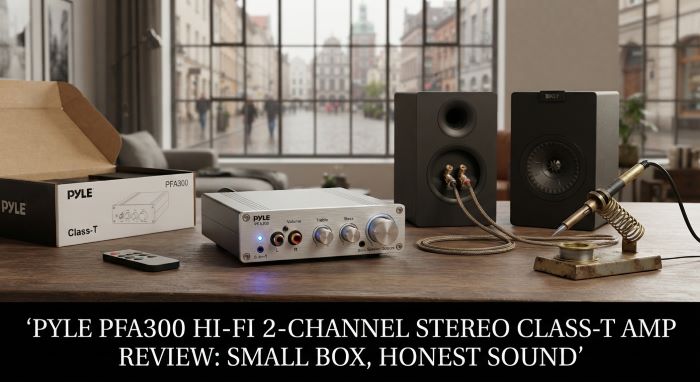
What Class-T actually means
You will see “Class-T” printed on the box and wonder if it matters. Class-T is a type of digital amplification built around a specific chipset design. In practice it runs cool, wastes very little power, and keeps distortion low for the price. The Pyle PFA300 hi-fi 2-channel stereo class-t amp uses this design to squeeze clean output out of a package that draws barely any electricity. You are not getting warm tube tone or the brute force of a big home receiver. You are getting tidy, efficient sound from a board that fits in your palm.
Power and what the numbers mean
Pyle rates this unit at 90 watts max, which works out to about 45 watts per channel. That “max” wording matters. It is peak power, not continuous, so treat it as a ceiling rather than a promise. For a small room, a desktop setup, a boat, an RV, or a golf cart, 45 watts a side is plenty to fill the space and then some. It will not power a large living room at party volume with demanding floor-standing speakers. Match it to bookshelf speakers or compact outdoor speakers and it holds its own.
The Pyle PFA300 hi-fi 2-channel stereo class-t amp handles speakers from 2 ohms to 8 ohms, which is a wider range than many budget units allow. That flexibility means you can pair it with cheap outdoor speakers or a nicer set of 6-ohm bookshelves without worrying about a mismatch.
Inputs, controls, and connections
Here is where the Pyle PFA300 hi-fi 2-channel stereo class-t amp earns its keep for casual users. The front and back give you more options than the size suggests:
- A 3.5mm aux input for phones, tablets, or laptops
- Stereo RCA inputs for a turntable preamp, a media player, or a receiver
- A microphone input, which turns it into a simple karaoke rig
- Bass and treble tone controls
- A direct switch that bypasses the tone circuit for a cleaner signal path
The direct switch is a nice touch at this price. Flip it and the equalizer drops out of the circuit, so you hear the source with less coloring. Leave it off and you can shape the low and high end to taste. The frequency response runs the full 20 Hz to 20 kHz range, which covers everything human ears can pick up.
Sound quality in real use
Set expectations correctly and you will be happy. The Pyle PFA300 hi-fi 2-channel stereo class-t amp produces clean midrange, decent detail, and low background noise for a unit under forty dollars. Vocals come through clearly. Acoustic tracks and podcasts sound natural. Push the volume near the top and you will hear the limits, with the bass thinning out and the sound getting a little hard. That is normal for a compact digital amp at this price.
Pair it with efficient speakers and the amp feels stronger than its rating. Pair it with power-hungry speakers and you will run out of headroom sooner. The tone controls help you dial in a fuller sound in a small space, though purists will likely keep the direct switch engaged.
Where it fits best
Think of this amp as a specialist, not an all-rounder. The Pyle PFA300 hi-fi 2-channel stereo class-t amp shines in these spots:
- A desktop system driving small bookshelf or computer speakers
- A garage, workshop, or shed where you want music without a big rig
- An RV, boat, or cabin running on 12-volt power
- A second-room setup or a spare pair of speakers you never got around to using
- A cheap, cheerful karaoke station thanks to the mic input
It fits less well as your main living-room amplifier or as the heart of a serious hi-fi chain. If you want to drive large speakers loudly or you care deeply about audiophile-grade detail, spend more and go bigger.
Quick spec snapshot
| Feature | Detail |
|---|---|
| Type | Class-T digital, 2-channel stereo |
| Power | 90 watts max (about 45 watts per channel) |
| Speaker impedance | 2 to 8 ohms |
| Inputs | 3.5mm aux, stereo RCA, microphone |
| Controls | Bass, treble, direct bypass switch |
| Frequency response | 20 Hz to 20 kHz |
| Power supply | 12-volt DC adapter included |
The honest verdict
The Pyle PFA300 hi-fi 2-channel stereo class-t amp is not trying to beat a real home receiver, and you should not judge it as one. Judge it as what it is: a tiny, efficient, flexible amplifier that costs almost nothing and does more than its size and price suggest. For a desk, a workshop, a vehicle, or a spare set of speakers, it delivers clean sound and enough connection options to keep things simple.
If your needs are modest and your budget is tight, this little box is easy to recommend. If you want to shake the walls or chase audiophile perfection, keep looking. Set your expectations at the right level and the Pyle PFA300 hi-fi 2-channel stereo class-t amp will likely surprise you in the best way.
Key Takeaways
- The Pyle PFA300 is a compact Class-T digital amplifier rated at 90 watts max, or about 45 watts per channel, best suited to small spaces rather than large rooms.
- Class-T design keeps it cool and efficient, running off an included 12-volt DC adapter, which makes it a strong fit for cars, boats, RVs, and cabins.
- It supports a wide 2 to 8 ohm speaker range, so it pairs with cheap outdoor speakers or nicer bookshelf speakers without a mismatch.
- Inputs include 3.5mm aux, stereo RCA, and a microphone jack, plus bass and treble controls and a direct switch that bypasses the tone circuit for cleaner sound.
- Sound quality is clean and clear at normal volumes, with midrange and vocals coming through well, though it loses headroom and body near maximum volume.
- Best uses are desktops, workshops, second rooms, vehicles, and simple karaoke setups, not main living-room hi-fi duty with large or power-hungry speakers.
- At under forty dollars, it offers more flexibility and cleaner output than its price and size suggest, making it a smart budget pick when expectations are realistic.