Why AI Is Becoming Essential for Modern Procurement Teams
Procurement is not just about comparing quotations, raising purchase orders and negotiating purchase prices. As teams need to move quickly, hold costs in check, manage suppliers and adapt to new needs, they can’t lose sight of it. The true potential of applying AI in procurement use case scenarios for organisations is to eliminate repetitive tasks from the equation and empower procurement professionals to make better decisions with technology. By integrating information, workflows, suppliers, and approvals, AI can help teams save time chasing tasks.
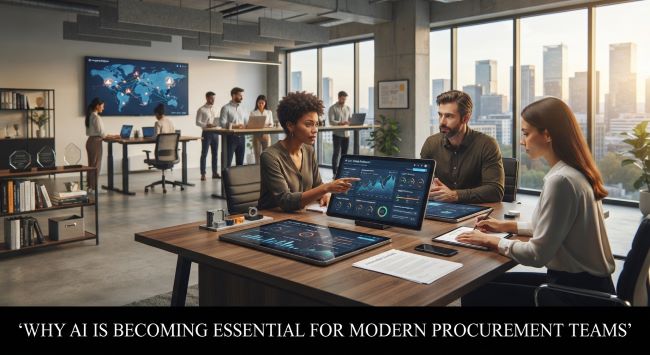
Why Procurement Teams are Turning Toward AI
Procurement teams today communicate through an array of tools, including emails, spreadsheets, enterprise systems, supplier portals, contracts, invoices and approval chains. If the data are spread out, it takes a lot of time for professionals to gather data before doing anything. AI can connect these fragmented activities through analysing vast amounts of data and finding patterns in a timely manner.
Leaders also want to see tangible cost reductions, improved supplier quality, adherence to specifications and regulations, and improved control of expenditure. Because of this, the role of AI in procurement use cases is growing more relevant, as automation can assist in the day-to-day process of procurement and provide more clarity in making strategic decisions.
The Business Value Behind AI Adoption
When it comes to the real-world problems that arise in procurement, AI can prove useful. Intelligent systems can automatically perform workflows, analyse supplier responses, assist in negotiations, and coordinate purchasing information. This empowers procurement pros to be strategic about their attention and focus on decisions that involve context, judgment and collaboration.
By using meaningful procurement KPIS, teams can measure impact. To measure improvements in operations, technology can deliver faster cycle times, savings, supplier responsiveness, contract compliance and purchase-order accuracy. There are good implementations that are based on the concept of automation and business goals.
- Quicker purchase requests and approvals processing
- Greater visibility into organisational spending
- Inconsistent supplier evaluation and engagement.
- Enhanced automation in repetitive procurement processes
Such enhancements can lead to smarter procurement, yet one that does not eliminate the need for human oversight. Rather, AI can provide better information to professionals and more time for them to focus on higher-value activities.
Key Ways AI Can Strengthen Procurement Operations
The most useful AI applications can help with procurement ranging from requests to sourcing, supplier management and purchasing to payment. This enables teams to see AI in procurement use cases not as standalone tools, but as unified elements of the procurement process.
-
Intelligent Purchase Intake
AI can understand purchase requests, find what information is missing, classify purchase needs and direct to the correct processes. This can decrease back-and-forth dialogue and promote uniformity.
-
Automated Supplier Discovery
The search for suitable suppliers can be very time-consuming and comparative. AI can help to categorise supplier information based on the requirements, enabling sourcing teams to locate relevant suppliers faster and facilitate a more comprehensive supplier search process.
-
Smarter Bid Analysis
AI can analyse supplier quotes and supplier replies, compare commercial information and bring to light variations that might warrant consideration. Procurement professionals can then focus on assessing the strategic factors and not have to worry about organising each and every bid by hand.
-
Supplier Operations and Risk Management
Supplier information is always changing, whether it be documentation, performance information, operational requirements, etc. By streamlining supplier management, identifying key concerns, and assisting with existing workflows, AI can help prevent what might be small issues from scaling into bigger procurement-related challenges.
-
Accounts Payable Automation
Many of the tasks in invoice processing are repetitive, such as matching and validation tasks. AI can assist in matching invoices to purchase and supplier data, identify discrepancies, and flag items for human verification, streamlining payment processes.
AI Helps Procurement Teams Make Better Decisions
Procurement teams also require dependable information to assess where their money is going, who is doing well in the suppliers’ segment and whether there are opportunities or risks. AI can analyse procurement data in a way that is too large to handle manually, and highlight the pertinent information that allows quicker interpretation.
This adds value to the procurement KPIS because teams can now track the way they are performing operationally and commercially, with greater ease and consistency. Rather than wait for a reporting period to review metrics, procurement leaders can make faster decisions based on connected data that indicate changes in supplier activity, sourcing results, purchasing behaviours, or workflow performance.
Building a More Strategic Procurement Function
It is developing opportunities for procurement pros to be strategic business partners. By relieving your team of mundane tasks, they can focus more on supplier relations, negotiation, category strategy, risk planning and collaboration. By establishing clearly defined procurement KPIS, leaders can monitor to see if these improvements are driving better results.
Even with the power of AI, there’s still a need for people. Business context, validation and exception handling by professionals and supplier relations. It is best used as an intelligent overlay that enables this expertise; it shouldn’t replace accountability and human judgment.
What Procurement Teams Should Prioritise
To become a successful implementer of AI, there needs to be a practical consideration of processes in which AI can add measurable value. It is essential for organisations to start by identifying clear pain points, setting up suitable controls and choosing solutions that are compatible with an organisation’s procurement system.
- Focus on repetitive tasks with many transactions
- Clarify measurable outcomes before automation
- Keep man in important commercial aspects.
- Synchronise the procurement workflow with AI workflows.
This is a measured approach that facilitates easier management of the adoption and provides a framework for measuring outcomes. In time, effective workflows can be rolled out to other parts of a procurement process.
Conclusion
In an increasingly complex procurement function, AI is proving to be an indispensable tool for today’s procurement teams, offering speed, automation, visibility, and analytical support. Organisations with technology that aligns with specific procurement KPIS can bridge the gap between piecemeal automation and automation that is more responsive, controlled and strategic.
For organisations looking to create a more connected and intelligent procurement process, Procol empowers organisations to do so with its AI in procurement use cases, which supports sourcing, supplier operations, purchasing, AP, spend management and procurement orchestration. Procol’s intelligent workflows can automate the procurement process, keeping business teams on top of the game, and provide a realistic way to become more efficient and data-driven.