Best Picaron Near Me: Peru’s Squash and Sweet Potato Doughnut
Peruvian street doughnuts are not made from flour and sugar alone. The dough contains roasted squash and sweet potato, which is why picarones are orange inside, lighter than they look, and taste faintly of vegetable underneath the sweetness. They are fried to order in front of you, shaped by hand into rings, and drowned in a dark syrup made from unrefined cane sugar. Here is the guide.
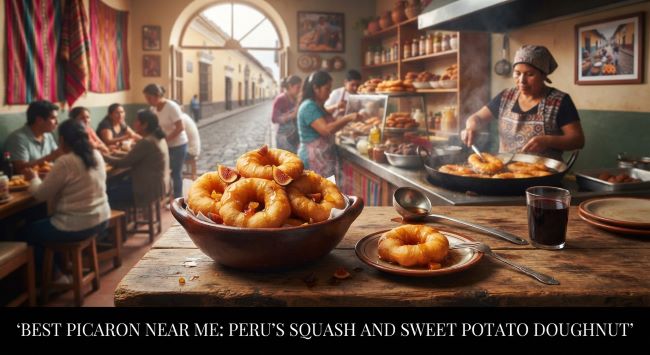
What They Are
Picarones are Peruvian fried doughnuts made from a dough containing squash and sweet potato. The best picaron near me are built from:
- Zapallo, squash or pumpkin, cooked and pureed.
- Camote, sweet potato, cooked and pureed.
- Flour, binding the puree into a dough.
- Yeast, since the dough is leavened and rested.
- Anise seed, commonly infused, giving a characteristic aroma.
- Chancaca syrup, poured over generously at serving.
The dough is soft and sticky rather than firm, and is shaped by hand directly into hot oil, which is why picarones have their irregular ring shape rather than a cut-out uniformity.
The Shaping Technique
Watching the shaping is part of the appeal of the best picaron near me.
The vendor takes a handful of the wet dough, and using wet hands, forms a ring by piercing the centre with a finger and stretching it, dropping it directly into the oil in one motion.
This happens fast and looks effortless, and it is genuinely skilled. The dough is too soft to roll or cut, so the shape is formed in the air above the fryer.
The resulting rings are irregular, often with uneven thickness, which is characteristic rather than sloppy.
Chancaca Syrup
The syrup on the best picaron near me is not optional and deserves as much attention as the doughnut.
Chancaca is unrefined whole cane sugar, sold in solid blocks and known elsewhere in Latin America as panela or piloncillo. For picarones it is melted into a syrup, typically infused with:
- Orange peel or other citrus.
- Cinnamon and often cloves.
- Fig leaves, in traditional versions, which add a distinctive note.
The result is dark, thick, and considerably more complex than plain sugar syrup, with a molasses-like depth.
A picarón without chancaca is a plain fried ring. The syrup carries much of the flavour, and a version served with generic sugar syrup or honey has substituted the defining element.
The Historical Background
Some historical context explains the best picaron near me.
Picarones are generally understood to have developed during the colonial period in Peru as a local adaptation of Spanish buñuelos, with squash and sweet potato substituted for more expensive ingredients.
They became strongly associated with street vending and with religious processions, particularly around the Señor de los Milagros festivities in October, when picarón vendors appear in numbers across Lima.
That October association is genuine and worth knowing, since availability increases noticeably around that period.
Where to Find Them
The best picaron near me search runs through:
Peruvian restaurants, where they appear as a dessert.
Peruvian bakeries and cafes.
Latin American food trucks and stalls, which suit the fried-to-order model.
Peruvian cultural events and festivals, particularly around October.
South American restaurants with genuine Peruvian menus.
Because picarones are best fried to order and deteriorate quickly, establishments making them fresh are substantially better than those holding them, and street-style vendors often produce better results than formal restaurants.
How to Judge Quality
Evaluating the best picaron near me comes down to texture and syrup:
| Element | Done right | Warning sign |
|---|---|---|
| Exterior | Crisp, golden, light | Heavy, greasy, or pale |
| Interior | Airy, soft, slightly chewy | Dense, doughy, or raw |
| Colour | Faintly orange from squash | Pale white inside |
| Syrup | Dark, spiced, generous | Thin, plain, or sparse |
| Freshness | Fried to order | Reheated or cold |
Interior lightness is the technical test. Because the dough is yeasted and rested, a proper picarón is surprisingly airy rather than dense. A heavy, bready interior indicates insufficient proving or too much flour.
The orange tint inside indicates genuine squash and sweet potato content. A pale white interior suggests the vegetables were minimal or absent.
Syrup quality distinguishes serious versions. Real chancaca infused with citrus and spices tastes noticeably different from a plain sugar syrup.
How They Are Eaten
The best picaron near me is straightforward:
- Hot, immediately after frying, which is genuinely necessary.
- Drowned in chancaca syrup, poured over at serving.
- By hand, since they are street food.
- Two or three per portion, typically.
- As a dessert or snack, commonly in the evening.
They are eaten quickly rather than lingered over, since they lose their texture within minutes of leaving the fryer.
Related Peruvian Sweets
Worth knowing since Peruvian dessert culture is substantial.
Mazamorra morada, the purple corn pudding, is frequently served alongside picarones or paired with arroz con leche.
Arroz con leche is the rice pudding half of that classic pairing.
Suspiro a la limeña is a rich caramel and meringue dessert.
Turrón de Doña Pepa is the anise-scented nougat particularly associated with the October processions, appearing alongside picarones at the same events.
Encountering picarones and turrón at the same October festivities is common and reflects a genuine shared tradition.
Part of the Peruvian Street Food Tradition
What makes picarones distinctive is how they transformed an imported concept using ingredients native to the Andes, which is the same pattern running through Peruvian cooking generally. Something like Best Tacu Tacu Near Me shows the savoury version of the same instinct, where leftover rice and beans were combined into a dish now considered a national staple, and both demonstrate how Peruvian cooking built its identity from adaptation and thrift rather than from luxury.
The bottom line on the best picaron near me search is that these Peruvian doughnuts are made from a yeasted dough containing pureed squash and sweet potato, shaped by hand directly into hot oil, and served drowned in chancaca syrup made from unrefined cane sugar infused with citrus, cinnamon, and traditionally fig leaves. They developed as a colonial-era adaptation of Spanish buñuelos and are strongly associated with October processions in Lima. Look for Peruvian restaurants and street-style vendors frying to order, judge them on a light airy interior with a faint orange tint, and eat them immediately.
Key Takeaways
- Picarones are Peruvian fried doughnuts made from dough containing squash and sweet potato.
- Zapallo squash and camote sweet potato are cooked and pureed into the yeasted dough.
- Anise is commonly infused, contributing a characteristic aroma.
- The dough is too soft to roll or cut, so rings are formed by hand directly above the fryer.
- Irregular shapes are characteristic rather than a sign of carelessness.
- Chancaca is unrefined whole cane sugar, known elsewhere as panela or piloncillo.
- The syrup is infused with citrus peel, cinnamon, cloves, and traditionally fig leaves.
- They developed as a colonial-era adaptation of Spanish buñuelos using local ingredients.
- Availability increases around the Señor de los Milagros processions in October.
- A properly proved picarón is airy rather than dense, and a heavy interior indicates insufficient proving.
- A faint orange tint inside confirms genuine squash and sweet potato content.
- They must be eaten immediately, since they lose texture within minutes of frying.