Best Kartoffelsalat Near Me: Germany’s Regional Divide
Ask a German about potato salad and you will learn where they are from before you learn anything about the dish. The country splits along a rough line, with the south making a warm salad dressed in broth and vinegar and the north making a cold one bound in mayonnaise. Both are called kartoffelsalat, both have committed defenders, and ordering without knowing which you are getting is how visitors end up surprised. Here is the guide.
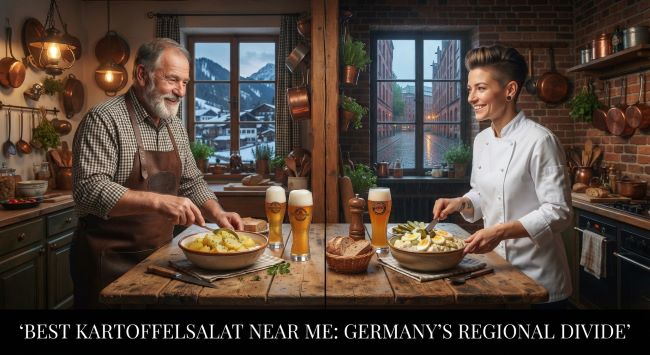
The Regional Divide
This is the essential thing to understand in the best kartoffelsalat near me search, because the two main styles are genuinely different dishes.
Southern German and Swabian style uses warm potatoes dressed with beef or vegetable broth, vinegar, oil, mustard, and onion. It contains no mayonnaise. The result is glossy, slightly soupy, tangy, and served warm or at room temperature.
Northern German style uses cold potatoes bound in mayonnaise, typically with onion, pickles, and sometimes apple, egg, or ham. It is closer to what most people outside Germany picture as potato salad.
Neither is more authentic. They are parallel regional traditions, and Germans hold strong opinions about which is correct based almost entirely on where they grew up.
Bavaria and Swabia are the heartland of the vinegar style. Regions further north favour mayonnaise.
The Southern Version in Detail
Because it is the less familiar version internationally, the southern style deserves explanation. Potatoes are boiled, peeled while warm, and sliced thin, since warm potatoes absorb dressing in a way cold ones cannot. Hot broth is poured over and allowed to soak in, followed by vinegar, oil, mustard, and finely diced onion. Starch from the warm potatoes slightly thickens the liquid, producing a glossy, faintly creamy result without dairy. It then rests before serving warm.
Done properly, it should be moist and glossy rather than dry, with visible liquid at the bottom of the bowl. A Swabian salad that is dry has not had enough broth.
The Potato Matters
This technical point separates good versions of the best kartoffelsalat near me from mediocre ones, and applies to both styles.
Potatoes must be waxy rather than floury. Waxy varieties hold their shape when sliced and dressed, while floury ones disintegrate into mush.
In Germany, potatoes are sold labelled by cooking type, with festkochend, meaning firm-cooking, being the right choice for salad. Getting this wrong is the single most common cause of a poor kartoffelsalat.
Potatoes should also be boiled in their skins and peeled afterward, which limits water absorption and preserves both flavour and texture.
Where to Find It
The best kartoffelsalat near me search runs through:
German restaurants, where it appears as a standard side.
Beer halls and gasthaus-style establishments.
German delicatessens and butchers, which frequently sell it prepared by weight.
Austrian restaurants, since a similar vinegar-based tradition exists there.
German cultural events and festivals, particularly Oktoberfest-style celebrations.
Because the divide is real, asking which style the best kartoffelsalat near me follows is reasonable, and most establishments will happily tell you.
How to Judge Quality
Evaluating the best kartoffelsalat near me depends slightly on style, but the core markers overlap:
| Element | Done right | Warning sign |
|---|---|---|
| Potato texture | Firm slices holding shape | Mushy or disintegrated |
| Dressing | Evenly absorbed, coating | Dry, or pooling separately |
| Seasoning | Clear vinegar tang and mustard | Flat or bland |
| Onion | Finely diced, softened | Coarse and harsh |
| Southern style | Moist and glossy | Dry |
| Northern style | Bound not drowned | Swamped in mayonnaise |
Potato integrity is the first test in both styles. Slices should be intact rather than broken down.
Acidity is the second. German potato salad in either style should have a clear vinegar presence. Bland potato salad is the most common disappointment, and it usually means insufficient vinegar or seasoning.
Resting time shows in the result. Both styles improve after sitting, and a salad assembled minutes before serving tastes disconnected, with dressing sitting on the surface rather than running through.
What It Is Served With
The best kartoffelsalat near me typically appears alongside:
- Schnitzel, the classic pairing, particularly in the south.
- Bratwurst and other sausages.
- Frikadellen, German meat patties.
- Fish, particularly in northern regions.
- As part of a cold plate with cured meats and cheese.
- At barbecues and gatherings, where it is a standard contribution.
The schnitzel pairing is the one most people encounter, and the vinegar style in particular cuts the richness of fried breaded meat effectively.
Additions and Variations
Regional and family variations of the best kartoffelsalat near me are numerous. Speck or bacon appears fried with its rendered fat. Pickles or gherkins are common in northern versions. Cucumber, egg and apple, and radish appear in various recipes, with chives or parsley the standard herbs. Family recipes vary enough that Germans regard their own household version as definitive.
Serving Temperature
The southern style is served warm or at room temperature, never fridge-cold, since chilling dulls the flavours and firms the potatoes. The northern mayonnaise style is served cold. A restaurant serving a Swabian salad straight from refrigeration has misunderstood it.
Part of the Regional Cooking Tradition
What makes kartoffelsalat interesting is how sharply it demonstrates that a national dish can split into incompatible regional versions that share only a name. That pattern repeats across cuisines wherever geography separated communities. Something like Best Ceviche Peruano Near Me shows the same principle from a different angle, where the Peruvian version diverged sharply from other Latin American ceviches through a shortened cure, and both illustrate how a shared name can conceal genuinely different dishes that locals would never confuse.
The bottom line on the best kartoffelsalat near me search is that Germany has two distinct traditions sharing one name. The southern and Swabian version dresses warm sliced potatoes in broth, vinegar, oil, and mustard with no mayonnaise, served warm and glossy. The northern version binds cold potatoes in mayonnaise with onion and pickles. Both depend on using waxy, firm-cooking potatoes boiled in their skins and sliced while warm, both need genuine vinegar acidity, and both improve after resting. Ask which style an establishment makes, since the difference is substantial.
Key Takeaways
- Germany has two distinct kartoffelsalat traditions divided roughly along a north-south line.
- Southern and Swabian style uses warm potatoes dressed in broth, vinegar, oil, mustard, and onion.
- The southern version contains no mayonnaise and is served warm or at room temperature.
- Northern style binds cold potatoes in mayonnaise, often with onion, pickles, apple, or egg.
- Neither style is more authentic, and Germans favour whichever they grew up with.
- Potatoes must be waxy and firm-cooking, labelled festkochend in Germany, rather than floury.
- Boiling potatoes in their skins and peeling afterward limits water absorption.
- Slicing potatoes while still warm allows them to absorb dressing properly.
- Starch from warm potatoes slightly thickens the southern dressing without any dairy.
- A Swabian salad should be moist and glossy, with visible liquid rather than dry.
- Both styles need clear vinegar acidity, and blandness is the most common failing.
- Both improve after resting, so a salad assembled just before serving tastes disconnected.