Best Pandebono Near Me: Colombia’s Cheese Bread
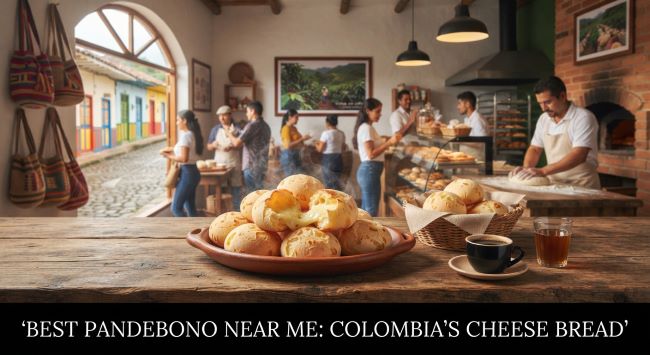
There is a fifteen-minute window in which pandebono is one of the best breads anywhere, and after that it is merely fine. Warm from the oven it is crisp outside, hollow and chewy inside, and unmistakably cheesy. An hour later it has firmed up and lost most of what made it special. Colombians know this, which is why bakeries bake in batches all day rather than once in the morning. If you are searching for the best pandebono near me, here is the guide.
What It Is
Pandebono is a Colombian cheese bread, most closely associated with the Valle del Cauca region and the city of Cali. The best pandebono near me is made from a short ingredient list:
- Almidón de yuca, cassava starch, which gives the characteristic chew.
- Precooked corn flour or masa, distinguishing it from similar breads.
- Fresh cheese, traditionally queso costeño or a comparable salty white cheese.
- Egg, binding the dough.
- Sometimes a little sugar or guava paste as a filling variation.
It is typically shaped into a ring or a ball, roughly the size of a fist or smaller, and baked until golden.
The texture is the point. A thin crisp exterior gives way to a soft, slightly hollow, chewy interior, with cheese flavour running through the whole thing rather than sitting in pockets.
Why the Cassava Starch Matters
This is the technical heart of the best pandebono near me search. Cassava starch, also called almidón de yuca, behaves quite differently from wheat flour, producing a chewy elastic texture and the slightly hollow interior, and containing no gluten.
That makes pandebono naturally gluten-free in traditional form, though coeliacs should confirm preparation practices given shared surfaces. The starch is also why the bread cannot be replicated with wheat flour.
How It Differs From Similar Breads
Several Latin American cheese breads look alike and are frequently confused:
| Bread | Origin | Key difference |
|---|---|---|
| Pandebono | Colombia | Cassava starch plus corn flour, ring or ball |
| Pão de queijo | Brazil | Cassava starch, typically no corn flour |
| Pan de yuca | Ecuador and Colombia | Cassava starch, often no corn |
| Almojábana | Colombia | Cuajada cheese, softer, different texture |
| Buñuelo | Colombia | Fried rather than baked, round |
The corn flour component is what most distinguishes pandebono from Brazilian pão de queijo, giving it a slightly different flavour and a denser character.
Almojábana is the one Colombians most often mention alongside it, and the two frequently appear together in bakeries. Almojábana uses cuajada, a fresh curd cheese, and is softer and more cake-like.
The Cheese
Traditional pandebono uses queso costeño, a salty fresh white cheese from Colombia’s Caribbean coast, or a comparable fresh salty cheese. It needs to be salty enough to season the bread and dry enough not to wet the dough. Bakeries outside Colombia substitute what is locally available, which is why the best pandebono near me varies noticeably between establishments.
A good pandebono tastes distinctly of cheese throughout rather than mildly. If it tastes like plain bread with a hint of something, the cheese was too mild or too sparse.
Where to Find It
The best pandebono near me search runs through:
Colombian bakeries and panaderías, the ideal option, where they are baked fresh through the day.
Colombian restaurants, which often serve them alongside coffee or with meals.
Latin American bakeries serving Colombian communities.
Colombian cultural events and festivals.
Some Latin markets, which sell them frozen for baking at home, a genuinely good option since they bake from frozen well.
Timing matters more than location, and a bakery producing batches through the day beats a better-reputed one selling this morning’s stock.
How to Judge Quality
Evaluating the best pandebono near me comes down to texture and freshness:
| Element | Done right | Warning sign |
|---|---|---|
| Temperature | Warm from the oven | Cold and firm |
| Exterior | Thin, lightly crisp, golden | Pale, hard, or tough |
| Interior | Soft, chewy, slightly hollow | Dense, dry, or doughy |
| Cheese flavour | Clear and salty throughout | Faint or bland |
| Shape | Holds form, not collapsed | Flattened or cracked open |
Warmth is decisive. This is not a preference, it is the difference between the bread being excellent and being unremarkable. Pandebono firms up substantially as it cools and never fully recovers.
Interior texture is the second test. There should be some chew and a degree of hollowness rather than a solid dense crumb.
Cheese presence should be obvious. A bland pandebono has failed at its defining characteristic.
How It Is Eaten
The best pandebono near me fits into Colombian daily life in specific ways:
- With coffee, the near-universal pairing.
- With hot chocolate, particularly popular.
- At breakfast or as an afternoon snack.
- Fresh and warm, which is worth repeating.
- On its own, since it needs nothing added.
- Alongside other bakery items, commonly with almojábana or buñuelos.
Reheating briefly in an oven restores much of the texture if you are eating them later, and this works considerably better than a microwave, which makes them tough.
Part of the Cheese and Starch Tradition
What makes pandebono appealing is how much it achieves from a very short ingredient list, relying on the properties of cassava starch and a single good cheese rather than technique or elaboration. That principle of a few strong ingredients carrying an entire dish runs throughout the food traditions Colombia inherited from Spain. Something like Best Fabada Bean Stew Near Me shows the Asturian version of the same instinct, where a specific bean and a few cured meats produce a celebrated dish with no herbs or elaboration at all, and both illustrate how ingredient quality substitutes entirely for complexity.
The bottom line on the best pandebono near me search is that this Colombian cheese bread from the Valle del Cauca region is made from cassava starch, corn flour, fresh salty cheese, and egg, producing a thin crisp exterior over a chewy, slightly hollow interior. The cassava starch makes it naturally gluten-free and impossible to replicate with wheat flour. Find a Colombian bakery baking in batches through the day, eat it warm since it firms up substantially as it cools, check for clear cheese flavour throughout, and pair it with coffee or hot chocolate.
Key Takeaways
- Pandebono is a Colombian cheese bread most associated with the Valle del Cauca region and Cali.
- It is made from cassava starch, precooked corn flour, fresh salty cheese, and egg.
- Cassava starch produces the chewy texture and slightly hollow interior, and contains no gluten.
- It is naturally gluten-free, though coeliacs should confirm preparation practices with the bakery.
- The corn flour component distinguishes it from Brazilian pão de queijo.
- Almojábana is a related Colombian bread using cuajada cheese, softer and more cake-like.
- Traditional versions use queso costeño or a comparable salty fresh white cheese.
- Warmth is decisive, since pandebono firms up substantially as it cools and never fully recovers.
- A good one has clear cheese flavour throughout rather than tasting like plain bread.
- Find it at Colombian panaderías baking in batches through the day rather than once each morning.
- Frozen pandebono sold at Latin markets bakes well at home and is a reasonable option.
- Reheat briefly in an oven rather than a microwave, which makes them tough.