KitchenAid Classic Series 4.5 Quart Tilt-Head Stand Mixer: A Complete Guide
The Classic is the model people buy when they want a KitchenAid without spending KitchenAid money, and the tradeoffs are real but frequently overstated. It is the entry point to the tilt-head range, with a smaller bowl and less power than the models above it, which matters enormously for some kinds of baking and not at all for others. Understanding which category you fall into is the whole decision. Here is the practical picture.
What It Is
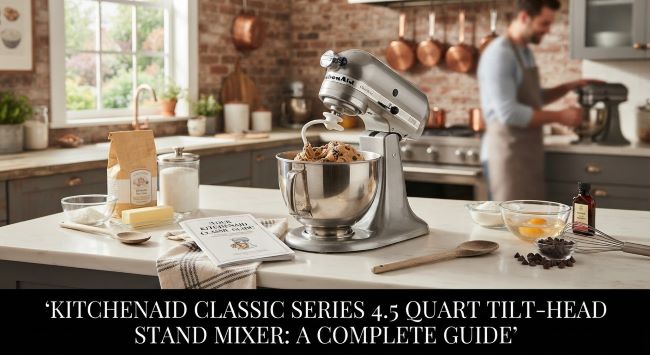
The KitchenAid Classic Series 4.5 quart tilt-head stand mixer sits at the entry level of KitchenAid’s stand mixer range. The defining characteristics:
- A 4.5 quart bowl, smaller than the 5 quart Artisan and considerably smaller than bowl-lift models.
- Tilt-head design, where the motor head tilts back for access to the bowl.
- Planetary mixing action, where the attachment rotates while orbiting the bowl.
- Multiple speed settings, covering slow stirring through fast whipping.
- A power hub accepting KitchenAid’s range of attachments.
- Included accessories, typically a flat beater, dough hook, and wire whip.
It is the most affordable entry into the KitchenAid ecosystem, and the ecosystem is a substantial part of what people are buying.
Tilt-Head Versus Bowl-Lift
Understanding this distinction matters when considering the KitchenAid Classic Series 4.5 quart tilt-head stand mixer against alternatives.
Tilt-head models have a head that tilts backward, giving open access to the bowl. Adding ingredients and scraping down is easy, and the machines are generally lighter and shorter, fitting under standard cabinets more readily.
Bowl-lift models have a fixed head and a bowl that raises on arms. They are typically larger, heavier, more powerful, and better suited to stiff doughs and large batches.
Neither is superior in the abstract. Tilt-head suits most home baking and smaller kitchens. Bowl-lift suits high volume and heavy dough work.
The Classic is a tilt-head, which means it is optimized for accessibility and footprint rather than raw capacity.
The Bowl Size Question
For the KitchenAid Classic Series 4.5 quart tilt-head stand mixer, capacity is the single most consequential specification, and it deserves honest treatment.
For most everyday home baking, it is sufficient. Standard cake batters, cookie doughs, and typical bread recipes fit comfortably.
Where it becomes limiting:
- Large batches of cookie dough or multiple loaves.
- Doubling recipes, which frequently exceeds capacity.
- Whipping small quantities, where a large bowl can leave the whisk above the contents. This is actually an argument in the Classic’s favour, since smaller bowls handle small quantities better than large ones.
- Holiday baking volumes, where capacity constraints show most.
The practical test is whether you regularly bake in quantity. Occasional bakers and small households rarely hit the ceiling. People producing large volumes will.
Power Considerations
The KitchenAid Classic Series 4.5 quart tilt-head stand mixer sits at the lower end of the motor range, which affects specific tasks.
For cake batter, cookies, whipping cream, and egg whites, the power is entirely adequate.
For stiff bread doughs, particularly whole grain or low-hydration doughs, and large dough batches, it works harder. Users report that heavy dough work is where the Classic shows its limits relative to Artisan and Professional models.
The practical guidance is to respect the machine’s limits. Working within recommended quantities, avoiding running at high speed for dough, and allowing rest periods during heavy work extends life considerably. Overloading a stand mixer is the most common cause of premature failure regardless of model.
Check the current product listing for exact wattage, since KitchenAid periodically revises specifications and figures differ by market.
How It Compares Within the Range
| Model | Bowl | Type | Positioning |
|---|---|---|---|
| Classic | 4.5 quart | Tilt-head | Entry level |
| Artisan | 5 quart | Tilt-head | Most popular, more power, more colors |
| Professional | 5 to 6 quart | Bowl-lift | Heavier duty, larger batches |
| Commercial | 8 quart | Bowl-lift | High volume |
The Artisan is the most common upgrade consideration. It offers slightly more capacity, more power, a wider colour range, and typically a pouring shield. Whether the price difference is justified depends entirely on whether you need the extra capacity and dough capability.
For anyone genuinely uncertain, the honest advice is that the Artisan is the better machine and the Classic is the better value, and which matters more is personal.
The Attachment Ecosystem
The attachment system is a significant part of the value proposition, and often underweighted.
KitchenAid stand mixers share a power hub at the front, and attachments made for it generally fit across the range. Available attachments include pasta rollers and cutters, food grinders, spiralizers, vegetable sheet cutters, ice cream makers, and grain mills.
This means the mixer functions as a platform rather than a single-purpose appliance, and it is a genuine reason people choose KitchenAid over comparably priced alternatives.
Attachments are sold separately and are not inexpensive, so factor that into any comparison if you intend to use them.
Durability and Longevity
KitchenAid mixers have a reputation for lasting decades, and that reputation is a substantial part of the brand’s appeal.
A few honest qualifications. The reputation was built largely on older models, and opinions vary on whether current production matches vintage machines. Parts are widely available and many repairs are feasible, which genuinely extends usable life.
Practical steps that extend life:
- Respect capacity limits rather than overfilling.
- Do not run heavy dough at high speed.
- Allow the motor to rest during extended heavy work.
- Clean attachments properly, checking which are dishwasher safe.
- Address unusual noises early rather than continuing to run.
What Comes With It
Standard inclusions typically cover a flat beater for general mixing, a dough hook for bread, and a wire whip for whipping. Bowl material and whether a pouring shield is included vary by configuration and market, so check the specific listing.
Some retailers bundle additional accessories, and configurations differ between regions, which is worth comparing when shopping.
Practical Kitchen Considerations
A few points people overlook when buying.
Weight. Stand mixers are heavy. If you intend to store it in a cupboard and lift it out for each use, that becomes a genuine deterrent, and many people find the mixer they leave on the counter gets used far more.
Height. Tilt-head models need clearance to tilt back. Measure under-cabinet height before buying, since a mixer that fits on the counter but cannot open is useless.
Noise. Stand mixers are not quiet, particularly at higher speeds.
Counter space. The footprint is modest but permanent if you leave it out.
Who It Suits
The KitchenAid Classic Series 4.5 quart tilt-head stand mixer suits some cooks far better than others.
Good fit: occasional to regular home bakers, smaller households, people with limited counter or storage space, anyone wanting entry into the KitchenAid ecosystem, and those for whom price is a meaningful factor.
Weaker fit: high-volume bakers, anyone regularly making large batches of stiff bread dough, people who routinely double recipes, and anyone who would be frustrated by capacity constraints.
Consider stepping up if you bake bread frequently, cook for large groups regularly, or know you will resent the smaller bowl.
Before Buying
Practical suggestions.
Check the current listing for exact specifications, wattage, included accessories, and colour options, since these change and vary by region.
Compare against the Artisan at current prices, since promotional pricing sometimes narrows the gap considerably.
Read recent reviews rather than older ones, filtering for people describing the kind of baking you do.
Watch for sales, since KitchenAid mixers are frequently discounted around major shopping periods.
Consider refurbished options, which KitchenAid and some retailers offer at reduced prices with warranty coverage.
The bottom line is that the KitchenAid Classic Series 4.5 quart tilt-head stand mixer is the entry point to KitchenAid’s range, offering the brand’s planetary mixing action, tilt-head accessibility, and full attachment ecosystem at the lowest price in the line, with a smaller bowl and less power than the models above it. It handles everyday cake batters, cookies, and whipping without difficulty, and shows its limits with stiff bread doughs and large batches. Occasional bakers and smaller households are well served, while high-volume and serious bread bakers should consider the Artisan or a bowl-lift model. Check the current listing for exact specifications, measure your under-cabinet clearance, and compare against Artisan pricing before deciding.
Key Takeaways
- The Classic is the entry-level model in KitchenAid’s stand mixer range, with a 4.5 quart bowl.
- Tilt-head design gives open bowl access and a shorter profile than bowl-lift models.
- Bowl-lift models are generally larger, more powerful, and better for stiff dough and large batches.
- The 4.5 quart capacity handles everyday baking but constrains large batches and doubled recipes.
- Smaller bowls actually handle small quantities better, since the whisk reaches the contents.
- Power is adequate for batters, cookies, and whipping, but shows limits with stiff bread doughs.
- Respecting capacity limits and avoiding high speeds with dough substantially extends machine life.
- The front power hub accepts attachments including pasta rollers, grinders, and spiralizers.
- Attachments are sold separately and add meaningfully to the total cost if you want them.
- Measure under-cabinet clearance, since tilt-head models need room to open.
- The Artisan offers more capacity and power, so compare current prices before deciding.
- Check the specific product listing, since specifications, accessories, and colours vary by region.