What Home Remedy Can I Give My Dog for Diarrhea?
Most dogs get diarrhea at some point, and a good proportion of those cases resolve without intervention. The difficulty is that the mild cases and the serious ones look similar at the start, and some of the widely shared home remedies are actively dangerous. This guide covers what is reasonably safe to try, what genuinely is not, and the signs that mean the question is no longer about home care.
Call a Vet First If
Before anything else, contact a veterinarian promptly if any of the following apply. These are not situations for home management:
- Blood in the stool, whether bright red or dark and tarry.
- Repeated vomiting alongside the diarrhea.
- Lethargy, weakness, or collapse.
- Signs of dehydration, including dry or tacky gums, sunken eyes, or skin that stays tented when gently lifted.
- A painful, bloated, or hard abdomen.
- Suspected poisoning or ingestion of a foreign object, toxic food, or medication.
- Diarrhea lasting more than about 24 to 48 hours, or worsening at any point.
- Fever, or a dog that feels unusually hot.
- Puppies, senior dogs, very small breeds, or pregnant dogs, all of which dehydrate faster and tolerate fluid loss poorly.
- Dogs with existing health conditions or on medication.
- Any unvaccinated dog, given the risk of parvovirus and other serious infections.
Puppies deserve emphasis. Diarrhea in a young puppy can become life-threatening quickly, and parvovirus in particular is a genuine emergency. Puppies should be seen rather than monitored.
Supportive Measures That Are Generally Reasonable
For an otherwise healthy adult dog with mild diarrhea, no other symptoms, and normal energy, the following are commonly recommended answers to what home remedy can i give my dog for diarrhea. Confirm with your vet, particularly for a first episode.
Ensure constant access to fresh water. Dehydration is the main risk with diarrhea, and dogs must be able to replace what they are losing. Withholding water is not appropriate.
A brief rest from food, typically around 12 hours for adult dogs, is sometimes advised to let the gut settle. This should not be applied to puppies, small breeds, diabetic dogs, or any dog with health conditions, and should be discussed with your vet rather than assumed.
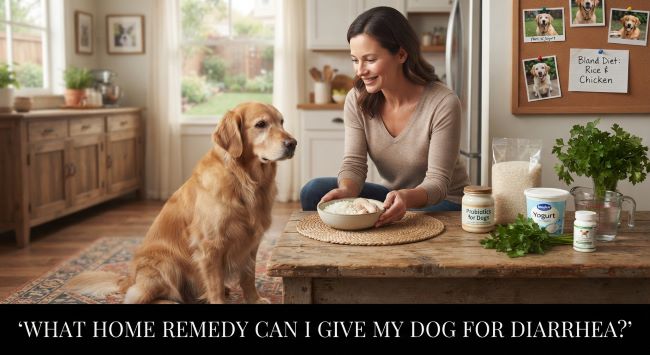
A bland diet is the most widely recommended answer to what home remedy can i give my dog for diarrhea. This typically means plain boiled skinless chicken breast and plain white rice, with no salt, oil, butter, seasoning, onion, or garlic.
Small, frequent portions rather than full meals, allowing the digestive system to handle less at a time.
Plain canned pumpkin, meaning pure pumpkin rather than pie filling, which contains spices and sugar and is not suitable. Pumpkin provides fiber that can help firm stool. Amounts should be modest and are worth confirming with your vet.
A gradual return to normal food over several days once stool firms, rather than switching back abruptly.
Probiotics formulated for dogs, which some vets recommend, though canine-specific products are appropriate rather than human ones, since the bacterial strains differ.
Plain boiled potato or sweet potato without skin, sometimes suggested as an alternative bland carbohydrate for dogs that will not eat rice.
Portion sizes and duration should be discussed with your vet rather than guessed. A bland diet is a short-term measure, typically a few days, not a long-term feeding plan, because it is not nutritionally complete. Dogs kept on chicken and rice for extended periods can develop nutritional deficiencies, which is a genuine reason the transition back to normal food matters.
What Not to Give
This section matters more than the previous one, because several widely shared answers to what home remedy can i give my dog for diarrhea are genuinely harmful.
Never give human medications without veterinary direction. Several common over-the-counter anti-diarrheal and pain medications are toxic to dogs or dangerous in certain breeds and conditions. Some are used in veterinary practice at specific doses for specific cases, which is precisely why the decision belongs to a vet rather than an internet search.
Never give anything containing xylitol, an artificial sweetener that is severely toxic to dogs and appears in peanut butter, sugar-free products, and some supplements.
Never give onion or garlic in any form, including in broths or seasoned foods, since both are toxic to dogs.
Avoid dairy. Many dogs handle lactose poorly, and milk products commonly worsen diarrhea rather than helping.
Avoid fatty foods, which can trigger or worsen digestive upset and, in some dogs, contribute to pancreatitis.
Do not give leftover or expired medication prescribed for a previous episode or for another animal.
Do not withhold water, which is an outdated and dangerous piece of advice that still circulates.
Common Causes
Understanding what typically causes it helps contextualize what home remedy can i give my dog for diarrhea:
| Cause | Notes |
|---|---|
| Dietary indiscretion | Eating something they should not have |
| Sudden diet change | Switching food too quickly |
| Food intolerance | Specific ingredients disagreeing |
| Parasites | Worms, giardia, coccidia |
| Viral or bacterial infection | Including parvovirus in puppies |
| Stress | Travel, boarding, household changes |
| Medication side effects | Including antibiotics |
| Underlying disease | Pancreatitis, IBD, organ disease |
| Toxin ingestion | An emergency requiring immediate care |
That range explains why home management is only appropriate for mild cases in otherwise healthy dogs. Several items on that list require diagnosis and specific treatment.
Monitoring at Home
If your vet has advised home management, or while you arrange an appointment, watch for:
Hydration status. Gums should be moist and pink. Tacky or dry gums, sunken eyes, or skin that stays tented when gently lifted at the shoulders suggest dehydration and warrant prompt veterinary contact.
Energy and demeanor. A dog that is bright, alert, and interested in surroundings is in a different situation from one that is withdrawn or reluctant to move.
Stool changes. Note frequency, consistency, color, and any blood or mucus. Photographs are genuinely useful for the vet, unglamorous as that sounds.
Appetite and thirst. Refusing water is a concerning sign.
Duration. Improvement should be evident within a day or so. Anything persisting or worsening needs assessment.
What Your Vet Will Want to Know
Preparing this makes the consultation more effective:
- When the diarrhea started and how it has progressed.
- Frequency and appearance, including any blood or mucus.
- Any vomiting, and whether the dog is eating and drinking.
- Any known access to unusual food, rubbish, plants, chemicals, or medication.
- Recent diet changes, travel, boarding, or stressful events.
- Current medications, including flea and worming treatments and dates.
- Vaccination status, which matters enormously for puppies.
- Existing health conditions.
Prevention
Once resolved, reducing the need to ask what home remedy can i give my dog for diarrhea again comes down to a few practical habits.
Change food gradually over about a week when switching brands or formulas, mixing increasing proportions of the new food. Keep rubbish, compost, and human food secured. Maintain routine parasite prevention on veterinary advice. Avoid giving table scraps, particularly fatty or seasoned foods. Keep vaccinations current. And be aware of stress triggers if your dog reacts to changes in routine.
Some dogs have consistently sensitive digestion, and a vet can advise on suitable diets rather than leaving you to experiment.
Why Professional Advice Matters Here
The core difficulty with the question of what home remedy can i give my dog for diarrhea is that the answer depends entirely on the cause, and the cause is not visible from the symptom.
Mild dietary upset and early parvovirus can both begin as loose stool. One resolves with a bland diet and a day of rest. The other is a medical emergency. Distinguishing them requires examination, history, and sometimes testing.
Home care is appropriate for exactly one scenario: a healthy adult dog, mild symptoms, normal energy, no other signs, and a short duration. Everything else belongs with a vet.
Many veterinary practices will also advise by phone on whether an appointment is needed, which costs little or nothing and resolves the uncertainty far better than guessing.
There is also a cost dimension worth acknowledging honestly. Veterinary care is expensive, and cost genuinely deters people from calling, which is part of why home remedy searches are so common. The practical point is that a phone call to ask is usually free, and a problem caught early is almost always cheaper to treat than one that has progressed. Dehydration in particular escalates from manageable to requiring intravenous fluids surprisingly quickly.
The bottom line is that for a healthy adult dog with mild diarrhea and no other symptoms, reasonable supportive measures include constant access to fresh water, small frequent portions of a bland diet such as plain boiled chicken and white rice, plain canned pumpkin, and a gradual return to normal food. Never give human medications without veterinary direction, never give anything containing xylitol, onion, or garlic, avoid dairy and fatty foods, and never withhold water. Contact a vet promptly for blood in the stool, repeated vomiting, lethargy, dehydration, suspected poisoning, symptoms lasting beyond a day or two, or any diarrhea in puppies, seniors, small breeds, or dogs with existing conditions.
Key Takeaways
- Home management suits only healthy adult dogs with mild diarrhea, normal energy, and no other symptoms.
- Contact a vet promptly for blood in stool, repeated vomiting, lethargy, dehydration, or suspected poisoning.
- Diarrhea in puppies can become life-threatening quickly, and parvovirus is a genuine emergency.
- Constant access to fresh water is essential, and withholding water is outdated, dangerous advice.
- A bland diet of plain boiled chicken and white rice, without seasoning or oil, is the standard recommendation.
- Plain canned pumpkin, not pie filling, provides fiber that can help firm stool.
- Feed small frequent portions and return to normal food gradually over several days.
- Never give human over-the-counter medications without explicit veterinary direction.
- Xylitol, onion, and garlic are toxic to dogs and must be avoided in any form.
- Avoid dairy, which many dogs tolerate poorly, and fatty foods that can worsen upset.
- Check hydration by looking at gum moisture and whether skin stays tented when lifted.
- Prevent recurrence by changing food gradually, securing rubbish, and maintaining parasite prevention.