How Do I Know If My Toe Is Broken or Just Bruised?
You caught your toe on a chair leg, the pain was extraordinary, and now it is swollen and turning colors. The natural next question is whether this needs a doctor or just time. The honest answer is that the difference between a bad bruise and a fracture cannot be established from symptoms alone, though there are signs that shift the odds substantially in one direction. Here is what to look for and when waiting is not appropriate.
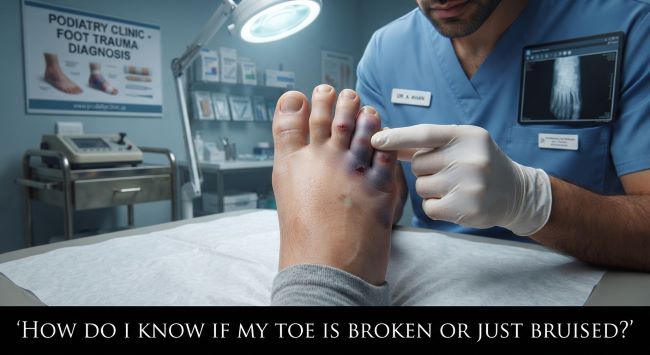
The Short Answer
Bruises and fractures share most of their symptoms. Both cause pain, swelling, and discoloration, and both can make walking uncomfortable.
Only imaging, usually an X-ray, can confirm a fracture. Anyone asking how do I know if my toe is broken or just bruised should understand that the certainty they are looking for comes from a clinician and a scan, not from a symptom checklist.
That said, certain findings make a fracture considerably more likely, and certain findings mean you should be seen urgently regardless.
Signs Pointing Toward a Fracture
When asking how do i know if my toe is broken or just bruised, these do not confirm a break but raise the probability:
- A snapping or cracking sound at the moment of injury.
- Visible deformity, where the toe points in an unusual direction or looks out of alignment.
- Inability to bear weight or walk without severe pain.
- Pain that is intense and persistent rather than easing substantially over the first day or two.
- Swelling that is severe and does not begin improving.
- Pain localized to a specific point on the bone rather than spread across soft tissue.
- Bruising extending beyond the toe into the foot.
- Numbness or tingling, which can indicate nerve involvement.
Signs More Consistent With a Bruise
Conversely, these suggest soft tissue injury rather than a fracture:
- Pain that improves noticeably within a day or two.
- Ability to walk, with discomfort but not severe pain.
- Normal alignment, with the toe looking straight and in position.
- Full range of motion, even if uncomfortable.
- Swelling that is moderate and improving.
- Discoloration without deformity.
None of these rules out a fracture, particularly a small crack, which is precisely why the question is difficult to answer at home.
Seek Medical Care Urgently If
Some findings mean stop asking how do i know if my toe is broken or just bruised and simply go. This is the most important section here.
Contact a doctor, urgent care, or emergency department promptly if you have:
- Visible deformity or a toe pointing the wrong way.
- An open wound over the injury, or bone visible.
- Numbness, tingling, or loss of sensation.
- A toe that is pale, blue, grey, or cold, which may indicate compromised blood supply.
- Inability to move the toe at all.
- Severe pain not controlled by over-the-counter pain relief.
- Injury to the big toe, which bears substantially more weight and load than the others.
- Signs of infection, including spreading redness, warmth, pus, or fever.
- A crushing injury, such as something heavy dropped on the foot.
Diabetes, peripheral neuropathy, poor circulation, or a compromised immune system change this assessment entirely. Anyone with those conditions should have any foot injury assessed promptly rather than managed at home, since reduced sensation and impaired healing raise the risk of complications considerably.
Why the Big Toe Is Different
Worth separating out. The big toe, medically the hallux, carries a disproportionate share of the load during walking and pushing off.
A fracture there is more likely to require specific treatment, more likely to affect gait if it heals poorly, and more likely to need follow-up. Injuries to the big toe should generally be assessed rather than watched.
The smaller toes are more often treated conservatively, though that is a clinical decision rather than one to make yourself.
What a Doctor Will Do
Knowing what to expect makes seeking care less daunting when wondering how do I know if my toe is broken or just bruised.
The clinician will examine the toe, checking alignment, tenderness, range of motion, circulation, and sensation. They will usually order an X-ray, which is quick and definitive for most fractures.
Treatment depends on findings. Options include buddy taping, splinting, a stiff-soled or post-operative shoe, reduction if the bone is displaced, and rarely surgery for complex or badly displaced fractures. Many simple toe fractures are treated conservatively and heal well.
The reason to be seen is not that every fracture requires dramatic intervention. It is that a displaced or unstable fracture treated as a bruise can heal in the wrong position, which causes lasting pain and gait problems.
The Persistent Myth
It is worth addressing directly. A widely repeated belief holds that nothing can be done for a broken toe, so there is no point seeking care.
That is not accurate. Displaced fractures may need realigning. Fractures involving a joint often need specific management. Big toe fractures frequently need more than tape. And even when treatment is simple, knowing what you are dealing with changes how you manage activity during healing.
The belief probably persists because many small toe fractures genuinely are treated simply, which people then generalize to all of them.
General Self-Care While Waiting
If you are arranging assessment, or if a clinician has confirmed a minor injury and advised home management, standard first aid applies:
| Measure | Purpose |
|---|---|
| Rest | Avoid loading the injured toe |
| Ice | Reduce swelling, wrapped, 15 to 20 minutes |
| Compression | Gentle support, not tight |
| Elevation | Above heart level where practical |
| Footwear | Stiff-soled, roomy shoes |
| Pain relief | Over-the-counter, per label |
Never apply ice directly to skin, and follow the labeling on any over-the-counter medication, checking with a pharmacist if you take other medicines or have health conditions.
Do not attempt to straighten a deformed toe yourself. Realignment is a clinical procedure, and attempting it can worsen the injury.
Buddy taping is commonly recommended, but only on medical advice, since taping the wrong toes or taping an unsuitable fracture can cause problems, and tape that is too tight restricts circulation.
Healing Timeframes
Anyone weighing how do i know if my toe is broken or just bruised benefits from timeframes. Uncomplicated toe fractures commonly take several weeks to heal, often quoted in the range of four to six weeks, with full recovery of comfort sometimes taking longer.
Bruises typically improve substantially within days to a couple of weeks.
That difference is itself informative. If pain and swelling have not meaningfully improved after a week or two, that is a reason to be assessed even if you initially assumed it was a bruise.
Stress Fractures
Worth knowing about because they present differently. A stress fracture is a small crack caused by repetitive loading rather than a single impact, and it typically causes pain that develops gradually and worsens with activity rather than appearing suddenly.
These are easy to dismiss as general soreness and may not show on an initial X-ray. If you have activity-related foot pain without a specific injury, that warrants assessment on its own terms.
Why You Cannot Self-Diagnose This
Returning to the core question of how do I know if my toe is broken or just bruised, the fundamental problem is overlap.
A severe contusion can produce dramatic swelling, deep discoloration, and significant pain. A non-displaced hairline fracture can produce surprisingly modest symptoms, and people frequently walk on them for days.
The severity of pain is a poor guide to whether bone is broken. Nerve density, swelling, and individual pain tolerance all vary, and none of them correlate reliably with fracture.
This is why clinicians image rather than guess, and why any article claiming to let you determine this at home is overstating what symptoms can tell you.
The bottom line is that you cannot reliably determine whether a toe is broken or bruised without imaging, because the symptoms overlap substantially. Signs that make a fracture more likely include a cracking sound at injury, visible deformity, inability to bear weight, pain localized to a specific point on bone, and bruising spreading into the foot. Seek care urgently for deformity, open wounds, numbness, a pale or cold toe, severe uncontrolled pain, any big toe injury, or a crushing injury, and always seek prompt assessment if you have diabetes, neuropathy, or poor circulation. Meanwhile rest, ice, elevate, wear stiff-soled shoes, and do not attempt to straighten the toe yourself.
Key Takeaways
- Bruises and fractures share most symptoms, so only imaging such as an X-ray can confirm a break.
- A cracking sound at the moment of injury makes a fracture considerably more likely.
- Visible deformity, inability to bear weight, and pain at a specific point on bone all point toward fracture.
- Bruising that spreads beyond the toe into the foot is another suggestive sign.
- Seek urgent care for deformity, open wounds, numbness, or a toe that is pale, blue, or cold.
- Big toe injuries warrant assessment, since the hallux bears disproportionate load during walking.
- Anyone with diabetes, neuropathy, or poor circulation should have any foot injury assessed promptly.
- The belief that nothing can be done for a broken toe is inaccurate and can lead to poor healing.
- Never attempt to straighten a deformed toe yourself, as realignment is a clinical procedure.
- Buddy taping should only be done on medical advice, since incorrect or tight taping causes problems.
- Uncomplicated toe fractures commonly take around four to six weeks to heal.
- Pain severity is a poor guide to fracture, since hairline breaks can produce modest symptoms.