Which Author Is Normally Responsible for Sharing Reprints of a Publication with Readers?
Academic papers carry a small marker next to one name, an asterisk or superscript symbol with an email address attached. That marker designates a specific role, and one of its duties is fielding requests from readers who want a copy. The convention predates the internet and survives in modified form.
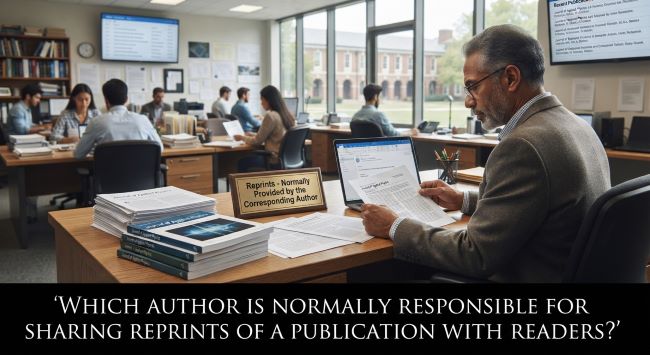
The Direct Answer
The corresponding author.
The corresponding author is the designated point of contact for a published paper, and among their responsibilities is handling requests for reprints from readers who cannot otherwise access the work.
That is why journals print an email address, and often a postal address, next to that author’s name. So when the question is which author is normally responsible for sharing reprints of a publication with readers? the answer is the corresponding author, identified in the paper itself.
What a Corresponding Author Is
The answer to which author is normally responsible for sharing reprints of a publication with readers? is a role: the corresponding author takes on the administrative and communication duties of a publication.
This is a role rather than a ranking. The corresponding author is not necessarily the first author, the most senior, or the largest contributor. What defines the position is availability and accountability, since they must remain contactable during submission, peer review, and after publication, sometimes for years.
The Full Range of Responsibilities
Understanding which author is normally responsible for sharing reprints of a publication with readers? is easier alongside the rest of the duties, since reprints are one item on a longer list.
Manuscript submission and completing associated paperwork.
Communication with the editor throughout review.
Coordinating revisions and peer review responses across co-authors.
Ensuring authorship accuracy, confirming all listed authors qualify.
Managing declarations: conflicts of interest, funding, ethics approvals, and data availability.
Proof approval before publication.
Post-publication contact, including reader queries and reprint requests.
Handling corrections or retractions if errors emerge.
That final duty is significant and often overlooked. The corresponding author remains the responsible contact if problems with the paper surface later.
Why Reprints Fall to This Role
Journals supplied authors with a set number of physical reprints, and researchers without journal access wrote to request a copy. Someone had to answer, and the corresponding author, already the designated contact with a published address, was the natural choice. Reprint request postcards were a real feature of academic life for decades.
How This Works Now
The practical side of which author is normally responsible for sharing reprints of a publication with readers? has changed while the principle stayed intact.
Physical reprints are largely obsolete. What persists is the same relationship in digital form:
- Email requests for a PDF from researchers without journal access.
- Requests through academic networking platforms such as ResearchGate, which has a built-in request function.
- Repository deposits, where the corresponding author uploads an accepted version to an institutional or subject repository.
- Preprint servers, making versions freely available before or alongside publication.
- Open access publication, which removes the need for individual requests entirely.
The corresponding author typically handles all of these, and the underlying duty is unchanged: making the work accessible to readers who want it.
Copyright Considerations
An important nuance affects which author is normally responsible for sharing reprints of a publication with readers? in practice.
When a paper is published in a subscription journal, authors frequently transfer copyright to the publisher or grant an exclusive license. That affects what the corresponding author may legally distribute.
Publisher policies vary considerably. Many permit sharing the accepted manuscript, meaning the peer-reviewed version before the publisher’s typesetting, while restricting distribution of the final published PDF. Many allow repository deposit after an embargo period. Some permit direct sharing with individual requesters but not public posting.
The practical guidance is that corresponding authors should check the specific agreement and journal policy rather than assuming. Sharing the version permitted by the agreement satisfies both the reader and the license.
Open access publication removes the issue, since the work is freely available by design.
Author Roles Compared
Distinguishing the roles clarifies which author is normally responsible for sharing reprints of a publication with readers?
| Role | Typical meaning |
|---|---|
| First author | Usually the primary contributor to the work |
| Corresponding author | Contact point, handles communication and reprints |
| Senior or last author | Often the supervising investigator or lab head |
| Co-authors | Contributors meeting authorship criteria |
Conventions differ substantially by discipline. In many biomedical fields, first author indicates the person who did most of the work while last author indicates the supervising researcher, and the corresponding author is frequently one of those two. In fields where authors are listed alphabetically, the position carries no such meaning.
It is entirely possible for one person to be first author, senior author, and corresponding author simultaneously on a single-author paper, and equally possible for the corresponding author to appear in the middle of a long list.
Some papers designate more than one corresponding author, which is increasingly common on large collaborative work.
Authorship Criteria
Widely used criteria, including those from the International Committee of Medical Journal Editors, generally require substantial contribution, involvement in drafting or revising, approval of the final version, and accountability for accuracy. The corresponding author carries that accountability most visibly.
Practical Advice for Authors
If you are the person answering which author is normally responsible for sharing reprints of a publication with readers? a few practical points apply.
Use a stable email address, since institutional ones expire when people move. Expect requests years later, as papers circulate long after publication. Know your license before requests arrive. Deposit in a repository, which handles most requests automatically and satisfies many funder mandates. Respond to reasonable requests, since it is professional courtesy and read papers get cited.
The bottom line on which author is normally responsible for sharing reprints of a publication with readers? is that the corresponding author holds this duty, alongside manuscript submission, editorial communication, coordinating revisions, managing declarations, approving proofs, and handling any post-publication corrections. The role is defined by being the contactable, accountable point of contact rather than by seniority or contribution size, which is why journals print that author’s email address with the paper. In modern practice reprints usually mean emailing a PDF or depositing a permitted version in a repository, subject to whatever the publishing agreement allows.
Key Takeaways
- The corresponding author is normally responsible for sharing reprints of a publication with readers.
- Journals print that author’s email address, and historically a postal address, alongside the paper for this reason.
- The role is defined by contactability and accountability rather than by seniority or contribution size.
- The corresponding author is not necessarily the first author or the most senior author.
- Other duties include manuscript submission, editorial communication, coordinating revisions, and approving proofs.
- They also manage conflict of interest, funding, ethics, and data availability declarations.
- They remain the responsible contact for post-publication corrections or retractions.
- Physical reprints are largely obsolete, replaced by emailed PDFs, repository deposits, and preprints.
- Copyright transfer to publishers can limit which version may be shared, so authors should check their agreement.
- Many publishers permit sharing the accepted manuscript while restricting the final published PDF.